


 Francais
 Deutsch
 Italiano
Refine Your Search
Rio de Janeiro Brazil 1946 stock footage and images
- Showing 127 to 132 of 2632 results more
more Hide
Hide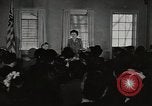
Women voters in the U.S. participating with the League of Women Voters; scenes of American life
Women Voters' League meeting. Guest speaker from Brazil talks to league meeting attendees. Narrator comments on the work of the women's suffrage movement in the United States that led to this point. Women in classes sponsored by the League of Women Voters. Male instructor at world globe. Female instructor demonstrates how to mark a ballot to vote in election. Woman at store newsstand buys a newspaper. Children play in a street. A group of boys fight and wrestle in the street.. View of a slum area and of abandoned, blighted property. View of old empty derelict home with eroded land in front of it somewhere in America. Union labor picket line demonstration during a strike and men fight and beat another man during a picket line demonstration. Grain truck with sign 'UNRRA' and "Mercy Wheat" sign on it. Mayor of New York Fiorello La Guardia with unidentified farmer during the mercy wheat campaign to aid Europe after World War 2. View of United Nations General assembly in meeting. Men and women meet at home in a citizen's living room. They vote by a show of hands. Woman sits at a desk and writes letter to elected representative and so does a man. Woman places letter in mail box. Woman hands letters to a Senator. Senator reads letters.
Visiting Latin American military officers become acquainted with firing of 155mm howitzer at Fort Sill Oklahoma.
U.S. Army Soldiers load a 155mm howitzer. Visiting Latin American officers from Chile, Columbia and Brazil, and several other nations, each take turns giving command for firing the 155mm howitzer, while the others watch. Afterwards, the visiting officers gather around U.S. Army Brigadier General Allen as he describes the gun and points out its features. The battery continues firing several rounds, which are seen exploding in the target field. (World War II period).
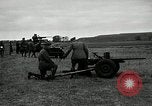
Visiting Latin American military officers learn about 37mm anti-tank guns at Fort Riley Kansas.
Fort Riley, Kansas. Latin American officers observe practice firing of 37mm anti-tank guns including prototype vehicle mounted 37mms. U.S. Army Soldiers fire the guns positioned on the ground and then mounted on a Bantam jeep and M3A1 scout car. View of moving target and tracers. Lt. Aponte from Bolivia, Lt. Belfort and Lt. Stall from Brazil, as well as other visiting officers, take turns viewing through the gun telescope and giving firing orders. (World War II period).
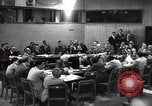
Iran's oil nationalization and takeover of the Anglo-Iranian Oil Company (AIOC) raised at 559th meeting of UN Security Council
59th meeting of UN Security Council at Flushing Meadows, New York. Agenda of the meeting is the Termination of Anglo-Iranian Oil Companies Concession. Council President J.C.Muniz of Brazil, gavels the meeting to order. Representative of UK Gladwyn Jebb addresses the Council. Representatives from various countries make statements regarding the issue.
Allied Forces Build up in Algeria to prepare for Spring offensive against German forces in Tunisia during World War II
At start of film, Allied forces are digging in after retreating from counterattacks by German forces in Tunis, during World War 2.. Rains create mud everywhere. A Lockheed P-38 fighter plane parked in foreground. Ground crews use shovels to free nose wheel of a B-24 Liberator bomber with engines running. A truck tows a C-47 transport plane from mud. Army trucks travel over road inundated by running streams. Soldiers standing in a jeep submerged in water. M2 tanks stuck in mud. Airmen huddled around an outdoor fire. P-38 fighter aircraft parked in the background. Soldiers eating around an outdoor fire. Animated map shows Allied battle lines stabilized in Algerian mountains, while German forces occupy the plains in Tunisia. German artillery batteries firing. British troops sheltering in damaged building. Allied wounded being transported atop, as well as inside a field ambulance. Interior of a transport plane configured for evacuation of wounded on litters. U.S. airmen including a woman in leather flying jacket, presumably an Army flight nurse, tend to the wounded aboard the medical evacuation flight. Wounded being transferred from an airplane to an ambulance. British patrols moving through the night. Heavy artillery firing. British soldiers silhouetted at dawn. They return carrying a wounded comrade on a litter. The British soldiers ("Tommies.") trying to clean mud from themselves and their weapons before heading out on patrols again at dusk. Allied soldiers moving on mules in a long line to obtain needed food and supplies. More views of the interminable mud. A British Hawker Hunter fighter plane taking off. A formation of Hawker Hurricanes peeling off to engage German aircraft. Closeup of one rolling over. A German Heinkel 111 bomber being attacked and trailing smoke. Pilot pressing gun firing button in cockpit and a German Dornier Do 17 bomber hit as British fighter plane passes it in cloud of black smoke. The German plane diving to crash in a fireball on the ground. U.S. B-24 Liberator bombers taking off and flying in formation. Formation of American B-17 bombers in flight. The American planes dropping bombs on Italy, Sardinia, and Sicily. Gunners in the bombers firing machine guns at attacking German fighter planes as their bombs keep dropping. Back on land in Algeria, mud still halted any Allied advance. Animated map showing both Allied and German forces building up on their respective sides of the front. Supply lines illustrated all the way back to factories in the United States and Britain. Allied war plants making bombers and munitions. Allied Soldiers assembling Army vehicles at a port. Lockheed lightning fighters being rolled out of a factory. Sign reading "Railroad Equipment Assembly Plant No. 1." Complete trains from locomotives to freight cars being completely assembled, loaded with freight and sent on their way. A formation of P-38 aircraft equipped with long range fuel tanks being ferried in flight from Brazil. It is led by a B-17 flying fortress bomber providing navigation. British Spitfire and Hawker Hunter airplanes heading to the front are seen taking off from an airfield in Gibraltar. A caterpillar tractor moving earth for a new road at the front. Trucks dropping materials for the road bed as soldiers with shovels smooth them on the surface. Soldiers installing Mardsen Matting pierced steel planking for an airfield surface as C-47 transport planes operate on the field. Crates of food supplies being unloaded at a port. War materiel stored in a large yard at a port.
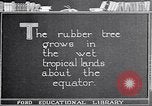
Rubber producing regions and extraction and collection of rubber
A map shows the rubber producing regions in the wet tropical areas along the equator. Workers in South America, possibly Brazil, extract latex on a rubber tree and collect it in containers. Acetic acid is used to thicken the latex. Workers fold and pile up flat rubber sheets.