


 Francais
 Deutsch
 Italiano
Refine Your Search
Rio de Janeiro Brazil 1946 stock footage and images
- Showing 229 to 234 of 2632 results more
more Hide
Hide
World tensions after World War II. The Baruch Plan. The Berlin Airlift. The Korean War. The Cold War. The Atomic age. Ballistic Missiles
Speaking before United Nations Atomic Energy Commission (UNAEC) in its first meeting in June 1946, Bernard Baruch proposes international control of all atomic energy -- the so-called Baruch Plan. Low level aerial view of ruined post World War 2 European city. Goods including heavy equipment, locomotives, being loaded aboard ships to aid in the postwar recovery of Europe (The Marshall Plan). Workers in Western Europe making use of Marshall Plan materials to rebuild their national infrastructures. West European farmers restoring agriculture. View from overflying light airplane of parts of postwar Berlin in 1948. Blocked roads and empty railroad tracks leading from East Germany to West Germany, blocked by the Soviet Union. Barge traffic at standstill due to Soviet actions. U.S. C-54 transport aircraft flying supplies into West Berlin (The Berlin Airlift) during the Soviet blockade of that city. West Berlin citizens watching U.S. transport aircraft bringing fuel, food and other essentials into the isolated city. A C-54 flying low over empty railroad lines, as it prepares to land in West Berlin. Supplies offloaded from a DC-3 ( AKA C-47 or British Dakota) equipped with unusual set of rear cargo doors. Supplies being moved on Tegel Airport with many C-54 aircraft in the background. Numerous C-47 aircraft operating at Tempelhof airport. An East German official opening a barricade as Soviet blockade of West Berlin ends on May 12, 1949, and supply trucks begin to move over roads again. Flags of Western nations flying on high flagpoles. Glimpse of Allied warships underway during the Cold War. Formation of P-38 Lightning aircraft in flight overhead. NATO troops marching and NATO armor on parade. Flashes of heavy artillery firing at night. Korean refugees moving South in 1950 with the outbreak of the Korean War. View of UN Security Council meeting in the absence of Soviet representative. U.S. tanks firing guns and American infantrymen in conflict with North Korea in Korean War. American wounded on stretchers.Delegates of both North and South Korea signing the Korean Armistice Agreement in P'anmunjŏm, on July 27, 1953. A rocket is launched. Images of earth from inside a space craft in orbit. Narrator mentions the first satellite to circle the earth, the soviet Sputnik 1 in 1957. View of Soviet pilots in low pressure altitude chamber. A test subject in an aircraft making a maneuver that allows him to experience "weightlessness." Objects in his cockpit float about. A military rocket launch monitored by arrays of radar. An object being retrieved from space by means of a parachute. A nuclear powered submarine. Rockets on display during a military parade in Red Square, Moscow, the Soviet Union. A U.S. Air Force B-52 bomber taxiing. More views of rockets seen during a Soviet military parade in Red Square, Moscow.
The use of RADAR by Allied forces throughout World War 2
Film made in 1946 recounts use of RADAR in World War 2. Air raid sirens sounding in London, England,1940, during Battle of Britain. Air raid warden helps people to shelters during blitz bombing run by German Luftwaffe aircraft. German He 111 bombers in formation overhead. Woman scoops up child. British gunners man a 3.7 inch antiaircraft gun. Farmer rides horse-drawn plow. RAF airman rings alert bell that reads: "Don't come and tell.Ring this like hell." RAF pilots scramble to their Spitfire fighter planes and take to the air from a British airbase or aerodrome. German He 111 bombers being intercepted.Wreckage of German bombers. Evening views of London. Prime Minister Winston Churchill contributing to a war drive and receiving a pin from a woman. He doffs or tips his hat. Technician using a slide rule. Early British radar antenna tower. A U.S. P-38 aircraft in flight. Animated diagrams explaining how radar works. Radar operators at their screens receiving radar transmissions. U.S. Army soldier operating antiaircraft radar in the field. Antiaircraft gun firing and downing an airplane. Artllerymen decorate gun barrel with symbols for enemy aircraft downed. A U.S. B-29 bomber in flight with bomb bays open. Bombardier with bomb sight having radar and optic options, using radar to sight target. Bombs away view of bombs falling from aircraft through clouds. A U.S. P-61 night fighter aircraft equipped with airborne radar. Hand of pilot of P-61 pressing button to fire on enemy aircraft at night. A C-47 transport aircraft flying in poor visibility makes a ground controlled approach and landing enabled by radar. A U.S. Navy F6F landing with radar help, on an aircraft carrier. A U.S. battleship. Sailors quickly get up from sleeping bunks responding to battle stations at night. Radar antenna rotating on a U.S. warship. Naval guns firing at night. U.S. heavy cruisers bombarding a shoreline. A submarine underway submerged. Navy ship tracking enemy submarine. Destroyer firing depth charges. A PBY Catalina flying over a convoy of ships.
A film titled 'The Photographer' featuring philosophy, techniques and artistry of Edward Weston, and various California landmark views
A film titled 'The Photographer' featuring philosophy, techniques and artistry of Edward Weston. A woman is seen taking photographs of two men on the Coast of California as they crack open a sea food. The woman later takes the camera along with her. Signboard reading 'Edward Weston' is seen. Several cats are seen in the simply furnished home of Edward Weston. Next scene shows a 1946 Pontiac car going through an automated car wash. Next scene shows Weston and the woman in a different car after their car is washed. Point of view (POV) shot from moving car on Wilshire Boulevard in downtown Los Angeles, California, as car passes by Chapman Park and approaches the Packard Bell building with radio towers behind. Next scene is on Wilshire Boulevard looking out at the Zephyr Room at the Chapman Park Hotel, and then on the opposite corner is the Brown Derby Restaurant (also called the Little Hat). The woman drives the car with the photographer seated beside her. Natural scenic beauty of California including plowed farm land outside Los Angeles, and then roads near Yosemite National Park and view of Half Dome from a moving car. Also seen are California farms, Sierra Nevada mountains, forests, rivers and sand dunes seen. The photographer takes pictures. Close up views of his old fashioned view camera. View from under cover or hood, just behind the photographer's shoulder, as he looks into the view screen from under the drape.
Cameramen take photographs of President Truman and President Weizmann
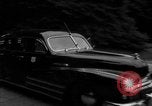
Mixture of scenes recorded during visit of Israel's President Chaim Weizmann to the White House in 1848. A 1946 Buick Special 4 door sedan Model 41 car pulls up to back of the White House and parks A Cadillac Series 75 limousine follows, carrying Israel's first President, Chaim Weizmann, who is assisted as he steps out. Scene shifts to portico of the White House, where President Weizmann presents a torah to President Truman, who holds it up and makes some remarks. Closeup of the two Presidents. View from behind the two Presidents as they pose for photographers. Main part of White House in the background. Scene shifts to back of White House as President Weizmann's car pulls up to the door, this time with a Secret Service agent riding on the running board. (He steps down as car stops.) Next, a battery of photographers is seen taking pictures. Scene shifts again, to President Weizmann walking slowly from his car, with assistance. Another shot of photographers taking pictures. Next, Weizmann is seen on the White House Portico with President Harry Truman who escorts him into the White House, followed by various staff members. President Truman and President Weizmann standing on Portico of White House. A group of staff stand nearby as President Weizmann's car is driven from the White House parking lot, past a U.S.Presidential 1947 Cadillac limousine. Some repeated views: of Presidents Truman and Weizmann, as they face reporters; and of Truman, Weizmann, and the gift torah.
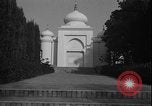
Scenes of Los Angeles: Hollywood Vedanta Temple, Chinatown, Relentless traffic, accident involving street car and van.
The Hollywood Vedanta Temple (1946 Vedanta Pl, Los Angeles, CA 90068, United States) founded by the Vedanta Society of Southern California in Los Angeles, California. Dome of the building in view. Li Po Chinese restaurant in the plaza of New Chinatown in Los Angeles. A 1950 Ford Coupe. Unbroken stream of automobiles traps pedestrians trying to cross. Another road lined with Palm trees and filled with moving automobiles. Scene of accident involving a streetcar or trolley, and a van.
Views of the United States. Farms, cities, highways, and beaches. Destruction in Japan by atomic bomb. U.S. infantry in combat
Farmers harvesting grain and corn with machinery on American farms with a narrow tractor harvester. Steel mills and heavy industry and cargo railroads in the United States. Industrial views with smokestacks releasing much smoke and smog (also pollution scenes). Scenes of New York City with busy streets filled with cars, buses, and truck traffic, together with pedestrians. Many varied 1940s and 1950s cars on the roads. Elevated and also aerial views of U.S. highway networks busy with 1940s and 1950s cars. Views of Jones Beach, on Long Island, New York. Scenes of destruction in Japan from the atomic bomb, with sweeping views of destroyed city in Hiroshima or Nagasaki circa 1945 or 1946. U.S. Army infantrymen engaged in house-to-house fighting in Europe during World War II, firing rifles and moving between points of cover in a city filled with rubble.