


 Francais
 Deutsch
 Italiano
Refine Your Search
Romorantin France 1918 stock footage and images
- Showing 127 to 132 of 6001 results more
more Hide
Hide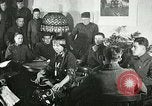
U.S. soldiers watching the performance of Tsianina Redfeather (a.k.a. Tsianina Blackstone), during World War I .
Tsianina Redfeather (also known as Tsianina Blackstone), a famous Creek-Cherokee Native American Indian mezzo-soprano, plays the Hawaiian guitar and sings for U.S. soldiers in YMCA- sponsored entertainment for the troops in a canteen, 1917-1918, during World War 1. (Historic note: While sailing to Europe in 1918 as a member of the American Expeditionary Forces, her vessel, the HMS Carmania, was struck by a torpedo. She continued the journey, entertained thousands of troops, and received a commendation for her service. Her interest in entertaining the troops, according to her autobiography, rested in the fact that so many American Indian soldiers were fighting overseas-- around 17,000. After her return to the U.S. her career continued to escalate. This clip perhaps represents the only surviving footage of this truly remarkable individual.)
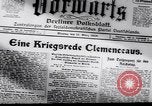
View from Berlin Germany, of events leading up to, and subsequent to, the Armistice in World War I.
Succession of Berlin, Germany, newspapers shown, from 1918 through 1919, chronicling progress of war towards the World War 1 Armistice, and subsequent problems and conditions in postwar Germany. Newspaper of November 12, 1918 addresses concerns about the conditions and the price of the truce. Crowd stands on a road covered with snow around statue of the Kaiser, with scaffold around it. Crowd in a square in War Bond rally. One of crowd carries a Communist red flag. Newspaper refers to gunfire in Berlin from Unter den Linden to Friedrichstrasse. Newspaper announces the Kaiser's abdication, which is then illustrated by reversed footage showing the Kaiser walking backwards and being lifted into his automobile, which then drives away backwards. Returning German soldiers are happy to see the war end, and sing in their returning trucks. An officer inspects war trenches that are now empty. Newspaper announce increasing domestic problems . Newspapers raise issue of German prisoners of War held in foreign countries. Troops are seen moving in streets and at checkpoints in Germany.
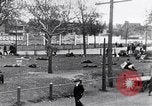
Homeless people and scenes of destruction after T. A. Gillespie Company Shell Loading Plant explosion
Displaced homeless people and refugees gather in grassy area near a railroad station, following explosion of the World War I shell loading facility. The T. A. Gillespie Company Shell Loading Plant explosion, sometimes called the Morgan Depot Explosion, occurred in October 4, 1918. The plant was one of the largest munitions facilities in the world at the time. Damage was extensive in the South Amboy and Sayreville area. Clip shows a refugee family posing together, sitting in the grass. Many billboard signs are on nearby fences and a grass and sidewalk area beside railroad tracks. The Perth Amboy Railroad Depot (train station) building on Smith Street is seen behind them (this building has since been moved to Lewis Street). With Martial Law imposed, the next scene shows a Coast Guard or Navy sailor on patrol to keep law and order and prevent looting in front of destroyed shopping area stores on Smith Street in Perth Amboy, including the Reynolds Brothers store (Reynolds Bros), at 134 Smith Street (also 136 Smith Street and 138 Smith Street), where the windows are blown out and debris are seen inside the store. The explosion of the Gillespie plant was one of three similar events in the New York-New Jersey area during World War 1: The Black Tom Explosion in 1916, the Kingsland Explosion in 1917, and then the Morgan Depot Explosion in 1918.
Civil war breaks out in Russia after Brest-Litovsk Peace Treaty, in year after Russian Revolution
After Lenin makes peace with Germany, civil war breaks out in Russia. White Russian troops are seen fighting against Bolshevik troops in the snow. American soldiers, supporting the White Russians, are seen in Archangel (Arkhangelsk). Cossacks on horseback carry the Tsarist flag. The Romanovs, Tsar Nicholas II and his family are photographed outdoors seated on a wooden bench by barricade fence at Ipatiev House in Ekaterinburg. Bolsheviks arresting other revolutionaries who were opposed to them, and executing them by firing squad. Vladimir Lenin with cat in his lap. View of Fanny Yefimovna Kaplan (AKA "Dora") who attempted to assassinate Lenin on August 30, 1918. View of Lenin speaking to Soviet workers. Newspaper of September 1, 1918 reports on the assassination attempt, with dateline London, August 31st: "Lenin wounded twice by assassin. Attempt on Red Premier's life at Moscow. Commissary Uritzky murdered at Petrograd." Crowd in turmoil in Moscow. Newspaper reports capture of would-be assassin, noting that "official Bolshevist paper says, "She is girl of intellectual class." Narrator states that some 500 anti-Bolsheviks are executed in Moscow.
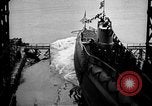
A mix of submarines from World War I to 1925
Sequence 1; The launching of the USS V-1 (later Barracuda SS-163) on July 17, 1924 from the Portsmouth Naval Shipyard in Kittery, Maine. Sequence 2; Two surrendered German U-Boats, most likely the U-117 (L) and the UB-148 (R) circa 1918/19. Sequence 3; The USS S-19 circa 1925 either looking to moor or pulling away to sea. Sequence 4; U.S. "L" class submarines ay Bantry Bay, Queenstown, Ireland circa 1918 World War 1, American submarines had to place an "A" before there name to avoid confusion with the British "L" class submarines. L to R are L-11 (bow), L-1, L-10, L-4 and L-9.
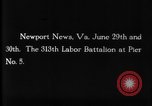
U.S. 105th Field Artillery march up to the docks and on to USS America and Madawaska in Newport News, bound for France
U.S. 313th Labor Battalion troops, 105th Field Artillery and 2nd Battalion Pioneers embark from Newport News, Virginia for Europe in 1918 during World War I. The troops of U.S. 313th Labor Battalion at a pier. U.S. 105th Field Artillery and 2nd Battalion Pioneers march up to the docks and on to gangplanks by U.S. Navy transport ships USS America and USS Madawaska. The World War 1 American troops at dock. The covered artillery at the dock. The troops walk up the gangplank. A building and a ship at the dock.
CRITICALPAST.COM: About Us | Contact Us | FAQs - How to Order | License Agreement | My Account | My Lightboxes | Shopping Cart | Advanced Search | Featured Collections | Website Terms & Conditions | Privacy Policy ©2026 CriticalPast LLC.
License Agreement |
Terms & Conditions |
Privacy Policy
©2026 CriticalPast LLC.