


 Francais
 Deutsch
 Italiano
Refine Your Search
Russia 1953 stock footage and images
- Showing 721 to 726 of 1877 results more
more Hide
Hide
European Persons and Events leading to World War I.
The funeral of Archduke Franz Ferdinand of Austria. Emperor Franz Joseph I of Austria arrives in a horse drawn carriage. Kaiser Wilhelm II of Germany with entourage. The German Emperor reviews German troops on parade. A newspaper headline "Kaiser defies Czar. Hands off or War!'. Nicholas II of Russia walks down steps followed by his wife and two daughters. People stand on steps and salute. The Czar and family are seated in an open carriage. Russian Soldiers parade. Another headline, 'France enters War'. French Cavalry and troops parade in open fields. A newspaper headline 'England prepares for War, German armies sweep France'. British King George V , in military uniform, and Queen Mary, standing at a window. British troops march and a soldier drives a motorbike.
Motorcyclists of the Belgian Expeditionary Armored Squadron, ACM-corps (Autos Canons Mitrailleuses) assemble for parade
Armed members of the Belgian Expeditionary Armored Squadron, ACM-corps (Autos Canons Mitrailleuses) are seen assembling with their motorcycles in preparation for their unit's parade in Longchamps, Paris, France, on April 17, 1915, before their departure to Russia, during World War I.
Key events involving German rocket pioneer Reinhold Tilling
Opening slate states (in German) that as early as August 1933, Reinhold Tilling's rockets were test fired from aircraft. However, while Germany paid little attention, Russia and England showed in this work. View of airplane with two Tilling rockets under its wings. Closeup of the one under the right wing. Pilot climbs into cockpit of the plane. Slate reads: Shooting from the aircraft in 1933-34, the rockets achieved distances of 500 meters at altitudes of 7000-8000 meters. Still pictures taken from the ground of the rockets leaving trails as they are launched from the aircraft. The airplane is also seen in at least one photograph. One picture shows a rocket exploding in the air. Scene shifts to view of fire burning at one of Reinhold Tillings workshops, at Osnabruck, Germany, where he and his two assistants, Angela Buddenbohmer and Friedrich Kuhr, were killed when gunpowder charges they were compressing for rocket motors exploded, on October 10, 1933. Photos of Tilling and his assistants are shown. Final scene shows a public memorial to the deceased trio, which includes flowers from several groups, including the Nazi party. Nazi swastika flags are displayed in the background. One floral tribute also contains an airplane propeller. A large greenery Christian cross is seen as well as three small brass menorahs, one at each of the three mounds of flowers.
USIA operations like radio broadcast, press edition and Director Streibert explains mission to a committee in U.S.
United States Information Agency (USIA) radio operators operate radio studio controls and set frequencies for transmission and receiving. USIA staff work on gathering additional facts, with newsroom reporters and editors in a press room typing and working on stories, a woman editing motion pictures, typing, printing at USIA. Exterior view of headquarters building of United States Information Service or USIS. People enter and exit the building of USIS. Members of a Citizens Committee and Director Streibert enter into a room. Map of world in room. Citizens seated on sofa. Director Streibert explains U.S.I.A. mission to a citizens' committee and talks about America's history and involvement in the world. One Citizen Committee member smokes a pipe. The Director shows a chart of how "communist propaganda is spread by a vast worldwide machine." Director Streibert explains (via anti-communist propaganda, or reverse propaganda...during Cold War) its mechanism and control exerted via the presidium of the Soviet communist party. View of Soviet Union leaders watching a military parade in Red Square, Moscow, Russia. Khrushchev is among the leaders. Next scenes show Communist rallies and speakers in Korea and then in China. At the Chinese rally, a scene of unrest unfolds as a group filling a large truck enters a rally, jumps down, and inflames the crowd. Communist leader Khrushchev with other Soviet officials debarks an airplane and meets leaders in India. He waves at a welcoming crowd during a visit. View of piles of Motion picture canisters ,magazines, pamphlets and books distributed as propaganda by Soviet Union. High production quality of paper shown. Industrial equipment and industrial farming equipment is displayed in a large exhibit hall for visiting foreign governments and dignitaries to view and consider investment. The Director states that long term Communist goals are world domination, and short term goals include the encouragement of neutralism, dividing and confusing American allies, and isolation of the United States. Director Streibert explains how the USIS works together with the Department of State to communicate American information. He ends the explanation by giving the USIA campaign pamphlets "Atoms for Peace" and "Atomic Power for Peace" ( The Eisenhower plan) to citizens of committee as example of a communication.
Allies demand the unconditional surrender of Japan in World War II. Entry of Soviets and use of atomic bomb ends the war.
Representatives of three nations, seated around table at Potsdam Conference held at Cecilienhof in Potsdam, Germany. British prime minister, Clement Attlee; President of United States, Harry Truman; and representative of Soviet Union, Joseph Stalin at the Potsdam Conference, July 1945. They deliver an ultimatum of unconditional surrender to Japan. Swarms of B-29 bombers and Aircraft Carrier Task Forces destroy Japanese homeland. Planes on carrier decks.Navy Grumman carrier-based TBF aircraft dropping bombs.. Destruction of ships at sea. Mushroom cloud due to atomic bombing. Chart depicts the power of one atomic bomb. Britain's 'grand slam' bomb, most destructive conventional bomb ever produced. Doctor Ernest Orlando Lawrence, inventor of the cyclotron (atom smashing machine). A man works at the Cyclotron at the University of California, Berkeley. General Leslie Groves, head of the project speaks. He is seated with Dr Vannevar Bush, government director of science and research, and Dr Richard Tolman, technical expert. Quantities of uranium shipped from Alberta, Canada are used in bombs. The atomic bomb process (Manhattan Project) is developed in widely separated areas; scenes from Hanford Project plant in Richmond, Washington. Project personnel exit cars and enter into the search area before starting their work day. Lieutenant colonel Franklin T Matthias with the army corps of engineers, appointed to the Hanford Project. Sign of 'Oak Ridge' in Tennessee. Largest of the three atomic bomb plants located near the Tennessee Valley Authority (TVA) dam. Employed personnel in atomic bomb plants are seen going to work. Man and woman employees at the plan read and smile at a Knoxville Journal newspaper in August 1945 with news headline "Power of Oak Ridge Atomic Bomb hits Japs" after the atomic bomb was dropped in Hiroshima. View of dense prefabricated home communities to house large number of Oak Ridge plant workers. View of families setting up their houses in trailer towns after the prefabricated homes were full. People come out from the Henebry's Jewelers and supermarket, among stores setup to meet the needs of the quickly built city. Scenes changes to show view of Soviet leader Joseph Stalin at conference. Russian artillery and troops in a parade at Red Square in Moscow, Russia (these parade scenes are from the May 1, 1945 May Day parade, just days before Germany's surrender). President Harry Truman reports on the latest developments regarding the war with Japan. He states that the United States is prepared to destroy every productive enterprise in Japan and the U.S. shall completely destroy its power to make war. He warns of an attack by the U.S. due to the rejection of the July 26th ultimatum at Potsdam. He warns that Japan "should expect a rain of ruin from the air; the like of which has never been seen on this earth." Truman notes that it will be followed by an unprecedented sea and land invasion of Japan.
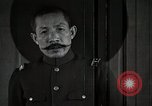
Japanese General Baron Sadao Araki speaks, and animated maps show danger of attacks on Japan and its occupied territories.
Film opens with closeup of Japanese general, Baron Sadao Araki, speaking. Behind him is a huge Japanese flag so that his head is silhouetted against its huge red ball. His image fades out and a map of Japan and Asia appears. Sadao Araki continues to narrate. The map shows animated arrows directed from Russia southward toward Japanese held Manchuria (Manchukuo) and from India northward. The arrows converge and are joined by arrows from the sea. All are directed against Japan. The message clearly speaks to need for Japan to be ready to protect against attacks by others. Back to closeup of Baron Sadao Araki speaking. Then flags of world nations are shown with Japan's rising taller and larger than all the rest. Next a map of Japan and its occupied territories in Manchukuo, and Korea, with arrows from foes threatening them. Japan seems to shudder on the animated map.