


 Francais
 Deutsch
 Italiano
Refine Your Search
Seoul Korea 1960 stock footage and images
- Showing 1285 to 1290 of 2020 results more
more Hide
Hide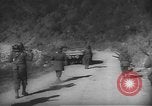
American Third Army Division forces operating on the offensive in the "Iron Triangle" and then pulling back, and finally participating in UN offensive "Operation Pile driver"in the Korean war
U.S. troops of the Third Army Division move along a mountainous road, past some parked army vehicles. Several of them scurry to take shelter by some boulders. Smoke rising from valley below as a soldier, in an M3 Half track, points and sets up an antenna. Four 50-caliber machine guns are mounted in the back of the half track. American soldiers firing rifles from a protected area. Two soldiers with an air-cooled machine gun. Spent cartridges are scattered in the sand by their weapon. Glimpse of troops firing the four 50 caliber machine guns in the back of the M3 half track. Overwhelmed by superior numbers, the U.S. troops are ordered to pull back. View of U.S. soldiers moving back from their protected position. American troops in vehicles moving back along the dirt mountainous road. Next, U.S. forces are seen moving South over snow-covered terrain. One U.S. mortar team fires a round to their rear. A Brigadier General conferring with another officer about mounting a counterattack back up the peninsula. Third Division troops are seen heading North, again, firing tank artillery as they proceed. Smoke rises from their shells exploding ahead of them. Infantry move carefully through burning villages and into the Korean central mountain sector. Smoke rises from a large explosion as the North Koreans launch an offensive in May. American troops rushing up a hillside to engage the enemy. A U.S. Sherman tank firing rounds from valley floor. Shells from U.S. armor exploding atop a hill occupied by American troops. Afterwards, the troops advance further. One fires at an enemy bunker just to be sure it is not occupied. Machine gunner atop a U.S. tank fires at haystacks that might hold enemy soldiers. Another view of a Sherman tank firing its main gun. Smoke rising from the shells striking a hill in the distance. Glimpse of a U.S. soldier with a North Korean prisoner of war. U.S. troops advancing through rice paddies filled with water. Narrator states that this was a full scale United Nations Offensive called "Operation Pile Driver." More views of American infantry setting up firing lines and firing water-cooled and air-cooled machine guns.
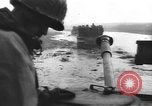
American forces in relentless drive against Communist forces during United Nations Operation Pile Driver during Korean War. Third Division assigned to contain Communist forces in Iron Triangle.
Opening scene shows view U.S. soldier atop a tank advancing along a waterway, behind a truck filled with infantry, during the Korean War. A civilian car caught in a flood. An American tank with 3rd Division infantrymen on edge of a flooded area. A civilian vehicle abandoned nearby. Narrator notes that Chinese forces were suffering defeats. Third Division infantry accompanied by armor, advancing in fields. Riflemen firing their weapons at an abandoned train and a building. Tanks advancing with infantry. Third division receives orders to anchor western end of the Iron Triangle in plan to contain Communist forces therein. American Junior officers discuss this with soldiers.
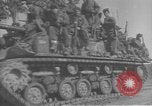
UN Operation Doughnut designed to seize dominating terrain of Sobang Mountains around the Iron Triangle, 1-4 July 1951
U.S. forces on the move to encircle the Iron Triangle, and blast the enemy from the hilltops during the Korean War. The first scene shows a U.S. Sherman tank carrying about 15 American infantrymen who occupy every possible space atop the tank. It is followed by a Patton tank, also covered with American infantry getting a ride. Fuzzy view of a tank in field with traces of snow. U.S. gun crew firing a towed field howitzer. Closeup of American Lieutenant commanding artillery. He is using a field telephone. Another crew firing a mortar. Shells exploding on the hilltops. U.S. soldiers observing with binoculars from a bunker. Numerous explosions of many kinds of ordnance in the hills. Soldier firing a 30-caliber Browning air-cooled machine gun. Another American soldier firing a sub-machine gun. Other infantrymen firing fully automatic rifles. A U.S. Air Force F-51 Mustang fighter plane drops napalm on a target. Another Mustang fighter dives low to fire rockets and strafe an enemy position. Many more views of American artillery, tanks, and machine guns firing at the hills. Infantry move uphill to occupy the hilltops. Two are seen carrying flame throwers. As the infantry enter woods on a hillside, a flamethrower is employed. Troops in a sandbagged position in a town. Sick and wounded Korean civilians lie on litters in a paved area from where they are being placed into trucks.
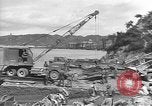
U.S. Corps of Engineers rebuilds bridge while U.S. troops engage the enemy during the Korean War
U.S. Army Corps of Engineers use a mobile crane and other construction equipment to rebuild a bridge during the Korean War. Closeup of engineers standing on the edge of a newly built section of the bridge. Wheels of the mobile crane are nearby. They lower a cable as an inflatable boat arrives carrying steel sections for the construction. The boat and its cargo is pulled in and tied up to the existing structure. Scene shifts to a dirt road, where several Patton tanks are clustered near a large tent. Tank crews are checking their guns and equipment. Closeup of Lieutenant General James Van Fleet, newly appointed Commander of the U.S. Eighth Army, at the construction site. Closeup of a Patton tank with crew members visible, as it passes the camera. Its main gun is wrapped in tarpaulin covering. Next, a Patton tank is seen crossing a pontoon bridge. U.S. troops firing an M20 75mm recoilless rifle at enemy positions from a temporary hillside base. American troops firing a mortar. Scene shifts completely to Korean refugees fleeing the battlefields. They and their belongings are loaded into trucks, along with food and other supplies. Closeups of some of the refugees. A column of trucks filled with refugees is seen making its way along a dirt road. United Nations troops investigate possible infiltrators from the North, They are seen searching and questioning some. A sign at one area reads: "65th PW Cage. Keep Out." Some in the prisoner area are seen being interrogated and writing answers to questions.
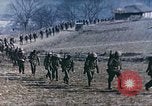
U.S. marines advance in a Korean village to occupy enemy positions and advance in the Korean War.
1st Marine Division in active battle during the Korean War. U.S. marines walk across a field. The marines run to advance and occupy enemy positions. U.S. Marine Skyraider aircraft fly over the enemy positions. A marine talks over a phone. A pilot talks over a phone during a flight. A napalm bomb is dropped by the aircraft. Houses on fire in a village. The aircraft continues bombing and firing. The marines throw grenades and run into the village. Buildings on fire. Marines emerging from trenches and running to take village. They walk on the village streets as flames burn nearby buildings.
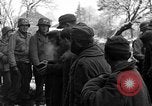
Prisoners of war being moved and searched by U.S. Army Military Police in WW2 and in Korean War
First scenes of clip show United States Military Police (MP) processing German prisoners of war (POW) during World War 2. German prisoners load into a U.S. Army truck under supervision of several MP, in cold winter weather conditions with snow on the ground. Next scene shows German prisoners of war enter a holding area in a large field under MP supervision. Scene changes to Korean War and activities of U.S. 8th Army Military Police. U.S. Army Military Police (MPs) and Korean or Chinese prisoners of war (POW) standing. The POWs board a truck. They are led by MPs. The POWs enter a camp area in a line. An MP frisks a prisoner. Prisoner of War documents being completed by an MP. Prisoner being fingerprinted. Elevated views of mass of prisoners running quickly into large column formation with Military Police watching at the head of the column. Prisoners standing on a road in groups. The MPs stand beside them. They check the identities of the prisoners. The prisoners are being searched by the MPs. Korean civilian refugee families fleeing an area. A young Korean child on a bicycle that is also laden with many belongings as a family evacuates. Families pulling open carts with Korean children laying on the carts bundled in blankets.