


 Francais
 Deutsch
 Italiano

Refine Your Search
Tontouta New Caledonia 1943 stock footage and images
- Showing 31 to 36 of 10542 results more
 Hide
Color Sound

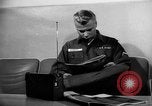
American workers and OSS in World War 2 work to estimate the loss of German military manpower in battle.
Film outlines process of U.S. military and War Department to estimate the German military manpower losses from 1939-1943 during World War II. Scenes of German military forces in battle. German tank on the battlefront smashes down a tree and German soldiers follow, running behind it. Dead bodies of soldiers lay on the battlefield. Airplane falling from sky to ground after being hit. German Soldiers fire rifles during battle. German soldiers carry wounded on litters and German medical staff treat the wounded soldiers. A wounded soldier on a hospital bed. Nurse leans over hospital bed and talks to a wounded soldier. A study made to find out the number of soldiers returning to their jobs after being injured. A man reads a magazine which reads: 'Estimate of non battle causalities'. German soldiers march through Arc de Triomphe in Paris during occupation of Paris by Nazi Germany. Headline of a newspaper reads: 'Germans silent on Russian gain'. Brief scene of Soviet leader Stalin speaking at a microphone. Cavalry soldiers, likely Soviet, crossing a battlefield. Scenes of World War I German troops being reviewed by officers. Civilian or OSS men lean over a German map and discuss among themselves. They study the map. Scene of men and women at a German news stand buying German newspapers in order to obtain obituary information. OSS personnel translate casualty reports from German newspapers to help estimate deaths of German soldiers and determine force strength. An operations room with American staff analyzing German newspapers. View of a Boeing 314 Clipper Flying Boat aicraft taking off from water. The reports from World War I and II, allied forces, chart, graphs and NARS computers used to estimate German Army's manpower loss. African American women workers operate keypunch machines recording battle casualty statistics which yield punch cards for further data analysis. Punch cards being created and being loaded in sorting and reading machines bearing brand "International" (for International Business Machines or IBM). A document entitled "analysis of obituaries." Man in an office studying a map and a document. A woman helps him as she enters numbers into a Remington Rand adding machine. They estimate the officers killed in war and the number of the killed enlisted men, in order to estimate the total battle loss. They compare the data of soldiers missing, killed, wounded, and unfit for duty from 1939 to 1943.
The story of AFN ( American Forces Network) Radio. Founding announced in 1942. First broadcast in 1943; growth in 1944.
U.S. Army soldier reads newspaper while listening to radio. Soldiers doing their respective chores, listen to AFN (American Forces Network) Radio. General Marshall and General Eisenhower announce the creation of AFN, in 1942. July 4, 1943, the first broadcast of AFN. General Eisenhower mingling with paratroopers of the 101st Airborne Division, on the eve of D-day. U.S. B-26 aircraft in flight. United States soldiers aboard landing craft and wading ashore at Normandy, France, on D-day, June 6, 1944. Soldiers tuning radios in the field. United States Sherman tanks and infantry move along country road in France. Audio includes portions from AFN broadcasts, including an announcer saying "You are listening to AFN Paris. This is the American Forces Network, on the road to Berlin." Road sign points to St. Lo. Group of U.S. soldiers gathered around a jeep with a radio, listening to AFN, in Germany. (World War II period).

Analysis of the German labor force from 1939 to 1943 (WW2)
Analysis of the Germany's labor force, military strength and effects of World War II on manpower. German soldiers march. Men work in factory on equipment and machinery. Women work in factory. A cemetery of World War 1 soldiers in Germany. Narrator explains how loss of man power from world War 1 deaths, and subsequent lower birth rate leads to war production worker needs being filled by many young German women and even German boys and girls working in industrial factories also. Wounded German soldiers being treated in field during World War 2. A map points Germany, Sudetenland and Austria. Graphs examine labor force by sex, age and military replacement availability; compare the labor force according to sex from 1939-1943; detail the increase of work force through the women part time workers and the veterans. Women weld equipment in a factory. Men do mining work. Narrator speaks of foreign workers (such as from Poland, Netherlands, Czechoslovakia, Yugoslavia), and how some now serve "under economic pressure and compulsion" (as forced labor or slave labor). Views of forced labor crews working digging earthworks. Laborers also work on building or repairing railroad stations and track work. Lines of prisoners of war, also used for labor, walk under German guard as lines of German uniformed troops walk in the opposite direction. Graphs compare the labor force in agriculture, industry, trade services, transport and government.
The comparison of Germany's total labor and military manpower from 1939 to1943.
Estimation of Germany's total working manpower. People walk with their equipment towards a factory. They read a notice pasted on the wall. They work in the factory. Vehicles parked on the street. Soldiers walk. Comparison of the military manpower from 1939 to 1943. The number of soldiers missing is also estimated. Destroyed military vehicles on the battlefield. Soldiers advance with tanks on the battlefield. Dead body of a soldier lay on the field. (World War II period).
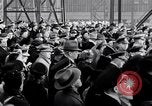
Launching of USS Wisconsin (BB-64). Philadelphia Navy Yard, December 7, 1943. Governor and Mrs. Goodland of Wisconsin.
Rear Admiral, M.F. Draemel, Commandant of the Philadelphia Navy Yard, introduces Assistant Secretary of the Navy, Ralph, A. Bard, who speaks to large group of Navy Yard personnel and visitors and spectators. The occasion is the launching of the second USS Wisconsin (BB-64) on December 7, 1943. Governor of Wisconsin, Walter S. Goodland and his wife are present. Mrs. Goodland is the official sponsor.
Inaugural air mail service in 1918; a R-4 helicopter in 1943 carries mail to an airport for air delivery in Washington DC, United States.
The 25th Anniversary of the Air Mail Service in the United States. Past events from year 1918 show the inauguration of air mail in the United States. A man holds an envelope to be delivered by air. President Woodrow Wilson talks to a pilot. Scene changes to 1943 in front of the U.S. Capitol building in Washington DC, on the occasion of the 25th Anniversary of the Air Mail Service. A U.S. Army Sikorsky R-4 helicopter lands outside the U.S. Capitol in Washington DC. The pilot speaks to the helicopter designer, Igor Sikorsky, and receive a special package of mail. The helicopter is seen landing in Arlington Virginia at recently opened Washington National Airport, to deliver the package to a waiting aircraft. Crowd of people gathered outside at Washington National Airport terminal building to watch the helicopter landing. Mail being loaded aboard an air mail aircraft. The helicopter takes off.
CRITICALPAST.COM: About Us | Contact Us | FAQs - How to Order | License Agreement | My Account | My Lightboxes | Shopping Cart | Advanced Search | Featured Collections | Website Terms & Conditions | Privacy Policy ©2026 CriticalPast LLC.
License Agreement |
Terms & Conditions |
Privacy Policy
©2026 CriticalPast LLC.