


 Francais
 Deutsch
 Italiano
Refine Your Search
US-Gliders- stock footage and images
- Showing 889 to 894 of 21920 results more
more Hide
Hide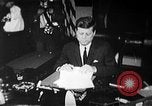
In the US, President Kennedy receives a message from Soviet Premier Khrushchev about dismantling of missiles in Cuba.
Events in the United States during the Cuban Missile Crisis of October 1962 when the United States and the Soviet Union confronted each other with nuclear destruction. U.S. President John Kennedy signs a quarantine order. U.S. Air Force B-52 Stratofortress bombers take off. U.S. Air Force interceptors and fighters take off from U.S. aircraft carriers at sea. Radar dishes moving. A U.S. battleship underway at sea. A U.S. aircraft intercepts a Soviet tanker and allows it to proceed. U.S. reconnaissance aircraft over Cuba. U.S. Air Force SAC (Strategic Air Command) bombers are prepared for a take off. U.S. missiles are prepared. Head Quarters of American Air Defense Command shows interiors of a control room. People wait for news. Exteriors of the White House in Washington DC. Exterior of the Kremlin in Moscow, Soviet Union. A press announcement about a message that President Kennedy has received from Soviet Premier Khrushchev saying that he will dismantle missiles in Cuba.
U.S. Marines battle Japanese troops to capture Saipan, Mariana Islands during World War II.
U.S. Task Force 58 attacks Japanese held island Saipan in the Mariana Islands during World War II. Task Force 58 ships head towards Saipan. A map of Saipan. Carriers, battleships and destroyers of Task Force 58 underway. U.S. Navy Admiral Raymond Spruance aboard a ship. U.S. Naval guns bombard Saipan. Smoke rises from shell explosions on the island. U.S. Marines embark on landing crafts off Saipan. The Marines and U.S. tanks advance on the island. U.S. heavy artillery guns bombard Saipan. The Marines continue to battle Japanese troops as they advance. Japanese installations in ruins. A U.S. Navy F6F Hellcat fighter aircraft lands on the island. The American flag is raised. U.S. medics treat wounded soldiers. Japanese women and children are removed to safety by U.S. troops.
U.S. 1st Cavalry Division makes an amphibious landing at Pohang, Korea and advances during Korean War
U.S. 1st Cavalry Division establishes beachhead at Pohang, Korea during Korean War. Animated map of South Korea depicts U.S. landings on east coast and highlights Pohang. U.S. LSTs (Landing Ships, Tank) and landing crafts head for beach of Pohang. U.S. soldiers disembark from landing craft. Equipment including bulldozer and trucks are unloaded. Soldiers and equipment advance inland. Commanding General of U.S. 1st Cavalry Division Major General Hobart R Gay holds a conference at commanding post of U.S. 8th cavalry regiment which includes Assistant Commanding General of U.S. 25th Infantry Division Ellis Warner Williamson and Commanding Officer of 8th Cavalry Division Colonel Ray D. Plummer. Welcome sign erected by South Koreans for U.S. officials. U.S. soldiers march.
Mission and operations of the U.S. Army Service Forces during World War II
Film opens with an explosion at Pearl Harbor, Hawaii, December 7, 1941, during the Japanese attack in World War 2. The USS Arizona sinking. Newspaper headline reading "U.S. Declares War." Relief map globe of the world. Narrator speaks about accomplishments of the U.S. Army Service Forces since the Pearl Harbor attack. Glimpse of two M4 DV early Sherman tanks moving on a road. The famous Uncle Sam recruiting poster. Huge number of massed U.S. Army troops marching toward the camera lined 16 abreast. Army supply service personnel inspecting providers of all manner of supplies needed to feed, clothe, and equip the U.S. Army. Brief views of supply operations underway involving food and fuels. An Army truck and a P-38 lightning airplane (under wraps) being loaded aboard a ship. A warehouse stacked from floor to ceiling with military supplies. Forklifts moving in the aisles. Group of officers sitting around a table. Some wear shoulder patch of Army Service Forces on their uniforms. The processing of millions of volunteers and draftees for military service. Men in recruitment office being guided by staff. Lines of new recruits undergoing physical exams and then arriving in civilian clothes, with their baggage, at a training center. Barracks being constructed at a training camp or base in the United States. Camera pans across a large completed military camp. Soldiers forming up in front of barracks. Sign reads "Dispensary, Recruit Reception Center." Recruits lined up and receiving vaccinations against tropical and other diseases according to the regions to which they are being sent. An Army Sergeant assessing recruit qualifications for various military assignments. New recruits eating in a camp dining hall and also in a chow line at an outdoor field mess. Views of industrial workers picking up tools and assembling military equipment in war plants. A coal burning electric generating plant with 8 smoke stacks. A furnace with hot steel visible. An Army agent and an industrialist or business man signing contract documents. Glimpses of women war production workers placing items on a conveyer; guns being assembled by men in an armory; railroad train carrying freight across rugged U.S. territory; ocean-going ships ready for loading; cargo stacked up at ports; numerous 55 gallon drums ready for loading; rope slings of cargo being loaded for shipment; numerous army trucks ready for shipment to Allies, under "Lend Lease;" a nurse checking medical supplies for shipment; Many U.S. Army M3 tanks ready for shipment. Views of British forces engaged in the North African campaign, before the U.S. entry in World War 2. U.S. soldiers marching along a Camp road past a sign reading: "Headquarters, 725th Railway Operating Battalion" (Located in New Orleans). Rapid glimpses of various supplies, equipment, etc. being loaded for shipment abroad. Women war production workers in plants. Men in outdoor yards filling long lines of jerry cans. Close up views of clock hands moving, and gears of clock working. U.S. Army soldiers shooting automatic weapons (including tracer rounds) at a firing range.
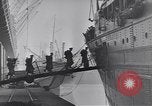
U.S. Army Service Forces transporting troops and supplies worldwide during World War II.
U.S. troops board a large troop transport ship via a gangplank. Troops on an intermediate deck of the ship. Some are sprawled out relaxing. View from above of more troops boarding a ship. Men and equipment on the pier below. American forces at various far flung places where the U.S. Army Services Forces facilitated their transport and logistic support. Fleeting glimpses of troops in: Ireland; Alaska; Trinidad; and South America. Troops jam the upper deck of a transport ship. Army Service Forces officers in a planning meeting. Naval officers on deck of a ship look through binoculars as U.S. Naval ships bombard the coast of Solomon Islands and landing craft carry marines in an amphibious assault. Next, a man is seen annotating a map of North Africa. Secret maps pertaining to Allied landings in Tunisia and Algeria. Animated map illustrates amphibious landings on North African coast, highlighting Casablanca, Oran, and Algeria. Landing craft carry troops and supplies that are piled up in the sand beach. Soldiers moving military supplies ashore, in fire brigade fashion. Soldiers working at desks in Offices of the Army Service Forces. Filing cabinet in background. Trucks on the move in remote locations. Supply ship being loaded at a terminal. Fuel drums and army vehicles a being loaded aboard ships. Officers seated at a conference table. Ordinary American enlisted soldiers in a griping session at an Army post in the United States. Camera pans over large formation of soldiers. Animated chart shows more than half of servicemen who are part of Army Service Forces (ASF), are unaware of that. Troops marching in review at a tropical location, where reviewing officers wear pith helmets. Chart illustrates lack of unit pride in ASF. Images of various ASF logos. Chart shows results of polling data from soldiers and service members. Signal Corps and Engineers elements of ASF have the greatest unit pride. But most think better of other branches of the Army. More troops marching, in steel helmets and carrying rifles with bayonets affixed. Troops marching overlaid by "50%" indicating that half don't believe their contributions to the war effort are significant. Troops lined up (for pay?). More charts expressing concern about low morale. A heavy gun firing. German paratroopers jumping from a formation of Junkers Ju 52 aircraft. Charts expressing prevailing U.S. troops view that Germany wouldn't be too hard to defeat. Chart showing lack of understanding about why the U.S. is fighting Germany. Image of President Franklin D. Roosevelt and Prime Minister Churchill seated in front of their key military officers at Casablanca Conference in World War 2. Chart shows U.S. soldiers believe that the greatest war effort is expended by the U.S. followed by Russia, with China and Britain providing little. Chart illustrates that only half U.S. troops want to get overseas and fight. Chart shows U.S. War Department films can correct this problem.
U.S. soldiers of the 69th Infantry Division patrol Leipzig, Germany and fire at remaining Germans offering resistance, near end of World War II in Europe.
As film starts, German civilians are seen running along a street in Leipzig, Germany near the end of World War 2 in Europe. There is no sign of any war damage in this particular area. Next, a young man with an injured arm is helped up from the pavement by German civilians and U.S. Army soldier of the occupying 69th Infantry Division. One of the civilians helps the young man bandage his arm. A group of U.S. Army troops gather around two medics tending to a person lying on the pavement. Scene shifts back again to the young man with the injured arm who seems unable to stand up. A U.S. Army soldier re-bandages his arm. View from a vehicle driving along a street, passing American infantry walking along a sidewalk, past others sitting against buildings. Several U.S. Sherman tanks are gathered along with American infantrymen, in a square in the city. The tank crews fire machine guns and their tank guns as the infantrymen fire their rifles at remaining German resisters and snipers (As film starts, German civilians are seen running along a street in Leipzig, Germany near the end of World War II in Europe. There is no sign of any war damage. Next, a young man with an injured arm is helped up from the pavement by German civilians and U.S. Army soldier. One of the civilians helps him bandage his arm. A group of U.S. Army troops gather around two medics tending to a person lying on the pavement. Scene shifts back again to the Young man with the injured arm who seems unable to stand up. A U.S. Army soldier re-bandages his arm. View from a vehicle driving along a street, passing American infantry walking along a sidewalk, past others sitting against buildings. Several U.S. Sherman tanks are gathered along with American infantrymen, in a square in the city. The tank crews fire machine guns and their tank guns as the infantrymen fire their rifles at German resisters and snipers (unseen). View from moving vehicle of civilians standing on sidewalk and street with some rubble on it. They wave white cloths and some smile. More views of American infantry patrolling a sidewalk and street with a Sherman tank in the background. A man waving a white cloth crosses a square toward the camera. A pair of Sherman tanks move on a street toward the camera. More brief views of infantry patrolling and civilians with anything white they can wave. A pair of Sherman tanks move slowly on a street toward the camera, past more German civilians waving makeshift white flags. View from moving vehicle of civilians standing on sidewalk and street with some rubble on it. They wave white cloths and some smile. More views of American infantry patrolling a sidewalk and street with a Sherman tank in the background. A man waving a white cloth crosses a square toward the camera. A pair of Sherman tanks move on a street toward the camera. More brief views of infantry patrolling and civilians with anything white they can wave. A pair of Sherman tanks move slowly on a street toward the camera, past more German civilians waving makeshift white flags.
CRITICALPAST.COM: About Us | Contact Us | FAQs - How to Order | License Agreement | My Account | My Lightboxes | Shopping Cart | Advanced Search | Featured Collections | Website Terms & Conditions | Privacy Policy ©2026 CriticalPast LLC.
License Agreement |
Terms & Conditions |
Privacy Policy
©2026 CriticalPast LLC.