


 Francais
 Deutsch
 Italiano
Refine Your Search
US-Gliders- stock footage and images
- Showing 901 to 906 of 21920 results more
more Hide
Hide
Gulf of Tonkin response: President Johnson announces U.S. action as United States soldiers and aircraft are rushed to Vietnam
United States planes and soldiers are rushed to Vietnam, responding to the Gulf of Tonkin crisis. U.S. Destroyer Maddox seen underway in the gulf of North Vietnam following reported skirmish with North Vietnamese torpedo boats (the "Maddox Incident.") Narrator indicates U.S. war planes from two carriers avenged the unwarranted Red communist assault with 64 sorties against North Vietnam. An airman boards a U.S. aircraft. Night view of the White House in Washington DC. President Lyndon Johnson addresses the American people in a midnight speech on August 4, 1964 describing U.S. actions in response to the Gulf of Tonkin incident. Scenes of South Vietnamese women and children evacuees looking exhausted and scared beside nearby American helicopters. The President's speech continues, including, "We Americans know, although others appear to forget, the risks of spreading conflict. We still seek no wider war." View of the United Nations building in New York and flags of various nations at the UN building. Ambassador Adlai Stevenson is seen making his report of the Gulf of Tonkin attacks to the UN Security Council and affirms U.S. position that it wants the people in Vietnam to be free of North Vietnamese intervention and agression. United States military advisors and U.S. Army soldiers board helicopters. A gunner aims at a target on the ground. Vietnamese troops accompany U.S. soldiers. South Vietnamese forces exit a helicopter and wade through water and rice paddies. U.S. soldiers advance in trucks with artillery. A Douglas TBD Devastator aircraft takes off armed with a torpedo. Another one lands at an airfield. A TBD plane, armed with a torpedo, taxis with wings folded. several TBD aircraft parked on a flight line. The President concludes his remarks referring to "firmness in the right" being indispensible for peace. (Vietnam War period).
U.S. Army forces build up supplies and advance positions in preparation for invasion of Germany during World War 2
Activities of American first Army in Germany. Aerial and ground views of an Allied supply depot at Liege, Belgium. U.S. Army soldiers arrange supply boxes. Signal Corps engineers work on readying communication lines from the rear to the front and are seen stringing communication lines and preparing communication hubs. New transmission equipment of various kinds are received and installed for news. U.S. Army engineers supervise steel manufacture and sawmill operation in Luxembourg at a protected steel works facility that was taken over by the Allied Supreme Command. U.S. Army Corps of Engineers personnel walk on finished steel beams and check them before shipment front. Plank boards are cut and stacked for use in road projects. U.S. engineers repair a bridge over the Meuse in Belgium that had been damaged in the Battle of Belgium. Train crosses a repaired bridge over the Meuse, and U.S. military and civilian pedestrian traffic seen on the bridge road. Track connectors are installed to better grip in mud and allow passage of Allied tanks and tracked vehicles. Aerial view of Siegfried line and Dragons Teeth. U.S. forces seen using a tank bulldozer and mud to effectively bury Dragon's Teeth tank traps to allow passage through the Siegfried Line. Allied trucks and vehicles are repaired. A convoy of Allied supply trucks passes by through a snowy landscape bringing supplies to the front in preparation for invasion into Germany.
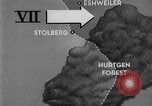
U.S. 4th and 8th infantry divisions enter Hurtgen Forest and 5th and 8th Inf. divs enter into Kleinhau to attack in Germany.
Activities of American first Army in Germany, advancing eastward in late 1944 during World War 2. Animated map shows: 4th and 8th infantry division move out from Stolberg and enter into Hurtgen Forest . U.S. 4th Infantry attack with field guns and artillery. Field gun amidst pile of shells fires toward Hurtgen Forest. 4th Infantry Division troops crawl up a hill in the Hurtgen Forest, sometimes pinned down under enemy German fire. Armor comes to their aid and casualties are treated by medical corps personnel. U.S. Army tanks arrive to support the infantry and they continue forward, where footage shows U.S. mortars and artillery bombing Grosshau, and point of view shot of a U.S. Army machine gun firing at a target in the town of Grosshau. Animated map shows: 5th and 8th Inf. Divisions enter into Kleinhau. Kleinhau is bombarded by a heavy volley of U.S. Army rockets and artillery from units of the 5th and 8th Infantry Divisions. Allied fighter bombers in flight over the area. Artillery is loaded and fired at close-range on target of Kleinhau which was then captured. U.S. Army Soldiers around the ruined buildings of Hurtgen, eating and drinking during a break. Infantry division move towards another towns. U.S. Army soldiers take a moment to relax during the long drive eastward. U.S. soldiers fire mortars from positions along the west bank of the Ruhr.
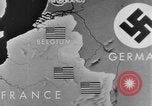
Burial of U.S. POW and Belgian civilians massacred by German troops in Malmedy; Battle of the Bulge scenes, Belgium (WW2)
German troops of KG Peiper advance in Malmedy, Belgium during World War II. A map points out Belgium, Germany and France. Camouflaged German StuG III Assault Guns advance. Flamethrowers used. German soldiers fire at American positions and bombard. German soldiers pass by a U.S. Army motor convoy in flames near Malmedy. The United States Army soldier prisoners of war in the town under German guard. Red Cross personnel examine the bound bodies of U.S. POW that were found and, separately, of Belgian civilians massacred by the German troops near Malmedy (the so called Malmedy Massacre). The dead are buried in a common grave. Wrecked houses and buildings. News headline reads, "3rd Army deep in Germany." Fire blazing in supply depots left by the retreating United States forces. U.S. artillery and antiaircraft guns fired point blank at the advancing German tanks. The U.S. tank guns and machine guns fire over the snow covered battlefield. Smoke arises from firing. U.S. Army Air Force aicraft and German Luftwaffe aircraft engage in aerial dogfight combat. Contrails across sky. U.S. soldiers in snow covered forest of trees in Battle of the Bulge. General Eisenhower visits troops at the front. News headlines about Russians smashing German lines and 40 Japanese ships sunk. Views of dead U.S. soldiers on Belgian battlefield.
The march to U.S. involvement in World War II, during 1940-1941
Presidential Palace in Havana. U.S. Secretary of State, Cordell Hull speaking at the Havana Conference. Flags of Nations attending. Franklin Roosevelt, on May 16, 1940, telling congress to mobilize for national defense. Airplane and engine factories and manufacturing plants. Navy ships being built. U.S. sailors and marines on parade. U.S. soldiers training with mock weapons. Flour bag "bombs" hitting a U.S. Army tank M2. Army trucks labeled "tanks." U.S. Army tanks M3. Empty "Adelphi" brand beer cans used for training. National Guard units Nationalized. President Roosevelt reading first draft numbers under the Selective Service Act. New recruits getting draft notices and physical exams. New soldiers in boot camp. German Ju 87 and Dornier 17 bombers taking off. Animated map showing German air attacks against Britain. View of radio broadcaster Edward R. Murrow in studio as he is describing the "Blitz" from London. German He 111 bomber aircraft in flight during blitz bombing of London, England, United Kingdom. British antiaircraft guns firing. London citizens in underground bomb shelter. British Fire brigades directing water hoses on burning buildings. British warships at sea. U.S. Destroyers transferred to Britain. British Prime Minister Churchill assigning military base rights to the U.S. Assistant Secretary of State, Berle. Brandenburg Gate and German, Italian, and Japanese flags flying in Berlin on September 27, 1940 Hitler greeting Italian Galleazzo Ciano, and Japanese representative Saburo Kurusu. Signing of Berlin Pact. London civilian citizens resting in underground air raid shelters, while the relentless bombing goes on. American Charles Lindbergh talks to an audience and says Britain is losing the war. Next scene shows Wendell Wilkie saying "England will not only survive, England will win!" British people cleaning up after a German blitz bombing run during the Battle of Britain. Fire fighter moving a mannequin from a store among rubble; a large commuter bus on its side and resting against a building in rubble; a British man with a hard hat clearing rubble finds a small British flag and mounts it in a wall. Polls showing increased American support for Britain based on polling between 1936 and 1941.
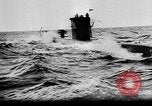
Period before U.S. formal entry into World War II. German submarines torpedo American ships and Japanese attack Pearl Harbor
Preface to U.S. in World War 2. German U-boat on surface. Crew climbing down into submarine and at duty stations while submerged. Torpedo trails bubbles underwater. Ship hit and explodes. Newspaper headlines report torpedoing of American ships: SS Robin Moor, SS Lehigh, SS Sessa, SS Steelfarer, and SS Montana, by German U-boats. Secretary of War, Henry L. Stimson calls on U.S. Navy to secure sea lanes. Wendell Wilkie agrees. U.S. Congress repeals Neutrality Act, November 17, 1941. Deck guns being placed on U.S. Merchantmen. Japanese warships docked and troops entering Indochina, as local people watch.Japanese troops by Dong Dang, near Chinese border. Situation described by animated illustrations.Japanese Special Envoy, Saburo Kurusu, is dispatched to Washington. Pan American Boeing 314 flying boat taking off. Japanese Naval Task Force of warships underway. Kurusu arriving in San Francisco, on November 14, 1941. He steps from the aircraft and makes statement to reporters. Japanese Ambassador, Kichisaburo Nomura, and Special Envoy Kurusu escorted into the White House by Secretary of State Cordell Hull, on November 17, 1941. Japanese troops in China bombarding Chinese city with artillery. November 26, 1941, View of Executive Office Building with statue of Victory atop U.S. Army First Division Monument. Secretary Hull announcing proposal to Japan.The Japanese representatives leaving the White House. Japanese aircraft carriers steaming toward Pearl Harbor. Japanese flight crews getting briefed on December 7,1941. Nakajima B5N (Kate) torpedo bombers taking off and in formation. Secretary Hull at his desk. The aloha tower and aerial view of Honolulu. Sailors at outdoor Sunday service, and relaxing at Pearl Harbor. Vehicle entering Hickam Field. Japanese airplanes bombing Pearl Harbor. Explosions on U.S. warships. USS Arizona (BB-39) suffers direct hit and explosion, as filmed from the deck of U.S. Navy Hospital Ship, USS Solace (AH-5). Shots of pilots and point of view from pilots inside Japanese bomber and attack aircraft, through a mix of dramatized segments from Japanese propaganda films about the Pearl Harbor attack, and real footage from the Pearl Harbor attack. View from Japanese planes bombing and strafing Ford Island. U.S. sailors firing antiaircraft and machine guns down Japanese planes. Secretary Hull describes memorandum from Japanese.
CRITICALPAST.COM: About Us | Contact Us | FAQs - How to Order | License Agreement | My Account | My Lightboxes | Shopping Cart | Advanced Search | Featured Collections | Website Terms & Conditions | Privacy Policy ©2026 CriticalPast LLC.
License Agreement |
Terms & Conditions |
Privacy Policy
©2026 CriticalPast LLC.