


 Francais
 Deutsch
 Italiano
Refine Your Search
US-Gliders- stock footage and images
- Showing 1033 to 1038 of 21920 results more
more Hide
Hide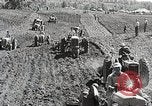
Marshall Plan aid relief to Europe after World War 2; U.S. military participation in NATO operation in Europe
American farmers on farmland with several tractors operating on the field. American men and women work to clear rocks and stones from a farm field. Group of rural neighbors in America working together to construct a barn building (raise a barn). They build the barn and wield hammers. Ships at dock with Marshall Plan food supplies from United States to Europe for post-war recovery after World War 2. Elevated view of main city square in Copenhagen, Denmark soon after World War 2. Busy roads with vehicle, pedestrian, and street car or trolley cars running on roads around the Liberty Memorial obelisk, on Vesterbrogade opposite the Grand Central Station. Crane lifting supplies for rebuilding effort beside some buildings in Copenhagen. Man in Europe cuts grass with a scythe or grass whip. American troops board ships to Europe to join NATO troops in Europe maintaining peace after World War 2. Close up view of group of American NATO forces marching in close ranks. U.S. military forces at NATO Naval headquarters in Norfolk,Virginia. Officer salute at a flag ceremony. Wide view of massive group of U.S. Navy sailors at attention during a ceremony in Norfolk. U.S. Naval fleet in Atlantic ocean. U.S. Navy jet fighter aircraft takes off from Carrier in Atlantic ocean. Camera view as planes take off from camera, and then view from rear facing camera in aircraft as plane takes off from aircraft carrier deck. View of the world's first atomic powered submarine, the U.S. Navy's USS Nautilus (SSN-571). The submarine at sea from an aerial view, and view from submarine of water breaking over its surface. American long range Boeing B-47 Stratojet aircraft parked at airfield. Personnel in control tower flashes light signals to waiting aircraft. A B-47 taxis for take off. American pilots exit personal equipment storage building of 306th Bombardment Wing at MacDill Air Force Base, Florida, and head to their aircraft for a mission. B-47 Stratojet plane taking off.
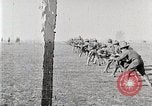
U.S. army troops train to shoot and practice marksmanship skills with rifles during World War I training
Newly recruited U.S. Army troops train for World War 1 deployment. U.S. troops carry rifles and aim during training. U.S. troops practice to aim and shoot in prone position. U.S. troops in a drill session. U.S. troops exercise.
Four new U.S. Security Policemen relieve old ones at Hill 151,Vietnam
Four new U.S. Security Policemen relieve old ones at Hill 151. Old Security Policemen board HH-43B 'Huskie' helicopter. U.S. Security Policeman opens supply package. U.S. Security Policemen carry supply items to observation post overlooking Phu Cat Air Base at Hill 151. U.S. Security Policemen place supplies near the tent post. U.S. Security Policeman looks towards the valley.
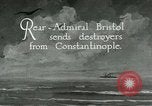
U.S. Destroyers of Naval Detachment in Turkish Waters, assist refugees from catastrophic fire at Smyrna, Turkey.
Destroyers of Squadron 14, U.S. Naval Detachment in Turkish Waters are deployed from Constantinople (Istanbul) By Detachment Commander, Rear Admiral, Mark Lambert Bristol, in response to emergency in city of Smyrna (Izmir). The Destroyer,USS Simpson (DD-221) is seen departing the harbor. Several destroyers of Squadron 14, viewed from one ahead of them, proceeding at high speed in Turkish waters. Background of a slate shows flames billowing over Smyrna at night. View from a U.S. Destroyer, of heavy smoke rising from the port area of Smyrna. Inhabitants are seen along the city pier. Nightime scenes of fires burning all along the waterfront. U.S. sailors are seen helping Greek and Armenian refugees from trucks on the quay, and guiding them across rail yards toward U.S. Destroyers at a dock.An injured refugee is carried on a stretcher by sailors. Aboard a destroyer, sailors assist refugees.One hands out chococlate Hershey bars. Several sailors entertain the refugees by playing banjos. A refugee man dances to the music. Refugees receiving food from an American sailor, on deck of a destroyer, as they approach Constantinople. Several men and women with a large group of Boy Scouts in uniforms on a pier. One Boy Scout carries a large American flag. Several U.S. sailors mingle with the group. The Ortakoy Mosque is seen in the background. The boys are helped from the pier and seated in a barge, which is then pulled by a tugboat, as their adult leaders stand and wave to people on shore. Refugees arriving at village of Bebek. Three Boy Scouts with a pet dog. Women and children being guided aboard a large open boat, flying the American flag. A sailor leads children in calisthenics at American Near East Relief orphanage, in ruins of ancient Temple of Jupiter at Athens, Greece. The children run in supervised exercises. The Acropolis seen in background. Sailors try to calm a crying baby with some candy, to no avail. But they successfully distract the child with pieces of fruit.
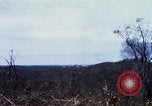
U.S. helicopter downed by enemy ground fire during Operation Jeb Stuart III in Vietnam War
U.S. 1st Air Cavalry Division in action during Operation JEB Stuart III in Vietnam.View from U.S. troop position as U.S. Air Force jet fighter bombers bombing enemy position. Smoke rises from explosion in valley. A U.S. helicopter gets hit by ground fire and crashes in jungle. 1st Cavalry troops watch from their positions as U.S. helicopters swarm around the crash area. A 1st Cavalry Army Captain sits, watching the action.
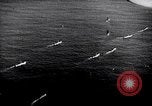
Preliminary U.S. Naval bombardment of Iwo Jima before invasion in World War II
February 17, 1945, Minesweepers move across the beaches of Iwo Jima, where U.S. amphibious landings are to be made. Diagram shows their positions and paths. Minesweepers are seen running parallel to the shore and then with Mount Suribachi behind them. Diagram illustrates Japanese shore batteries pattern of fire at U.S. gunboats. Actual scenes of the gunboats being destroyed and damaged by Japanese fire. At the same time, American reconnaissance swimmers jump from fast patrol boats. U.S. Navy ships begin firing white phosphorus shells to set up smoke screens. U.S. swimmers are recovered, after reconnoitering the beach areas. Gunboat 474 (USS LCI(G)-474) is seen severely damaged. Stretcher bearers seen on deck of a U.S. ship. Diagram shows the plan to employ naval gunfire from the battleships, Idaho, Nevada, New York, and Tennessee, at close range, against Japanese shore batteries. Numerous views of gunfire from those battleships.
CRITICALPAST.COM: About Us | Contact Us | FAQs - How to Order | License Agreement | My Account | My Lightboxes | Shopping Cart | Advanced Search | Featured Collections | Website Terms & Conditions | Privacy Policy ©2026 CriticalPast LLC.
License Agreement |
Terms & Conditions |
Privacy Policy
©2026 CriticalPast LLC.