


 Francais
 Deutsch
 Italiano
Refine Your Search
US-Gliders- stock footage and images
- Showing 1039 to 1044 of 21920 results more
more Hide
Hide
U.S. warships fire moving barrage of naval gunfire to support amphibious assault on Iwo Jima in World War II
World War 2 invasion of Iwo Jima by U.S. amphibious forces. U.S. warships continue bombardment of Japanese fortifications on Iwo Jima, but cease temorarily, allowing U.S. air strikes. U.S. dive bombers attacking Japanese positions.The Cruiser USS Indianapolis (CA-35) is seen maneuvering close to shore. U.S. gunboats firing barrages of rockets that saturate the beach with explosions. Diagram illustrates the way heavy naval gunfire overhead is coordinated with advancing amphibious craft. Views of landing craft and battleships firing overhead in a moving barrage. Landing craft arriving at the beach.
Japanese fortifications destroyed by U.S. naval gunfire on Iwo Jima, Japan, during World War II..
Post-invasion views of Japanese fortifications destroyed by U.S. Naval gunfire prior to the U.S. amphibious assault on Iwo Jima in World War 2. Remains of Japanese defensive positions on Iwo Jima. Steel-reinforced concrete fortifications, including pill boxes, heavy gun emplacements, and block houses, destroyed by U.S. naval heavy guns. A marine stands near destroyed concrete bunker. U.S. Flag flies high above the scene. U.S. battleships underway at sea.
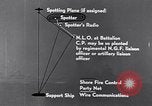
Coordinating naval gunfire during U.S. invasion of Okinawa in World War II. Destroying enemy caves and hideouts
Animation graphic describing how land sea and air information was coordinated to enable precise targeting of enemy positions by naval gunfire during the U.S. invasion of Okinawa, Japan in World War 2. U.S. minesweepers enable capital ships with heavy guns to safely operate close to enemy targets. Views of heavy naval gunfire. Advance of the Marine 3rd Amphibious Corps. U.S. troops, advancing slowly, routing out Japanese defenders dug in to caves and holes throughout Okinawa. Naval heavy guns were called upon to destroy these caves. Detailed live images include: Mine sweepers off Okinawa, sweeping for mines; heavy cruiser USS San Francisco, CA-38, under a head of steam and using signal lights; battleships fire at Okinawa; A bow view of a Tennessee Class battleship; battleship USS Nevada, BB-36, fires its main battery; closeup of a Cleveland Class light cruiser's main aft battery firing at Okinawa; stern view of the heavy cruiser USS Pensacola, CA-24, fires her aft main 8-inch/55 main battery; U.S. Marines on the march and blowing up caves; battleship USS New York, BB-34, fires her main battery; time 03:36 shows a Cleveland Class light cruiser firing its forward main 6-inch battery; time 03:30 shows the USS New York, BB-34, again; various naval guns fire and explosions on Okinawa are shown; time 04:08 shows the forward main deck, looking aft, of the USS Nevada, BB-36, with a Tennessee Class battleship in the background.
U.S. Battleships fire at Japanese defenses during the battle for Okinawa, Japan, in World War II.
U.S. Battleships fire at Okinawa, Japan. A map shows the area of operation of the land forces. 483 Japanese artillery pieces located in the area. U.S. tank destroyed by Japanese artillery fire. Japanese antiaircraft fire interferes with U.S. observation planes. U.S. naval gunfire from ships was able to destroy 120 Japanese artillery emplacements. An airplane in flight. Many views of U.S. naval gunfire. Views of destroyed Japanese heavy artillery.
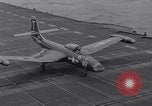
U.S. Navy Training film about recovering aircraft that return to carriers, at sea.
Film illustrating proper technique for recovering jet aircraft as they return to land on U.S. Navy aircraft carrier. A U.S. Navy F2H Banshee airplane lands on carrier flight deck. View of green shirt arresting gear deck crewman greasing an arresting cable to reduce friction for higher speed engagement in jet landings. More views of F2Hs landing. One fails to engage any of seven restraining cables and crashes into the barrier. An F6F airplane engaging cables as it lands on a carrier. View of jet nose passing under top cable of conventional barrier. "Davis"-type barrier used for jet airplanes. View of jet that passed all barriers and crashed into other aircraft. The deck covered in foam from firefighters. View of a Banshee jet crashing, bursting into flames, and falling in pieces off the flight deck. Deck crewmen surround a jet after engaging a Davis barrier. They disengage cables and push the aircraft clear of the deck. Arresting gear deck crewmen seen stowing a damaged Davis barrier. Adapting conventional barriers for use with jets by lowering them. More F2H landings. Landing signal officer with paddles. View from carrier deck of jet on final approach. View from an aircraft on final approach. F2H landing on the USS Coral Sea (CV-43). Taxiing after landing. An F9F that passed the barriers, being stopped and signalled to fold wings. Animated sketches of jet aircraft rocking and tilting. Deck crewmen chocking wheels and latching nosewheels. Firefighters foaming a jet when its engines would not shut down, and fuel continued to flow. View of damaged jet engine turbine wheel. An F6F landing on the carrier. F4U Corsairs, with folded wings, being moved by tug on deck. Views of poisonous lead compound powder on inside of jet engine tailpipe. Maintenance crewmen waxing wings of jet aircraft. Red shirt armament crewmen rearming a jet. Purple shirt aviation fuel crewmen refueling jets, mixing jet engine fuel with oil and spreading wings to refuel tip tanks. Use of a special wing-side ladder to refuel tip tanks on jets where permissable. Diagram of carrier illustraing proper method of spotting jets and conventional aircraft on deck. A Marine F2H being brought up on elevator. Deck crewmen pushing a jet backwards. Summary of jet handling techniques, with brief glimpses of actions being described. Formation of jet planes flying overhead.
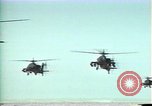
Various U.S. weaponry firing on Iraqi enemy targets during Operation Desert Storm
U.S. Army helicopters in flight over Iraq during Operation Desert Storm in the Persian Gulf War. Camera views at night of targets being destroyed by "smart bombs" and rockets. Targets include buildings and tanks. U.S. tanks move on the desert. Destroyed Iraqi tanks in desert. Smoke from the destroyed tanks. U.S. Army infantry soldiers running near a U.S. tank. Battery of rockets rotating atop a U.S. Army launcher. Images of tanks and artillery firing on targets.
CRITICALPAST.COM: About Us | Contact Us | FAQs - How to Order | License Agreement | My Account | My Lightboxes | Shopping Cart | Advanced Search | Featured Collections | Website Terms & Conditions | Privacy Policy ©2026 CriticalPast LLC.
License Agreement |
Terms & Conditions |
Privacy Policy
©2026 CriticalPast LLC.