


 Francais
 Deutsch
 Italiano
Refine Your Search
US-Gliders- stock footage and images
- Showing 1045 to 1050 of 21920 results more
more Hide
Hide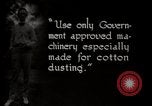
Dramatization: Government expert demonstrates the use of different dusting machines to people in United States.
Dramatization: Calcium arsenates spray to combat Boll Weevils in United States. A Government expert addresses the people about the use of different dusting machines at the Deer Park. He says that only the government approved machines should be used for the purpose. Men on engine power machine, the machine not suitable for the purpose of dusting. A cart duster can be used for the purpose. The cart duster is a two mule, two wheel and three nozzle machine. Man on a cart duster. Another man stands nearby. He sprays poison with the cart duster in a large field. Men stand near a one mule machine. Trees in the background. Small fields dusted by the one mule machine. Hand guns can be used where the horse-drawn machines cannot be used. Men dust pesticide on a small field with hand held dusting guns.

German propaganda film showing Luftwaffe prowess defending against U.S. daylight bombing operations in World War II
Formation of U.S. Army Air Forces B-17s on a bombing raid into Germany during World War 2. A formation of U.S. P-38 fighter aircraft escorting the bombers. German Me-109s engage the U.S. Army Air Force P-38 fighter aircraft in dogfights. German gun camera view of B-17 being fired upon. Several German FW-190s in the air. Gun camera view of B-17 having its wing shot off and another being raked with gunfire by a German fighter plane passing from behind and over it. View of a German Me-109 and gun camera showing B-17 being shot to pieces from behind. A U.S. Douglas Dauntless aircraft in flight, and one being shot at by a German FW-190. Formation of USAAF B-24 Liberator bombers viewed from behind. More gun camera footage of FW-190 shooting a B-17 from behind, putting one engine out of commission and severly damaging it. More Me-109s in flight. More B-17s being shot from behind. One dramatic shot of a U.S. B-24 Liberator bomber being attacked by a German plane, from the front and top. A B-17 being shot and burning. Footage includes occasional views of German pilots in cockpits pressing gun firing buttons on the control stick.
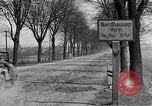
U.S. troops mingle with German residents in Nordhausen, Germany. Views of destroyed buildings
A U.S. Army jeep drives past a road sign reading "Nordhausen, Harz." American GIs are seen mingling with German town folk in front of the Hasselee Hof. Two American soldiers talk with German girls. One soldier points to a tag with letter "P" on one girl's coat. A U.S. soldier drinks a small glass of spirits poured by a German workman, from a large wicker-covered container. U.S. soldiers wash and shave by a tank in front of a destroyed building. U.S. soldiers with army vehicles parked in the town. U.S. troops walk along sidewalk in Nordhausen. Views of many destroyed buildings. (World War II period).
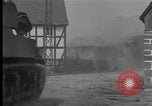
U.S. Army 7th armored division in action near Westenfeld Germany, and German civilians fire fighting
Troops of the U.S. Army 7th Armored Division pass by Westenfeld Germany. Townspeople at road side work to put out a fire using a manual pump on wheels. View of a German civilian holding the firehose and spraying water at a burning building. U.S. troops pass through on various military vehicles. U.S. troops march along a road. View of a large fire burning in the foothills above the road. Troops atop tanks and other vehicles pass. U.S. troops take cover in ditches along roadside. Smoke arises from the wreckage of a house in Westenfeld. An injured, burned pig hobbles out of a burning building. Civilians including men, women, children race to a water pump and work to extinguish the fire. (World War II period).
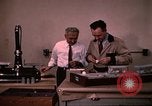
Technicians use live, chemical and physical tools to measure nutrition value at the Beltsville Research Center in Maryland.
Research work by the Bureau of Human Nutrition and Home Economics Service (United States Department of Agriculture). Chief of the Bureau Dr. Hazel K Stiebeling talks about research in the field of food and nutrition at the Beltsville Research Center in Maryland. Laboratory technicians compare the nutritive value of foods. They measure the growth of a chicken using a machine, and that of a rat using an apparatus. A technician measures certain vitamins and amino acids using micro organisms in test tubes. Technicians use chemical methods to measure Vitamin C and small food proportions. A photoelectric calorimeter is used to measure carbohydrates in a food.
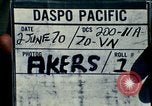
U.S. Army soldiers saw and fell logs to construct bunkers at a Camp Carroll FSB in Vietnam.
Construction and use of bunkers on Fire Support Bases (FSB) by U.S. Army soldiers in Vietnam. U.S. soldiers construct duel blade bunkers at FBS Charlie One at Camp Carroll. Logs fixed vertically into the ground. Soldiers use chain saw to cut log piles used to support the bunker wall. A rope tied to a log. Soldiers fell logs by pulling the ropes. Construction machinery and equipment around. A bucket loader drives to the top of a bunker and dumps load of fill. (Vietnam War period).
CRITICALPAST.COM: About Us | Contact Us | FAQs - How to Order | License Agreement | My Account | My Lightboxes | Shopping Cart | Advanced Search | Featured Collections | Website Terms & Conditions | Privacy Policy ©2026 CriticalPast LLC.
License Agreement |
Terms & Conditions |
Privacy Policy
©2026 CriticalPast LLC.