


 Francais
 Deutsch
 Italiano
Refine Your Search
US-Gliders- stock footage and images
- Showing 11335 to 11340 of 21913 results more
more Hide
Hide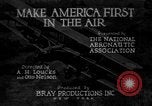
Reduction in time taken to cover distance between places due to the development of air power in the United States.
A film titled 'Make America first in the air' on the development of air power of the United States. Animated map of the U.S. with a line from New York to Kansas. A covered wagon train of settlers moving west along desert terrain, depicting the Santa Fe Trail of 1849. Mountains in the background. Animated map of the U.S. with a line from New York to Kansas, and continuing through New Mexico and Arizona to California. Railroads decreased the time taken to cover the distance between the places to four days. A train using a steam locomotive moves to the right along a double track. Animation over a map of the U.S. with a line from New York to California. Airways further reduced the time taken to cover the distance to 27 hours. A U.S. Army Air Service Fokker T-2 aircraft in flight.
A modified Airco DH-4 aircraft loaded with mail sacks in flight in the United States.
Aircraft are used for different purposes in the United States. The U.S. Air Mail Service makes use of commercial aviation. Workmen place mail sacks in the front cockpit of a U.S. mail service modified Airco DH-4 aircraft. A pilot in the back cockpit. The aircraft takes off. Animation shows a small aircraft going over a line on a map from New York across the United States. An early model U.S. mail service aircraft in flight. Animation of a small airplane traveling along a line on a map from New York to San Francisco. Chicago, Omaha and Cheyenne highlighted on the map.
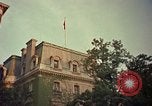
Nikita Khrushchev hosts a banquet at the Soviet Embassy in Washington DC while on a visit to the United States.
Soviet Premier Nikita Khrushchev on a visit to the United States. Exterior of the Soviet Embassy in Washington DC. People at a formal banquet hosted by Mrs. And Mr. Khrushchev. U.S. Vice President Richard Nixon and his wife arrive for the banquet. U.S. President Dwight D. Eisenhower and his wife also arrive. They pose with dignitaries. Khrushchev in a railroad towards New York. Soviet Ambassador to the U.S. Mikhail A. Menshikov and U.S. Ambassador to the Soviet Union Llewellyn E. Thompson with him. The train rushes past rivers, farms, factories, towns and market places. We see his train passing through a station in Newark New Jersey. Mr. Khrushchev waves to people from the window of the train. Khrushchev's motorcade escorted by police escorts rolls through the streets in New York. People on the side of the streets to watch. Mr. Khrushchev addresses people at mayor's luncheon. He talks about peace and relations between the Soviet Union and the U.S. People applaud. New York Governor Nelson Rockefeller welcomes him.
America fully mobilized in World War II
Opening slate announces 11 million Americans to bear arms (in World War 2.). U.S. Army Chief of Staff, General George S. Marshall conversing with Chief of Naval Operations, Admiral Ernest King. Next, Admiral King is seen standing with Commanding General of the U.S. Army Air Forces, Lieutenant General Henry H. (Hap) Arnold, and Admiral William D. Leahy, Chief of Staff to the President of the United States. Scene shifts to a graduating class of cadets from the United States Military Academy, at West Point. They are seen receiving their diplomas. West Point cadets are also seen cheering at an athletic event and in several views of them marching in formations on different occasions. Views of cadets from the U.S. Naval Academy, at Annapolis, Maryland, on parade and at a graduation ceremony in Dahlgren Hall, where each receives a diploma and they toss their hats into the air at the end of the ceremony. Next, ordinary citizen soldiers (mostly draftees) are seen marching in formation They participate in calisthenics en masse. Heavyweight boxing champion, Gene Tunney, is seen leading an exercise session. Soldiers run over an obstacle. Next cadets are seen on parade in the U.S. Merchant Marine Academy, at Kings Point, New York. Some cadets are seen practicing escape from a burning vessel at sea. U.S. soldiers engage in field training that includes live weapons fire above their heads as they crawl under barbed wire on a training course. View of soldier firing a Browning M1917 water-cooled machine gun near the trainees. Another is firing a Browning M1919 air-cooled machine gun.

Lend Lease materials transported across the world by convoys of American and British ships in World War II
Opening scene shows Lend Lease military equipment covered with canvas, at a port in the United States, during World War 2. A B-26 bomber with wings removed outboard of its engines, is being maneuvered for shipment at a port in the United States. A Lockheed P-38 airplane is moved on a crane and then rolled along a pier toward the stern of the U.S. Light Cruiser, USS Phoenix (CL-46) which is docked there. Wings of a Curtiss SOC-1 Seagull scout plane can be seen on the Phoenix. Two more P-38 aircraft are rolled along the pier, past another Brooklyn class Light Cruiser at the end of the pier. (Her triple 6-inch gun turrets are noticeable.) Crated supplies are seen being lowered into ship cargo holds. An American M2 light tank being lowered from a crane. An American M3 Lee tank being secured in a ship. Numerous tanks in a ship’s cargo hold. Next, a convoy of ships carrying war materiel overseas is seen at sea. A U.S. Cruiser plunging through heavy seas. View from her bridge overlooking her triple gun turrets, as her bow is awash in waves. A formation of U.S. battleships, led by a Nevada class Battle Ship armed with twin over triple forward gun turrets. She is followed by what appears to be a modernized Pennsylvania class Battleship and other battleships. A British Battle Cruiser followed by another British warship. Various Allied battleships firing their heavy guns. Animated map tracing the “Lend-Lease” routes across the North Atlantic to Iceland, the British Isles, and Murmansk. Map also shows routes by sea and air to the West Indies, Brazil, and South Africa and West Africa, and then by air across Africa, to egypt and the Middle East. Other routes are shown to Suez, Iran, India, and China, as well as trans-Pacific routes to various places. American soldiers crowd the upper deck of a troop transport ship. A military chaplain conducts religious services aboard ship at sea. More views of ships in convoys. A U.S. Navy Kingfisher float plane in flight over the water. A barrage balloon aloft. A U.S. Navy Catalina PBY flying boat in the air above a fleet of supply ships in a vast convoy.
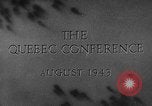
British Prime Minister Winston Churchill in many meetings before and after America's entry into World War II
Opening slate reads: "Quebec Conference August 1943." The English battleship, Prince of Wales, is seen in fog off the Coast of Newfoundland, in August 1941. View of sailor on fore-deck of the British ship. View inside engine room of the ship where sailor manipulates her power. Closeup of engine crankshaft stopping as she drops anchor in Placentia Bay. View of Prime Minister Winston Churchill, greeting U.S. President Franklin D. Roosevelt aboard the Prince of Wales. He proffers a letter to the President, from the King of England. View of Roosevelt and Churchill seated on deck with their respective military leaders standing behind them. Admiral Ernest King, U.S. Chief of Naval Operations converses with U.S. Army Chief of Staff, George Marshall, as they stand behind Churchill and Roosevelt. Wider camera view shows the larger military entourage accompanying the Prime Minister and the President. Glimpse of prisoners and enslaved workers taken by Nazi Germans in Europe. Glimpse of bombs falling from an airplane. Classic film views of the Japanese attack on Pearl Harbor in December 7, 1941. Bombs exploding along "Battleship Row." Heavy smoke rising from the bombed ships. The USS Arizona tilted heavily and burning. Camera pans along the path of destruction, as the voice of President Roosevelt is heard in the background, asking the Congress to declare that the Japanese attack created a state of War between the United States and the Japanese Empire. View of President Roosevelt speaking to the U.S. Congress. Seated behind him are Vice-President Henry Wallace and Speaker of the House, Sam Rayburn. Glimpse of Congress members applauding. Change of scene shows President Roosevelt and Winston Churchill meeting in Washington, DC, in December of 1941, during World War 2. Views of war preparations in the United States, including the building of new war production plants and facilities. A large steel ingot being forged into an artillery gun barrel. Machinist at work turning a gun barrel on a lathe in a munitions factory. Views of manufacturing plants in operation and steel being made. A railroad train carrying new Army trucks. Another meeting of Churchill and Roosevelt in Washington, D.C. June, 1942. Standing behind them is President Roosevelt's special assistant, Harry Hopkins, a British naval officer, and an American navy Captain. American soldiers boarding a troop ship, and closeups of them as they enter the ship, looking out of portholes, and waving from the ship's deck. Glimpse of Washington Monument and its image in the reflecting pool in Washington DC. Closeup of a book entitled, "Time Table for Invasion." General George Marshall with several of his generals doing preliminary planning. Series of scenes involving senior military officers engaged in war planning. A convoy of warships is seen at sea during the Operation Torch Allied invasion of French North Africa during 8–16 November, 1942. Views of Allied Navy ship guns firing. Allied troops riding in landing craft, and advancing from beached craft on shore of Algiers. Aerial view of a flight of Douglas Dauntless bombers in formation. "Bombs away" view from Allied airplane dropping bombs. Allied troops firing camouflaged antiaircraft guns from sandy positions near shore. Enemy shells or bombs exploding nearby. Two U.S. Army soldiers holding a document in French entitled, "Message from the President of the United States.
CRITICALPAST.COM: About Us | Contact Us | FAQs - How to Order | License Agreement | My Account | My Lightboxes | Shopping Cart | Advanced Search | Featured Collections | Website Terms & Conditions | Privacy Policy ©2026 CriticalPast LLC.
License Agreement |
Terms & Conditions |
Privacy Policy
©2026 CriticalPast LLC.