


 Francais
 Deutsch
 Italiano
Refine Your Search
US-Gliders- stock footage and images
- Showing 1135 to 1140 of 21920 results more
more Hide
Hide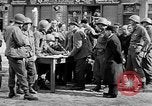
U.S. soldiers interact with German civilians in Munich during occupation of Germany after World War II.
Training film for U.S. soldiers during occupation of Germany after World War 2, guiding them on their role of "reeducation" and restoring normal life to civilians in Germany after World War II. U.S. soldiers seated and Germans standing around them talking to the solders. A German MG Police officer outside a building. A German police officer monitors citizens in a line. Germans talk to U.S. soldiers outside the Office of Military Government for Bavaria, in Munich. The U.S. soldier reviews their identification papers and questions them. German children at play. A smiling American soldier seated with a group of young German children around him. A group of German boys plays baseball on the lawn in front of the largely destroyed Altes Armeemuseum in Munich (later home to the Bayerische Staatskanzlei or Bavarian State Chancellery) in Greek architectural style with six prominent ionic columns. A U.S. soldier talks to German civilians. Soldiers talking with German men , women and children. A soldier frisks men and women entering a secure area. German police grab and restrain a German citizen for some offense and escort him away. Young children seated and learning at an outdoor class. The children standing and smiling.
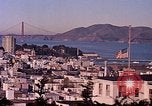
President Lyndon B. Johnson leaves the House of Representatives chamber in the U.S. after first address to Congress
U.S. President Lyndon B. Johnson takes new responsibilities as the President in an atmosphere of grief in the U.S, following the assassination death of President John F. Kennedy. Elevated sweeping view of city of San Francisco, with a flag at half staff in the foreground and bridge, bay, and mountains in the background. Flags waving at half mast on the grounds of the Washington Monument in Washington DC. U.S. flag at half staff over the Supreme Court. View inside the House chamber of the U.S. Capitol. The House of Representatives members stand and applaud for President Johnson as he leaves the chamber following his November 27, 1963 address to Congress. Citizens of the United States descending the stairs of the U.S. Capitol, after viewing the coffin of President Kennedy lying in state.
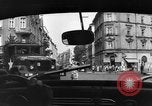
U.S. Military police (MP) direct trucks, tanks, amphibious vehicles at beachhead in Normandy, France, in World War II.
Activities of the U.S. Army Military Police. (Introductory scenes, from 1950 : A U.S. Army truck collides with a VW Beetle automobile in Europe. Local onlookers speak with the man and woman from the car. Local police arrive on scene. U.S. Army Military Police arrive and help resolve the matter with local police. ) U.S. Army Military Police insignia of two crossed flintlock pistols. A Military Policeman at attention. Military Police (MP) directing trucks and amphibious vehicles at a beachhead in Normandy, France, in 1944. U.S. Landing Craft at the beachhead. MPs directing military traffic in Town of Canisy, France.
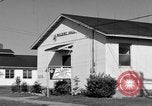
U.S. Military Police experts at work in the Criminal Investigation Laboratory, Fort Gordon, Georgia, United States.
Activities of the U.S. Army Military Police at U.S. Army Criminal Investigation Laboratory, Fort Gordon, Georgia, United States. A sign: 'U.S. Army Criminal Investigation Laboratory, Commanding Officer , Document and Fingerprint Section, Administrative and Firearm section'. SP-6 Holford, at his desk, examines a pistol. He shows how each weapon barrel creates distinct markings on bullets. Chief Warrant Officer-4, R.F. Roscoe at his desk. He moves to the laboratory, where he applies flame to a weapon, bringing out fingerprints on it. Laboratory personnel demonstrate use of other devices, including special photographic equipment, used to link weapons to crimes.
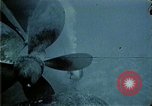
Carl M. Brashear dives into deep sea water and works in Naval and Salvage department of the Naval Safety Center in the U.S.
Carl M. Brashear, a Master Diver in the U.S. Navy, demonstrates his bravery and determination after an injury in the U.S. Carl M. Brashear, an decorated African American U.S. Navy Master Diver works in deep sea water and examines a sunken aircraft. Men assist him in donning underwater diving gear. A submarine underway at sea. Carl Brashear aboard a ship. He jogs, running with a prosthetic leg, although he sustained an injury during a salvage operation which resulted in the amputation of his leg . He does physical exercise lifting weights and boxing with a punching bag for physical fitness. Brashear, in scuba gear, descends from a dock into ocean water. Brashears in U.S. Navy walks into a building at the Naval Safety Center in Norfolk, Virginia. He enters the department of 'Naval and Salvage' at the Naval Safety Center. He works in his office. He instructs U.S. Navy students in a classroom. Brashear talks about his views on his injury and how he motivates himself. Sailors assist Carl Brashear in preparing for a dive, and he is seen underwater during a dive.
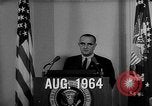
1964 Gulf of Tonkin incident brings the U.S. into direct, active involvment in the Vietnam conflict
U.S. President Lyndon B. Johnson on August 4, 1964, announcing that he is ordering U.S. military forces to respond to an incident involving hostile action by North Vietnamese in the Gulf of Tonkin. View of the U.S. Aircraft Carrier, USS Constellation (CV-64) underway in the Gulf of Tonkin, off Vietnam. Next, pilots are seen walking on flight deck of the carrier,USS TICONDEROGA (CVA-14). Behind them are A-3B Skywarriors of VAH-4 "Fourrunners," Det. B (tail code "ZB"). One displays BuNo 142255. Clear view, from another aircraft overhead, of a U.S. carrier-based Douglas A-4 Skyhawk aircraft diving and firing a rocket at a target in North Vietnam and pulling out over hills afterwards. View of another rocket headed toward a target in hills, followed by fairly close views of an A-4 making another attack. U.S. Secretary of Defense, Robert MacNamara, broadcasting that "We seek no wider war."
CRITICALPAST.COM: About Us | Contact Us | FAQs - How to Order | License Agreement | My Account | My Lightboxes | Shopping Cart | Advanced Search | Featured Collections | Website Terms & Conditions | Privacy Policy ©2026 CriticalPast LLC.
License Agreement |
Terms & Conditions |
Privacy Policy
©2026 CriticalPast LLC.