


 Francais
 Deutsch
 Italiano
Refine Your Search
US-Gliders- stock footage and images
- Showing 13045 to 13050 of 21917 results more
more Hide
Hide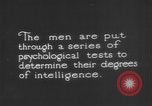
American military recruits for World War I undergo psychological tests in United States.
Draft and mobilization activities for U.S. Army soldiers of World War 1 in 1917-1918. American military recruits undergo psychological and mental acuity tests to determine their intelligence and ability to serve as soldiers. They undergo attention and observation tests. Figures drawn on a board as an instructor guides them, and Army recruits write on papers. Recruits must rapidly pick up their pencils on cue in a test of alertness. Rejected recruits discharged with payment and a discharge letter. The discharged soldiers stand in line at pay window. Close-up view of U.S. Army honorable discharge certificate. Slates indicate that most soldiers participated in the life insurance plan that was offered. Scene of soldiers seated at tables as they write letters home.
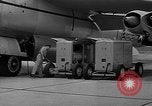
Boeing aircraft plant in United States.
Wright Air Development Center in Ohio, United States. Electric engine generator used for firing the engines of the B-47 as officer starts its operation. A small cylinder holding hydraulic fluid hit by unseen object, a flame erupts and it burns up immediately. A B-47 aircraft lands at Wright Patterson Air Force Base. A parachute brakes trail behind as the aircraft lands. Boeing aircraft manufacturing plant with the nose section of B-47 aircraft protrudes in the scene, large shaping machine in the foreground. Operator shapes section of an aircraft fuselage at production factory. A typist at desk. A young woman operates a mimeograph machine. Civilian men office workers wearing suits sit at desks and confer on drawings and plans for aircraft. A man gets into a U.S. mail carrier cab. A young woman operates an adding machine and makes entries into a ledger. A steno and a woman Air Force officer file cabinets. A mechanic works on an electrical generator section of wind tunnel. A worker takes out books at a library, a female worker cuts out sections of Photostats from large roll. A document marked secret. Women Air Force officers assemble sections of paper work on aircraft. File clerk files up paper work on project. Air Force Officer and a civilian contractor discuss plans.
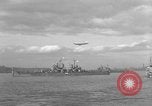
Various ships salute USS Franklin D Roosevelt air craft carrier (CVA-42) by firing guns,Navy Day, New York City, United States.
The United States aircraft carrier Franklin D Roosevelt (CVA-42) commissioned in New York City, United States. A dirigible flies overhead. Ships of the U.S. Navy Fleet in the Hudson Riverj. . A dirigible flies overhead. The USS Macon (CA-132) fires salutes. Guns on United States Enterprise (CVS-6) fire salutes, with sailors lined up on the flight deck. Dirigible flies overhead. Ships of U.S. Navy Fleet in the Hudson River. A bridge in the background. (World War II period).
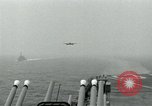
British Royal Navy Supermarine Attacker F1 aircraft practice touch and go landings on the angled deck of the USS Antietam (CVA-36) in 1953.
British Royal Navy Supermarine Attacker F1 aircraft is seen approaching to land on the U.S. Aircraft Carrier, USS Antietam (CVA-36) during British Navy practice carrier operations using her angled flight deck, in 1953. Anti-aircraft guns on the Antietam are seen in foreground. The aircraft bounces upon touchdown and immediately continues in a touch and go landing. Another (or the same) Supermarine aircraft repeats a similar touch and go landing. A third British Attacker aircraft approaches to land, but rounds out too high and simply goes around. The next one seen executes a perfect touch and go but the one behind it fails to "touch" before continuing, as does the next one trying a touch and go. The next one makes a smooth touch down before proceeding to go. The final scene shows a Supermarine Attacker F1 aircraft touching down and staying there, in a full stop landing employing arresting gear.
Precautions to be taken during a gas attack in United States.
'What to do in a gas attack' A dramatization shows the precautions to be taken in event of a gas attack and the first aid measures to be used after the gas exposure. Newspaper headlines about the gas attacks, a gas alarm sounds. Plane drops gas bombs and smoke rises. Various precautions to be taken in case of a gas attack like closing the windows and other openings in the house. A man and woman move upstairs in the house to escape fumes. In case of liquid gas attack, gas spreads and men of the United States Citizens Defense Core neutralize the gas. Men wearing protective clothing and masks wipe off the gas. A sign reads 'gas mustard'. Men neutralize the crops in a field after a gas attack. After a liquid gas attack a man removes his clothes and shoes before entering the house as a preventive measure. Removes liquid gas from the skin by blotting with a tissue, tissue thrown in a bin. Exposed skin cleaned and rinsed with bleaching solution. A baking soda solution containing water used to irrigate eyes. Man takes a shower and soaks himself up. Nose irrigated with baking soda solution. Man gargles with the solution. Man smokes a cigarette and lies down to prevent exertion. A man of the United States Citizens Defense Core takes away the clothes lying outside the house for treating them. (World War II period).
Supplies transported to flood victims in United States.
U.S. Coast Guard sailors lined up to board a railroad train in United States, bound for a flood ravaged area. Boats loaded on flat railroad cars and the train moves away to flooded area providing relief to the victims. A large stadium seen in the background. Supply boxes piled up, men load boxes of relief supplies onto a U.S. Coast Guard airplane. Aircraft takes off to provide supplies to flood victims.
CRITICALPAST.COM: About Us | Contact Us | FAQs - How to Order | License Agreement | My Account | My Lightboxes | Shopping Cart | Advanced Search | Featured Collections | Website Terms & Conditions | Privacy Policy ©2026 CriticalPast LLC.
License Agreement |
Terms & Conditions |
Privacy Policy
©2026 CriticalPast LLC.