


 Francais
 Deutsch
 Italiano
Refine Your Search
US-Gliders- stock footage and images
- Showing 1399 to 1404 of 21920 results more
more Hide
Hide
U.S. troops disembark ship, they talk to Indians and make preparation to protect India.
U.S. troops arrive in India during World War II. Convoy of troops ships arrive in India. British army on deck of ship. Crane hoist British soldiers. Military equipment and supplies are lined up. Troops in large numbers stand in attention. U.S. troops disembark ship. Military equipment is unloaded. U.S. soldiers move in streets of India. U.S. troops talk to Indians to learn their language. They make tents, workers work in tent city. Bombers being tested. Troops march at a parade.
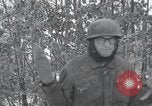
German prisoners questioned,and wounded carried by U.S. soldiers in Bastogne,Belgium during the Battle of the Bulge of WWII.
U.S. 6th Armored Division in Bastogne, Belgium during the Battle of the Bulge of World War II. Opening scene shows German soldiers surrendering from positions in the forest. Snow covers the ground and they emerge with hands up. A group of German prisoners under guard. U.S. soldier comes upon a German foxhole. Camera shows a wounded German soldier lying on a bed of straw in the trench. Next scene shows U.S. troops carrying a wounded on a stretcher. Scene shifts to group of German prisoners of war assembled outdoors, under guard by U.S. soldiers. Several German officers are interrogated separately. Then other German prisoners are seen being interrogated. A sizeable group of German prisoners is escorted under guard across snowy field.

U.S. civilians are freed by communists after imprisonment and brain washing by Communist China
The People’s Republic of China releases detained U.S. civilians in the Chinese border with British colony of Hong Kong. U.S. civilians cross "Bamboo Curtain," arriving to freedom in Hong Kong. U.S. civilians are freed by the Communist Chinese government after imprisonment and brain washing. Civilians include Catholic Church missionary Father Harold Rigney, Rector of the University of Beijing. A young naval intelligence officer and Fulbright Fellow student at Beijing University named Walter Allyn Rickett and his wife Adele are among the released prisoners. Former U.S. Flying Tiger pilot Lawrence Buol shows happiness after his release from China. Buol sits while Rickett drinks a bottle of soda after their release.
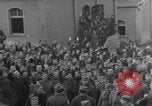
Group of US, Czech, Russian, Yugoslavian prisoners cheering, waving and laughing at liberation of OFLAG XIII-B Camp Hammelburg (WW2)
Freed Allied prisoners of war at OFLAG XIII-B, known as Camp Hammelburg, outside of Gemünden, Germany during World War II. A group of United States, Czech, Russian, Yugoslav prisoners of war standing together along with the liberating 14th U.S. Armored Division soldiers. Two prisoners talk to each other. The prisoners cheering, waving and laughing. Two prisoners walk down the road smiling; one waving a copy of Yank Magazine, the other a chunk of bread. U.S. Amry M-4 tank crashes through barbed wire fence of Camp Hammelburg. A group of freed prisoners gathers. Several prisoners stand and pose. Mass gathering of elated former prisoners. Freed prisoners of war dash toward U.S. soldiers and embrace them. (Note: This was the conclusion of the originally failed "Operation Hammelburg", initially attempted by "Task Force Baum," under Captain Abraham Baum, ten days prior. Inmates at the camp included the recently injured and captured Captain Baum, and Lieutenant Colonel John K. Waters, son in law of U.S. Army General George Patton. LTC John Waters was injured during the initial rescue attempt 10 days prior and was hospitalized and not seen in this film.)
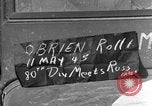
Russian soldiers raise Russian flag, and U.S. and Russian officers raise a toast in Liezen, Austria.
United States Army 80th Infantry Division meets Russian troops in Liezen, Austria. Russian soldiers over bridge. Russian soldiers raise Russian flag next to the U.S. flag on bridge. Soldiers standing in attention. U.S. and Russian officers inspects formations of U.S. and Russian troops. Russian and U.S. Generals raise a toast to one another. (World War II period).
Mixture of scenes from various U.S. amphibious assaults on Japanese occupied islands in the Pacific during World War 2
First scenes show United States Marines riding in a landing vehicle tracked (LVT) heading toward a Japanese occupied island in the Pacific. View from one of the landing craft of heavy smoke obscuring the island coast. Next, a dozen landing craft from the USS George Clymer (APA-27) are seen with mountains of the target island looming in the background. View from a different perspective shows several landing craft heading toward an inlet to the island. View from a landing craft of a Japanese Mitsubishi A6M "Zero" airplane flying overhead. Closeup of American soldiers in a landing craft headed toward a different Japanese occupied island. U.S. soldiers leaving a landing craft in the surf. View from inside a landing craft as U.S. Marines head ashore. Soldiers splashing in the surf. Troops wading ashore. Soldier dug in on beach near underbrush, firing many round from his Browning M1919 machine gun. Marine firing his rifle behind a palm tree. Troops seeking cover at very edge of shore. Some lying in the water, before moving on. A soldier firing an automatic weapon through foliage. A bomb explodes near an invasion ship. Troops descending on rope nets from the troopship, USS Crescent City (APA-21) and entering her Higgins boats. Heavy equipment and ammunition being offloaded from the troop transport ship. Marines coming ashore. An LVT in the background. Marines behind a barricade built by the Japanese. Marines throwing hand grenades and firing Browning M1919 machine guns. Flame throwers being used to force Japanese from strongholds. Marines gathered all along a shore line. A bulldozer driving along the waters edge. Soldiers rolling steel mesh across the sand. An antiaircraft machine gun with a side magazine mounted on a jeep, moves on the sand. Several ensuing scenes show flame throwers being used. Marines near a wrecked Japanese structure and then escorting a Japanese prisoner. A group of Japanese prisoners being spoken to by a Marine with a microphone. Marines hunkered down on a beach. One is cranking a hand powered radio transmitter. Front ramp of a landing craft is dropped down with a splash at waters edge. An M3A1 light tank drives off the landing craft. A truck being offloaded onto the shore. A heavy field artillery piece being moved into position. Troops work to move another field artillery piece into position. Trucks and other vehicles wading through shallow water as they leave an LST. Troops wading ashore from the LST. Trucks arriving on the shore. A tractor pulls a canvas covered vehicle. Soldiers ride aboard a light tank. Unusual view of troops assembled on shore of a mountain with ice seen in places on it (likely in the Aleutians). Crowded beachhead with LST 477 seen beached. Marines looking at destroyed Shore defense installation containing heavy gun. Remains of a 4-engine Japanese Kawanishi H8K2 (Emily) flying boat in the water. Seabees building an airfield with heavy construction equipment. Troops gathered around a Navy F4F aircraft that landed on the new (unfinished) airfield. Closeup of the smiling pilot climbing down from his plane. Troops saluting as the American flag is raised on remains of a Palm tree trunk, on Eniwetok, February 1944. Remains of a Japanese shrine and views of dead Japanese soldiers.
CRITICALPAST.COM: About Us | Contact Us | FAQs - How to Order | License Agreement | My Account | My Lightboxes | Shopping Cart | Advanced Search | Featured Collections | Website Terms & Conditions | Privacy Policy ©2026 CriticalPast LLC.
License Agreement |
Terms & Conditions |
Privacy Policy
©2026 CriticalPast LLC.