


 Francais
 Deutsch
 Italiano
Refine Your Search
US-Gliders- stock footage and images
- Showing 2125 to 2130 of 21924 results more
more Hide
Hide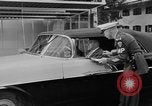
U.S. Army Military Police on duty in posts around the world.
Activities of the U.S. Army Military Police (MPs) throughout the world. An MP checks credentials of American driver in a 1955 Oldsmobile, at a Base checkpoint in Germany. An MP wearing patch of Army Support Command-Europe on his shoulder, obtains directions from a local Policeman in Europe. U.S. Army trucks move through a checkpoint manned by MP, in Pointe de Grasse, France. MPs of the 728th Battalion, in Korea. They are seated in a jeep, with a Korean counterpart in the back seat. The U.S. MPs wear patches of 7th Logistical Command on their uniform sleeves. Military Police units and jeeps pass in review at a parade in Fort Gordon, Georgia.
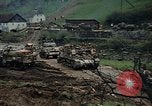
A large convoy of U.S. Army tanks drive past and infantry men advance across an open field in Germany.
U.S. Army tanks leaving a town in Germany during the last days of World War II in Europe. A large convoy of U.S. Army tanks drive past. U.S. soldiers throw bricks in the foreground on a muddy incline to provide traction for other military vehicles. A tank drives up and stops. Personnel carriers and trucks and jeeps follow through the mud on the road. Soldiers spread hay or straw on a muddy incline for traction. Tanks move on a rural road past a burning building. Infantry men advance across an open field.
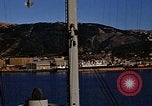
Sailors standing on deck and Navy personnel in attention as they are given instructions aboard U.S. Ship in the Atlantic Ocean.
Activities of U.S. navy personnel aboard U.S. Ship in the Atlantic Ocean. Ships anchored at harbor as seen from a ship. Mountains in the background. Smoke rising from explosion in the far background. U.S. flag on the ship. Sailors standing beside railings. Captains and an official talk. Sailors on deck. Navy personnel standing in attention as they are given instructions.
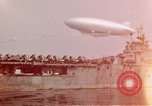
U.S. Navy blimp flies above USS Shangri La (CV-38) and crowds at pier welcomes ships and personnel in the United States.
USS Shangri La (CV-38) returns to the United States. A U.S. Navy Blimp flies above the USS Shangri-La. Decorative string of balloons above ship. U.S. aircraft on flight deck. U.S. Navy blimp flies with welcome sign above the USS Shangri La (CV-38). 'USS Shangri La' written on the ship. Workers aboard ship. Tugboat alongside the ship. A crowd at the pier welcomes ships and personnel.
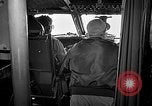
U.S. Air Force airlifts French paratroopers to Indochina.
Film opens showing entrance to cockpit of a U.S. Air Force Troop Carrier Douglas C-124 Globemaster aircraft en route from France to Indochina. A pilot is seen at the controls in the left seat, and the Aircraft Commander is observing from behind and between the pilots' seats. Close-up of number 3 and 4 engines with propellers turning as viewed from copilot's window. Two crew members are seen asleep on bunks in rear of flight deck compartment. Another is napping in a bulkhead seat. More views of engines running and propellers turning. Glimpse downward of land and clouds below. Close-up of Copilot in right seat of cockpit, wearing headset and making an announcement through his microphone. View of French paratroopers seated in cargo compartment, listening to the announcement from loudspeaker above them. Next, a French paratrooper passenger is seen opening contents of a flight lunch package. He uses the tiny can opener included in the package to open a can (with some difficulty). Paratroopers eating flight lunches.Two of the passengers playing chess on a miniature board with plug-in chessmen. Close-up of the chessboard. Co-pilot speaking on intercom again and a French paratrooper, wearing headset and microphone, speaking as well (likely translating). Glimpse of engine running on left wing. A different person (not in flight suit) at the controls in copilot's seat. The crew's Flight Engineer making throttle adjustments at his panel. View on the ground of French greeting party on the destination airfield to meet the arriving aircraft. Arriving C-124 aircraft taxiing on inboard engines only, as it proceeds along layers of pierced steel plank (Marsden matting) comprising the surface of airfield ramp. Views of French military waiting to greet arriving paratroopers. The aircrew's loadmaster lowering one of the aircraft's front loading ramps. French paratrooper passengers use it to leave the aircraft. (The other ramp is partially down and contains cartons and boxes.) Close-up of a French major in the greeting party. A woman greeting troopers, individually, as come down the ramp from the aircraft. Some French aircraft lined up on ramp, in background. (They appear to be Grumman F8F Bearcat aircraft.) Glimpse of an armed French Colonial (Tirailleurs Sénégalais) sentry standing near the aircraft. Troopers carrying cartons of rations from the aircraft and joining others preparing to board trucks for a ride to their quarters. Uniformed French soldiers in the greeting party help load heavy crate into an Army truck. Some troopers leave on trucks.
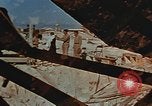
U.S. Navy and Marine personnel recover after the battle of Midway in World War II
Recovery actions by U.S. Navy and Marine personnel in the wake of the Battle of Midway in World War 2. Opening scene shows religiious services being held by a bomb crater that had once been a chapel on Midway Island. That evening, marines are assembled near flag-covered coffins of fallen comrades, in a burial ceremony. A marine chaplain conducts a funeral service, as Marines stand, with their rifles, at parade rest Several views from different perspectives of the event. An honor guard fires a volley with rifles. The American flag is at half staff, in the background. Among the officers seen is Marine Major James Roosevelt, son of the U.S. President, Franklin Roosevelt. Next, Navy boats are seen offshore, carrying the fallen for burial at sea. U.S. Navy aircraft fly in formation overhead. A marine scans the sky with binoculars as dense black smoke continues to billow from the petroleum facility bombed by the Japanese several days ago, and hangs like a pall over Midway Island. The American flag on a tall pole, is highlighted against the black smoke. Film ends with series of Slates summarizing Japanese losses in the Battle of Midway. The first shows 4 Japanese Carriers sunk. It is painted over by a brush containing red paint. Another slate announces 28 Japanese Battleships, Cruisers, Destroyers sunk or damaged. A paint brush places a large black cross over that slate. A final slate states 300 Japanese aircraft destroyed. The red paint brush appears again, but this time it marks a big “V” for Victory across the slate.
CRITICALPAST.COM: About Us | Contact Us | FAQs - How to Order | License Agreement | My Account | My Lightboxes | Shopping Cart | Advanced Search | Featured Collections | Website Terms & Conditions | Privacy Policy ©2026 CriticalPast LLC.
License Agreement |
Terms & Conditions |
Privacy Policy
©2026 CriticalPast LLC.