


 Francais
 Deutsch
 Italiano
Refine Your Search
US-Gliders- stock footage and images
- Showing 2143 to 2148 of 21924 results more
more Hide
Hide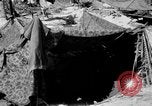
Marines use mobile phone and other communications equipment and Marines work on LVTA at Peleliu, Palau Islands.
U.S. Marine Corps Communication activities at Peleliu, Palau Islands. Shelter half over dugout. Interior of dugout. Marine uses phone. Dugout with shelter half over roof. Several aerial antennas mounted on LVTA (Landing Vehicle Tracked Armored) being parked at edge of beach. Other LVTAs in the background. Marine climbs aboard LVTA. Marines standing near turret of LVTA. Dugout on beach which contains switchboard. Rolls of wire on beach. Switchboard operator with earphone at switchboard. View of Marine using mic.
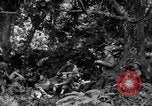
U.S. 5th Marines 2nd Battalion observe target area and operate BC-1306 radio set at Peleliu, Palau Islands.
U.S. Marine Corps Communication activities at Peleliu, Palau Islands. Forward observation party, for 75mm pack How, U.S. 5th Marines 2nd Battalion, with binoculars, other men sitting in jungle. Marine observer watches fire through binoculars. Large body of water in background. Target area observer in the foreground silhouetted against sky. Operator of BC-1306 radio set sending message using hand crank generator. Shell bursts, smoke rising skyward. Shell burst in water. (World War II period).
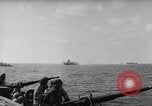
Aircraft of U.S. Navy Task Force 58, attack Kyūshū and Japanese home islands in World War II
Film begins showing sailors in battle gear manning Bofors 40mm anti-aircraft guns beside flight deck of U.S. aircraft carrier, during World War 2. Navy Task Force 58 ships, including a cruiser and another aircraft carrier, are seen in background. View of SBD Douglas Dauntless dive bomber aircraft on the carrier flight deck. Two have engines running.The rest are parked with wings folded. Next, the aircraft are seen being sent on takeoffs by a white shirt on deck. The number "6" on her flight deck identifies her as the USS Enterprise (CV-6). Views of several Douglas Dauntless aircraft flying off her deck. Glimpse of aircraft in formation from a different Squadron, bearing checkerboard markings on their tails. View from above of 5 of the aircraft in formation above the sea below. Gun camera views of U.S. aircraft strafing Japanese ships. One explodes in fireball and smoke. U.S. aircraft firing rockets that strike a Japanese carrier, setting it on fire, and causing an escort ship to blow up. Task Force 58 aircraft strike Japanese coastal installations and strafe several Japanese airfields destroying parked Japanese aircraft. They attack industrial sites causing fires and explosions. Gun cameras show aircraft firing rockets at lines of communication and striking more Japanese airfields.

Types of mines used by a Minesweeping Boat underway off the shore of the United States is demonstrated by animation.
Demonstration of areas mined, characteristics of mines and types of mines used by a Minesweeping Boat (MSB) underway off the shore of the United States. A mine sweeping boat underway in an ocean. Animation depicts: the areas which are mined including rivers, harbors, channels, coastal waters and ocean areas. Moored mines and bottom mines are used. Moored mines are held at predetermined depth and bottom mines rest on the sea floor. Mine characteristics include contact and influence mines. Moored mines are of either type. All bottom mines are influence types which includes magnetic, acoustic, pressure or combination of these. Demonstration of damage range is shown. The United States flag flutters in wind from the mast of a ship. Modern types of minesweeper includes Ocean Minesweeper (MSO), Coastal Minesweeper (MSC), Harbor Minesweeper (MSB) and craft type used for shallow minesweeping.
Men work with pontoons for salvaging U.S. Navy submarine Squalus off the coast of Isles of Shoals near Portsmouth,New Hampshire.
Salvaging activities for the U.S. Navy submarine Squalus (SS-192) off the coast of Isles of Shoals near Portsmouth,New Hampshire. Pontoon afloat on surface with cable slings attached. Men work with pontoon alongside U.S. Navy Ship Falcon (ASR-2). Men on top of pontoon. "Flowerpot"cable clamp is lifted from pontoon by crane hook. Men work with "flowerpot" on deck of U.S. Navy Ship Falcon (ASR-2). Officer sits on bitts in the foreground. Men work with cable on top of pontoon. Air hoses stretched over surface seen in the background. Pontoon alongside USS Falcon. Air bubbles come up along lower portion. Air hoses in mass lying on surface. View of the motor launch and crew work. Man stands on the top of mass of hoses on surface. Men work with hoses stretched over surface. View of the rescue site. Air hoses seen on surface.
U.S. Air Force Major Blackburn and recovery team remove debris of USAAC LB-7 bomber aircraft from swamp in Bluefields,Nicaragua.
U.S. Air Force team recovers debris from a Keystone LB-7 bomber aircraft that crashed in Bluefields,Nicaragua. U.S. Air Force Major William A Blackburn and recovery team removes pieces of a United States Army Air Corps Keystone LB-7 bomber aircraft from swamp. They use machetes to clear some of the swamp grass, and probe for pieces of the bomber. They manually retrieve a number of parts and pieces of the airframe, which are seen piled in a small heap.
CRITICALPAST.COM: About Us | Contact Us | FAQs - How to Order | License Agreement | My Account | My Lightboxes | Shopping Cart | Advanced Search | Featured Collections | Website Terms & Conditions | Privacy Policy ©2026 CriticalPast LLC.
License Agreement |
Terms & Conditions |
Privacy Policy
©2026 CriticalPast LLC.