


 Francais
 Deutsch
 Italiano
Refine Your Search
US-Gliders- stock footage and images
- Showing 2161 to 2166 of 21924 results more
more Hide
Hide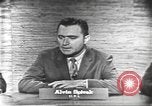
Richard Nixon and John Kennedy answer reporters' questions during a presidential election debate in Washington DC, U.S.
The second Kennedy-Nixon Presidential Debate in Washington DC, United States. Alvin Spivak of United Press International asks Republican candidate U.S. Vice President Richard M. Nixon to comment on his intentions in the field of civil rights. Nixon answers and states that progress is to be made in the field of employment by giving statutory authority to the Committee on Government Contracts. He states that in the field of schools, provisions should be laid whereby the federal government would give assistance to districts who want to integrate their schools. He speaks about presidential leadership. He concludes and says that the civil rights of the Americans should be recognized in order to protect the country from communist rule. Democratic candidate Senator John F Kennedy points that Nixon hasn't discussed what would be his policy on implementing the Supreme Court decision of 1954 and what would he do and what would be his leadership in providing fair employment, housing and education. He concludes by saying that the president must establish a moral leadership. Harold R. Levy of Newsday asks Kennedy to comment on what the President should do in racial discrimination events such as Little Rock Nine or the lunch-counter sit-ins. Kennedy says that he thinks that a president operates in different areas as a legislative leader, an executive leader and a moral leader and his functions differ in each area. He talks about the government contracts. He speaks about the standards set by the Americans which the Communists don't set. He comments on the case of Little Rock and says the U.S. President should go with the Supreme Court's decision. Nixon comments on the matter of the Committee on Government Contracts being mentioned by Kennedy. He talks about the functions of the Democratic Congress. He states that actions are required along with hopes. He concludes and says that in the field of executive leadership, U.S. president must lead and act as he talks.
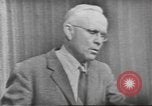
Vice President Nixon and Senator Kennedy debate over a fight against communism prior to presidential elections in the U.S.
The fourth presidential election debate held between Democratic nominee Senator John F. Kennedy and Republican nominee U.S. Vice President Richard Nixon in New York, United States on 21st October 1960. ABC News correspondent Quincy Howe speaks during the debate and allows correspondent Walter Cronkite to ask Senator Kennedy a question. Mr. Cronkite asks Senator Kennedy that in what areas the United States might take offensive against communism rather than being defensive to the Soviet Union. Senator Kennedy replies to the question and says that the eastern Europe is very vulnerable area according to him. He says there should be policies which make it possible to establish closer relation with a country like Poland and he also mentions the Hungarian Revolution. Senator Kennedy speaks about the relations between the Soviet Union and China. He says that India represents a great area for affirmative action by the free world. India started from about the same place that China did. India under a free society has been making some progress. But if India does not succeed, Communism can take over. He says that in Africa, Asia, Latin America, eastern Europe, the great force on their side is the desire of people to be free. Correspondent Howe asks Vice President Nixon to comment on the topic. Nixon speaks about Poland and says that Poland in not in a position to take any independent position under Soviet control. He talks about aids being sent to Poland from the U.S. and says that the U.S. can have more exchange with Poland or with any other Iron Curtain countries.
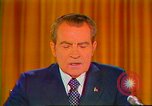
U.S. President Nixon speaks about inflation and federal budget during his address from the White House in Washington DC.
Television broadcast of U.S. President Richard Nixon's speech from the White House in Washington DC, United States on the withdrawal of the remaining U.S. troops from Vietnam on 29th March 1973 during the Vietnam War. President Nixon talks about prosperity in the United States without war abroad and without inflation at home. He says that inflation is a terrible cost of war with which the United States is battling at home presently. He speaks about cutting the rate of inflation by controlling meat prices. He says that the U.S. has increased imports from abroad and production at home which will increase meat supply and he has ordered Council of Cost to impose ceiling of prices so that the meat price does not increase any higher. President Nixon says he has submitted 268 billion dollars of federal budget to the Congress this year and if this budget increases as proposed by the Congress then that would mean an increase in taxes by 15% or an increase in the prices. He says he shall veto bills which will break the federal budget he has submitted.
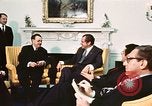
President Nixon with Soviet Ambassador Dobrynin and Soviet Foreign Trade Minister Patolichev at the Oval Office in the U.S.
U.S. President Richard Nixon with Soviet dignitaries in the Oval Office of the White House in Washington DC, United States. President Nixon, Soviet Ambassador to the U.S. Anatoly F. Dobrynin, Soviet Foreign Trade Minister Nikolai Patolichev, United States Secretary of Commerce Peter George Peterson, U.S. National Security Advisor Dr. Henry Kissinger, and Assistant to the President and Assistant to the President for International Economic Affairs Peter Flanigan pose for pictures in the Oval Office.
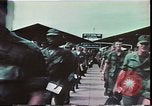
The last U.S. troops leave Vietnam and are greeted by relatives and friends upon their arrival in the United States.
The last U.S. ground units leave Vietnam during the Vietnam War. Columns of U.S. soldiers march to board an aircraft which will carry them to the United States. Troops wave to a crowd. A Vietnamese woman cries as she looks at the troops. U.S. sailors being greeted by their relatives and friends upon their arrival in the United States.
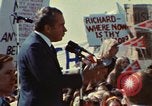
U.S. President Richard Nixon finishes his speech and gets into his car at Tri-City Airport in Saginaw, Michigan.
U.S. President Richard Nixon delivers a speech at Tri-City Airport in Saginaw, Michigan. Placards held by a crowd display welcome messages for President Nixon. President Nixon speaks from a podium. He talks about his recent journey to Europe and the wars in which the U.S. was engaged since World War II. He talks about everlasting peace and prosperity in the U.S. without war and inflation. The crowd cheers for him. A band plays. President Nixon gets in his car. The President's car pulls away.
CRITICALPAST.COM: About Us | Contact Us | FAQs - How to Order | License Agreement | My Account | My Lightboxes | Shopping Cart | Advanced Search | Featured Collections | Website Terms & Conditions | Privacy Policy ©2026 CriticalPast LLC.
License Agreement |
Terms & Conditions |
Privacy Policy
©2026 CriticalPast LLC.