


 Francais
 Deutsch
 Italiano
Refine Your Search
US-Gliders- stock footage and images
- Showing 2461 to 2466 of 21924 results more
more Hide
Hide
U.S. Federal Marshals search bus passengers around AIM (American Indian Movement) occupant area in United States.
Activities of United States Federal Marshals during AIM (American Indian Movement) occupation at the outskirts of Native American Indian Lakota Nation in United States. U.S. marshals stand. Man click pictures. Marshal frisks men. A marshal walk with a man holding his hand. A woman gets off car. People sit on the ground. U.S. marshal searches pocket and collar of a man.
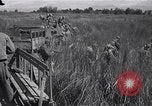
U.S. Army Rangers, Alamo Scouts, and Filipino Guerrillas rescue Allied POWs from Japanese Cabanatuan World War II prison camp
Scenes from the successful World War 2 Mission that rescued more than 500 Allied prisoners of war from the Japanese prison camp near Cabanatuan, Luzon, the Philippines. U.S. soldiers of the 6th Ranger Battalion are seen as they leave their transport trucks, check their weapons and commence their 30 mile trek to the camp. They start down a dusty trail. In view from a hill, above, they are seen fording some streams,. One Ranger looks up and waves his hat at the camera, but all the others keep moving without distraction. The scene shifts to the next day, after the successful rescue of the prisoners. Alamo Scouts, Filipino Guerrillas, and U.S. Rangers mingle with rescued prisoners. Some of the rescued sit in carabao carts provided by local villagers. Former prisoners are interviewed by Rangers, who make notes of their accounts. Several Army ambulances are parked at the site. Some Filipino women and children are seen, around the edge of the gathering. A Ranger helps one former POW to a carabao cart. During all this post-mission activity, beginning at TC: 02:28, the mission commander, Colonel Henry Andrews Mucci, is seen debriefing others around him, and referring to a map and gesturing with a pen, as he does so. He has a growth of beard and mustache, and wears a "booney" hat. View of rescued prisoners resting near a large haystack. A medic seen in midst of others, some of whom sit in carabao carts.

U.S. Army troops make amphibious landing at Nasugbu, Batangas, Philippines, in World War II
On January 31, 1945, during World War 2, elements of the 11th Airborne Division attached to the U.S. Eighth Army, are seen in landing craft approaching the shore of Nasugbu, Batangas. They hit the beach in an unopposed landing, but one of their vehicles stalls near the shoreline. A DUKW Military Amphibious Vehicle moves along the shore as soldiers board the stalled vehicle and head toward the beach pulled by a bulldozer using a towline. Another vehicle is also seen, being pulled by a bulldozer.
Activities of U.S. forces after landing at Nasugbu in Philippines Islands during World War II
United States military forces on Nasugbu beach, Philippines Islands. Soldiers of the 6th ranger Battalion with artillery piece. Smoke rises from artillery striking shore across body of water. U.S. soldiers moving along dirt road as some pick up their packs and gear from under a tree and moving out with the rest. U.S. intelligence officer interviews Mrs Betty Santa Maria, a Spanish Citizen who had been permitted by Japanese to leave Manila and come to Nasugbu, several weeks earlier. Partly disassembled Piper L-4 Grasshopper Liaison airplane on truck crosses small bridge. Soldiers inspect wreckage of a Nakajima Ki-43 "Oscar" in a grassy field. Another Piper L-4 being transported on a truck. A landing ship in the background.

U.S. Navy training film about escape from ditched modern jet fighters that sink faster than the old propeller airplanes
An F6F Hellcat ditches in the sea. It floats long enough to allow pilot to abandon it before sinking. Next an A-4 Skyhawk ditches. Narrator remarks about the short time for escape from such aircraft on the surface of the water. Views of tests conducted by the U.S. Navy to test the sink rates of jet aircraft from various heights and attitudes. A dummy is placed in the cockpit of a derelict F9F Panther, which is lifted by a crane and is dropped into water from a low height. It is seen floating. (Narrator states that even with no structural damage, it sinks in less than a minute.) Next an FJ-2 Fury is dropped from about 55 feet. Due to structural damage, narrator states such an aircraft may sink in a few seconds, and generally between zero to 55 seconds. View of crane operator and then of an airplane sinking rapidly. Scene shifts to James F. Roth of U.S. Navy Attack Squadron 42,(VA-42) the "Green Pawns," in the closed cockpit of a Navy jet airplane. Next, an F-4 phantom jet is seen being catapulted from an aircraft carrier. Animation shows that the airplane falling into the sea right after takeoff will sink ballistically and can descend as deep as 100 feet in 10 seconds.
Aerial views of U.S. Army V-100 armored cars and M-151 armored jeeps passing through villages in a truck convoy
Aerial view from U.S. helicopter of U.S. Army M-151 armored jeeps and V-100 armored cars passing through village areas and farming areas. Truck convoy en route passes through village and drives on roads beside flooded rice paddy areas. (Vietnam War period).
CRITICALPAST.COM: About Us | Contact Us | FAQs - How to Order | License Agreement | My Account | My Lightboxes | Shopping Cart | Advanced Search | Featured Collections | Website Terms & Conditions | Privacy Policy ©2026 CriticalPast LLC.
License Agreement |
Terms & Conditions |
Privacy Policy
©2026 CriticalPast LLC.