


 Francais
 Deutsch
 Italiano
Refine Your Search
US-Gliders- stock footage and images
- Showing 295 to 300 of 21920 results more
more Hide
Hide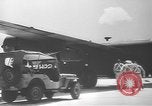
U.S. Navy PB4Y-2 Privateer and U.S. Air Force WB-29 aircraft used in weather reconnaissance operations
Flight crew hurries to a U.S. Navy PB4Y weather reconnaissance aircraft parked on a ramp. It has "HP2" written on its side. It is later seen in flight. Then a U.S. Air Force WB-29 is seen in flight, followed by a switch to the PB4Y (with HP2 on its side) again seen in flight.
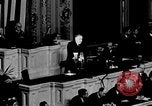
President Roosevelt addresses the U.S. Congress in Washington DC, seeking to limit use of U.S. products by belligerent nations.
President Franklin D Roosevelt addresses the Congress in Washington DC, United States. Roosevelt explains the essence of the foreign policy of America. He states that America has always tried to limit armament and aimed at peaceful solution of disputes. He says that United States believes in equality and popular rule. He also speaks about the steps America would take in event of a war including the practice of discouraging use of American products by belligerent states.
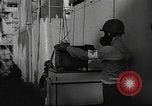
U.S. Army damage control personnel work with an air sampling kit for a biological warfare test aboard a U.S. ship in the U.S.
A training film based on biological warfare defense aboard a U.S. ship in the United States. Damage control personnel work with an air sampling kit to take air samples. A man puts a liquid in an impinger and prepares two molecular filters. He takes out a tube containing a nutrient which is the food for bacteria. He fits a filter on one of the impinger and removes cotton plugs. The man connects the impinger to a pump. The pump draws air through the impinger and BW (Biological Warfare) agents are trapped in the liquid. The impinger is inverted, the liquid goes through the filter and bacteria is caught on it. The man removes the filter and the liquid is kept in a container. The liquid from the impinger is also preserved. Samples are sent to a hospital ship by a helicopter for analysis. Laboratory testing of the samples. A man injects an animal to identify the BW agent. A doctor aboard the ship examines the laboratory results.
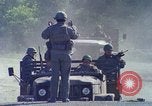
In the U.S. the use of holding area and dispersal area by deploying U.S. MP platoons during a river crossing operation in war.
A training film in the United States details the role of Combat MP (Military Police) of the United States Army in supporting river crossing during war. Use of holding area which is located between the staging area of equipment and the ERP (Engineer Regulating Point) shows advance of equipment from midway to bridge aided by holding areas controlled by MPs. An MP directs lesser priority traffic to the holding area to let the higher priority traffic go first. Trucks and jeeps advance along a road. Evacuation of prisoners shows prisoners being loaded into a truck under an MP guard. Engineers work on damaged crossing equipment. MPs direct the traffic to a dispersal area while waiting to proceed. Equipment moves across the river on an MAB (Mobile Assault Bridge) and traffic is directed by MPs on the other side of river. Animation depicts the position of MPs in a crossing area during a crossing operation. Animation depicts deployment of division MP platoons and core MPs.
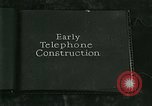
Methods used for laying telephone lines in earlier years in contrast to the modern methods used in later years in the U.S.
Telephone facility construction in the United States. A picture showing a man digging a hole for a telephone pole in 1894. A picture shows several men raising a telephone pole in 1895. Men using a tractor to pull telephone lines in the later years. A tractor with auger drilling holes for the telephone posts. A derrick (out of sight) placing a post in the hole. A man standing beside the post guiding it into the hole. In 19th Century, crews of men are seen manually digging trenches on the sides of the road in a city street for laying telephone lines. In contrast , a man operates a powered trenching machine along a street, while helpers watch, Houses in view along the side of the road.
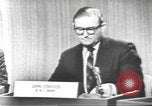
U.S. Vice President Nixon speaks about U.S. foreign policy towards Latin America prior to the presidential elections in the U.S.
The fourth presidential election debate held between Democratic nominee Senator John F. Kennedy and Republican nominee U.S. Vice President Richard Nixon in New York, United States on 21st October 1960. News correspondent John Edwards asks Senator Kennedy if he can give the names of three or four Americans whom he can appoint as the Secretary of State. Senator Kennedy replies to the question and says that this decision can only be made by the president and not presidential candidates. He says that he has made no judgment about who should be the Secretary of State. News correspondent Quincy Howe asks Richard Nixon to comment. Nixon says that it would be the responsibility of the next president to appoint the Secretary of State. Vice President Nixon speaks about a previous comment made by Senator Kennedy regarding Fidel Castro's regime. He says that President Eisenhower's administration appropriated five times as much for Latin America as was appropriated by the previous administration. He speaks that Democratic Congress has cut eighty million dollars off of the Voice of America appropriations to Latin America.
CRITICALPAST.COM: About Us | Contact Us | FAQs - How to Order | License Agreement | My Account | My Lightboxes | Shopping Cart | Advanced Search | Featured Collections | Website Terms & Conditions | Privacy Policy ©2026 CriticalPast LLC.
License Agreement |
Terms & Conditions |
Privacy Policy
©2026 CriticalPast LLC.