


 Francais
 Deutsch
 Italiano
Refine Your Search
US-Gliders- stock footage and images
- Showing 307 to 312 of 21920 results more
more Hide
Hide
Camouflage techniques used by Japanese snipers in jungle against U.S. Marines deployed on Pacific islands during World War II.
Training film titled 'Notes on Jungle Warfare' on deployment of U.S. Marine Corps on islands of Pacific during World War II. U.S. Marines advance inland into jungle after disembarking from amphibious vehicles. Wounded and dead Marines lying on beach. Crosses at a cemetery. Marines caring for a wounded man. Jeep is driven in the jungle. Marine comes out of a foxhole. Japanese prisoners marching under guard on an island. U.S. Commander in Chief of Pacific Ocean Areas Chester Nimitz decorates a soldier. U.S. platoon advance into jungle. Camouflage techniques used by Japanese snipers in jungle shows an isolated U.S. Marine attacked by a sniper hiding under bushes. U.S. Marines counter such Japanese tricks and techniques by setting his own traps. Platoon leader sends a signal for location of sniper. Second U.S. platoon moves ahead. Shows two Marines find a dead sniper. Japanese sniper fires from a spider trap. Sniper is handled by grenade attack. Soldiers in foxhole are shot down.
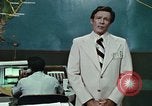
How the Civil Reserve Air Fleet, contract carriers, and U.S. Reserve and National Guard augment active U.S. military airlift capability.
Views of civilian airlines and examples of how they and U.S. Air Force Reserve and National Guard aircraft augment the active U.S. military airlift Command capability in time of emergency. Civilian narrator speaks from inside the U.S. Air Force Military Airlift Command (MAC) Headquarters Command Center, at Scott Air Force Base, Illinois. Next scene shows U.S. commercial airline passenger airplanes parked on a ramp. United Airlines, Delta Airlines, American Airlines, and Pan American aircraft are seen, some taxi, some parked, some taking off. A Boeing 727 jet taxis on the ramp. A Western Airlines 727 taxis behind a set of baggage carts being pulled by a tractor. The Narrator is discussing the Civil Reserve Air Fleet (CRAF) to which most U.S. airlines belong, and which can be activated by the Secretary of Defense, for airlift support in the event of a national defense emergency. The Western 727 aircraft takes off. A TWA 727 aircraft takes off. U.S. military personnel and dependent women and children are seen descending a stairway from a commercial airliner contracted by the Department of Defense. Military supplies are seen being offloaded by U.S. Airmen, onto a traveling cargo carrier, from a Flying Tigers Boeing 707 aircraft. Refugees from Southeast Asia are gathered and processed at an airport and then board an American Airlines Boeing 747 aircraft. Refugees from Vietnam and Cambodia boarding an Overseas National Airways Boeing 747. An American Airlines 747 taking off. A glimpse of the narrator in MAC headquarters, at Scott Air Force Base, is followed by a mix of private and military aircraft on a parking ramp, including a, presumably privately owned, Japanese Nakajima B5N Navy Type 97 Carrier Attack Bomber (Kate) with Japanese markings. U.S.Air National Guard C-130 and C-123 aircraft are seen taxiing, and taking off from this civilian airfield.
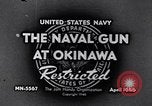
U.S. Fifth Fleet commanded by Vice Admiral Spruance, and U.S. 10th Army, commanded by Lieutenant General Buckner, at Okinawa.
Animation depicts Okinawa in relation to Japan,China,Formosa, and Iwo Jima. U.S. landing ships carry troops who make unopposed landings on Hagushi beach, U.S. troops seen pouring ashore. Okinawa. Lieutenant General Simon Bolivar Buckner and Vice Admiral Raymond A. Spruance seen looking through binoculars on the deck of the amphibious Flag Ship. U.S. troops move inland from the beachhead. Troops bringing bulldozers. U.S. Army infantry of the 24th Corps engage Japanese defenders. Japanese bunkers and fortifications seen. U.S. battleships and other ships of the line begin intense bombardment of the Japanese positions. U.S. army artillery fire large howitzers. U.S. tanks attack Japanese fortifications and suffer counter fire. Troop movements impeded by rain and mud. Ammunition ships seen having difficulty on congested beachhead. Animation shows how naval gunfire could successfully strike Japanese fortified positions because of flat trajectory. (World War II period).
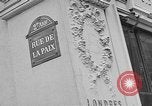
U.S. Ambassador to France Jefferson Caffery reopens U.S. Embassy in Paris, France, during World War II.
U.S. Ambassador to France, Jefferson Caffery occupies the U.S. Embassy in Paris, following its liberation from German occupation in World War 2. A sign on the entrance gate to a building reads 'Rue De La Paix' and another sign reads 'Londres - New York'. The U.S. flag on the American Embassy building. Two guards with the U.S. flag in one of the balconies of the building. Two men look at the guards from another balcony of the building. Two American Military Police open the gates of the U.S. Embassy. U.S. Ambassador to France Jefferson Caffery with other officials enters through the gates of the building and stands on a path. The officials hold their hats in their hands. American Military Police lined up on the sides of the path. 'MP' written on the helmets of the guards. The U.S. flag on a pole in a courtyard. The officials walk past the guards.
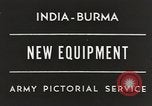
A U.S. Soldier demonstrates the use of a carbine equipped with a night vision sniper scope in Burma during World War II.
U.S. Army soldiers train with new "Sniperscope" equipment during the Burma Campaign in World War II. The 475th Infantry regiment of the U.S. Mars Task Force are seen gathered for a demonstration of the new Sniper Scope. A U.S. Army soldier demonstrates the parts and use of the sniper scope. He shows a carbine equipped with the sniper scope for accurate firing in the dark. He explains the functioning of the scope and how its attached infrared spotlight operates in conjunction with a telescopic sight mounted on the rifle to enable night vision. He looks through the telescope sight. He demonstrates the use of a unit, attached by a cord, that contains batteries and an electrical focusing attachment. He turns a focusing dial on the unit. The American soldiers examine the carbine and look through the telescopic sight. Narrator explains that the night scope will be used primarily in preventing night infiltration of U.S. held positions.
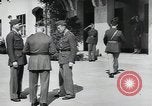
U.S. military training film demonstrates an interview of a captured U.S. soldier and a booby trap set up (WW2)
Film based on advantages and procedures of using U.S. Army training films. Demonstration on U.S. Army life as U.S. army officers talk outside a building and soldiers salute a Navy officer as he arrives. A soldier gets first aid from a medic. A captured U.S. soldier is being interviewed by Nazi German officials. U.S. soldiers enter a room and find a booby trap device set up by enemy to be triggered by an unsuspecting victim. U.S. soldier places the same booby trap device on an enemy motorbike. Motorbike explodes as enemy troops stand around the motorbike. (World War II period).
CRITICALPAST.COM: About Us | Contact Us | FAQs - How to Order | License Agreement | My Account | My Lightboxes | Shopping Cart | Advanced Search | Featured Collections | Website Terms & Conditions | Privacy Policy ©2026 CriticalPast LLC.
License Agreement |
Terms & Conditions |
Privacy Policy
©2026 CriticalPast LLC.