


 Francais
 Deutsch
 Italiano
Refine Your Search
US-Gliders- stock footage and images
- Showing 313 to 318 of 21920 results more
more Hide
Hide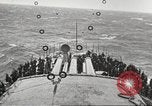
Various scenes of U.S. warships in 1917. British Admiral David Beatty welcomes U.S. Battleship Division Nine to the Grand Fleet.
Scenes of U.S. warships in World War I. Sailors take calisthenics, on deck, aboard Pennsylvania class U.S. battleship underway in Atlantic ocean, as viewed from above her three-gun upper turret. Different time and place: British Admiral David Beatty welcoming officers of the U.S. Ninth Battleship Division upon their arrival to join the Grand Fleet, in 1917, at the Firth of Forth, in Scotland. Admiral Beatty giving a welcome speech to officers and sailors of the Ninth Battleship Division, aboard the USS New York. US destroyer Manley (DD-74) camouflaged in Firth of Forth. Different place and time: Sailors hold on to lines as they watch a U.S. destroyer pass at high speed, and a Battleship following. U.S. warships signal each other using lights and morse code. Battleship passes at high speed.

7th U.S. Army soldiers fire at German positions and French civilians greet U.S. troops in France during World War II.
U.S. troops in cities in France during World War II. Equipment on docks in Naples. A few dirigibles in flight over the dock. Several aircraft in flight. Paratroops of U.S. 7th Army coming down over Southern France. The soldiers advancing and firing. Smoke and flames rise from explosions. The soldiers on tanks advancing and firing. German prisoners being led by U.S. troops. The prisoners walking in columns on a path. The civilians of Marseilles on the streets welcome U.S. troops. U.S. troops marching on the streets. People waving to the troops. A large crowd gathered on the streets waving to the tanks moving past on the streets. Prisoners with their hands behind their heads are led. German soldiers in Lyon firing at U.S. troops entering the city. A hospital building catches fire. Patients being evacuated on stretchers from the building. U.S. troops on trucks moving along a road. People shaking hands with soldiers on trucks. View of the crowd on the streets.
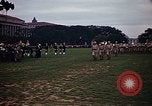
U.S. Marine officers pass reviewing stand and U.S. Navy WAVES officers salute reviewing stand on Nimitz Day in Washington DC.
Nimitz Day in Washington DC. U.S. Marine officers pass reviewing stand. U.S. Fleet Admiral Chester William Nimitz reviews the parade. A U.S. Marine band pass reviewing stand. U.S. Marine Corps parade on Washington Monument grounds. People stand in the background. A U.S. Marines flag and U.S. flag pass Battleship float on parade ground. U.S. Navy WAVES (Women Accepted for Volunteer Emergency Service ) officers salute reviewing stand. A band plays music. The soldiers parade. They pass through reviewing stand. (Immediate post-World War II period).

U.S. President-Elect Jimmy Carter tours the Pentagon with U.S. Secretary of Defense Donald Rumsfeld and other officials.
U.S. President-Elect Jimmy Carter arrives at the Pentagon in Virginia, United States. U.S. Secretary of Defense Donald Rumsfeld greets U.S. President-Elect Jimmy Carter as he arrives in a car. Interior of the Pentagon shows Jimmy Carter, U.S. Vice President Walter Mondale, Chairman of the Joint Chiefs of staff George Brown, Chief of Staff of the U.S. Army Bernard W. Rogers, U.S. Navy Admiral James Holloway, U.S. Air Force General David Jones and United States Marine Corps General Louis Wilson tour the Pentagon. Officials take their seats at a dining table.
A training film in the U.S. depicts attack patterns used by gun ships in an enemy territory.
A training film in the United States on tactical operations of U.S. Air Force UH-1 Iroquois helicopters. Attack patterns used by gun ships under various situations are explained. Animation depicts various attack patterns. Figure 8 pattern. Two aircraft are used in this pattern. Timing is an important matter in this attack pattern. Two guns can be used simultaneously in this pattern. Turns are made in random directions. Another is the race track pattern. As a helicopter breaks contact, other helicopter should acquire the place and engage the enemy. The circling pattern. This is used to check activities in the vicinity of an area. The cloverleaf pattern which is used when attack is to be made from a stand off position. It is used against point or small area targets. The L attack pattern which is effective against point targets. A pilot at the controls of a helicopter. The pilot has to make a thorough estimate of the situation and take the final decision for the best attack pattern. The helicopter in flight, searching for the enemy. Aerial view of a wooded area. Gun ships fire.
Signal Corps weekly film reports sent to Photographic Center and used in training films for U.S. troops during World War II.
The role and contribution of the U.S. Army Signal Corps in combat and war. Amphibious landings of the first wave of Allied troops including Signal Corps Units in Normandy, France on D Day during World War 2. The Joint Assault Signal Companies (a Signal Corps Unit that accompanies the soldiers on every beach landing) go ashore in Normandy. Soldiers in landing crafts approach the beach. Landing crafts anchored along the shore line. A U.S. flag on the beach. Crafts approach the beach. U.S. Army Signal Corps combat photographers using motion picture cameras to film the battle that ensues on the beach and in the fields. Gun fire and explosions in the battlefield, filmed by combat cameraman. Allied aircraft in flight. Airmen load weekly film reports of the war in all Theaters made by Signal Corps officers from a van into an aircraft. The films are sent to the Photographic Center in New York. A soldier assembles the films. Technicians organize and arrange the films. They place the film reels onto racks. The film content is used to make training and orientation films for the U.S. troops. Troops watch the films in order to cut down the training period, and stay informed about the order of event in other Theaters of Operation. The films include 'Why We Fight' and 'The Fighting Men' series. Clips and recordings from these films.
CRITICALPAST.COM: About Us | Contact Us | FAQs - How to Order | License Agreement | My Account | My Lightboxes | Shopping Cart | Advanced Search | Featured Collections | Website Terms & Conditions | Privacy Policy ©2026 CriticalPast LLC.
License Agreement |
Terms & Conditions |
Privacy Policy
©2026 CriticalPast LLC.