


 Francais
 Deutsch
 Italiano
Refine Your Search
US-Gliders- stock footage and images
- Showing 319 to 324 of 21920 results more
more Hide
Hide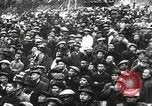
U.S. Army Air Forces employ air power in the India-Burma theater during World War II. Chinese troops are equipped and trained by U.S. soldiers.
Camera pans across scenes showing masses of Chinese. Narrator cites their large population as a war asset. Lt Gen. Daniel Sultan Commander of US Forces, India–Burma Theater (USFIBT) describes the Allied mission as simply "placing guns in the hands of men in order that they can kill our common enemy." He describes Japan's 1942 strategy of completely isolating China from outside help. Animated map shows Japanese forces attacking China from bases in Thailand and advancing north, driving British forces into India, and leaving Burma in Japanese hands.Glimpse of Japanese troops occupying Burma. Views of American troops evacuated to India. View of Chinese soldiers boarding U.S. Air Transport Command C-46 transport planes for flights from Kunming to Dinjan and Chabua, India. Closeup of some troops inside the cabin of a plane. Chinese soldiers await transport as a C-47 aircraft takes off in the background. Aerial view of two C-47 planes in formation. View from the air of high cloud covered mountains. Storm clouds over the mountains. Downward view from an aircraft flying over the Himalayan Mountains (called flying the "hump" by U.S. pilots). View of Chinese soldiers inside a transport plane. View out the window of a transport plane landing in India. A C-46 airplane taking off. A large formation of Chinese troops seen after more were brought from China to India, later in the war. American soldiers training troops of the Chinese 38th and 22nd Divisions. General Sultan speaks of the need to build up the U.S.Air Transport Command. Two C-47 airplanes on the ground. One named "The Joker." View of sky filled with B-24 Liberator bombers. Sky filled with C-47 transport planes. Chinese soldiers training in Kunming, climbing out of trench in live fire exercise with machine guns firing over their heads and explosive charges detonating near them. Air frame of a P-47 aircraft being loaded and several of Bell P-39 Airacobra aircraft being loaded aboard ship bound to strengthen the U.S. Army 10th and 14th Air Forces in Burma, in 1944. Covered P-47 aircraft without engines being towed by jeeps along a street in Burma. A large airfield with many U.S. fighter planes parked on its ramps. Engines being installed on P-39 aircraft. A flight line filled with P-40 aircraft displaying Chinese roundels. Some fly over a flight line of U.S. Army Air Forces P-39 aircraft. Glimpse of a fighter plane escorting a transport aircraft. A formation of B-24 Liberator bombers dropping bombs and exploding on Japanese ground targets. Workers are seen unloading large amounts of cargo from a B-24 bomber. Workers rolling a large bomb from the plane onto the tailgate of a truck.
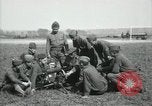
British soldiers instruct U.S. Army Infantry troops on setup and use of Vickers machine gun during World War I in France.
British soldiers demonstrate rapid setup and use of Vickers machine guns to U.S. Army 307th and 308th Infantry troops in France during World War 1. British instructor shows parts of the gun and demonstrates how to load it, with U.S. Army soldiers gathered close around. The U.S. Army forces in two facing lines observe as a pair of soldiers work together to quickly transport the gun base and muzzle separately, and then join the two to be ready for firing. A Commanding Officer walks the line of observing soldiers and talks to them. A target firing line of machine guns is seen. U.S. forces practice use of the machine guns, and then inspect their targets to evaluate accuracy. (World War I; World War 1; WWI; WW1)
U.S. President John F Kennedy arrives at the U.S. Military Hotel General Von Steuben in Wiesbaden Germany
A U.S. Army VH-3A helicopter lands on the lawn of the Hotel General von Steuben, in Wiesbaden, Germany. A crowd of spectators stands across the drive from the hotel lawn, constrained by German policemen. U.S. Air Force Military policemen stand guard on the nearer side of the drive. Soon the Presidential VH-3 helicopter, Marine One, lands on the lawn. It displays the Presidential seal and that of the Military District of Washington, DC. Next, President John F. Kennedy is seen walking past the Army helicopter and into the U.S. Military's Hotel General von Steuben. He is accompanied by German Chancellor, Ludwig Erhard, U.S. Secretary of State, Dean Rusk and U.S. Army Aide, Brigadier General Chester V. Clifton, along with a phalanx of Secret Service Agents. Other officials look out from a dining room window of the hotel as the Presidential party arrives. (Note: In the 1950s, the U.S. built three large military hotels in Wiesbaden. In 1951,a star-shaped Hotel [the American Arms] was built on Frankfurter Strasse. In 1955, the 9-story Amelia Earhart Hotel was opened. It was a utilitarian structure, with row after row of windows. President Nixon once stayed there. It closed in 1995. The General von Steuben Hotel, depicted in this film, was the newest, built in 1956, on Auguste Viktoria Strasse, near the train station. It is now a commercial hotel, "the Dorint Hotel Pallas Wiesbaden.")
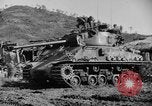
U.S. Troops examine abandoned North Korean T-34 tank. U.S. M4 tanks in action during Korean War.
Activities of U.S. Cavalry tanks in Korea during the Korean War. U.S. troops examine North Korean T-34 tank. U.S. M4A3E8 Sherman tanks in operation. Mountains in background. U.S. tanks go through an open field. M4 Tank passes through muddy terrain. U.S. M4 tanks take up positions and fire guns at distant targets. Smoke rises from exploding shells. Two U.S. Army field grade officers consult a map and converse.
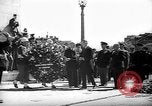
U.S. Ambassador to France Caffery at the Tomb of the Unknown Soldier in Paris and U.S. military cemetery in Suresnes in France.
Memorial Day in Paris, France. U.S. Ambassador to France Jefferson Caffery with officials. The ambassador lays a wreath at the Tomb of the Unknown Soldier. A guard helps the ambassador. The officer behind the ambassador salutes. The ambassador signs on a book. The wreath has a band across it which reads 'American Overseas Memorial Day Association'. U.S. military cemetery in Suresnes. American and French flags beside the graves. U.S. soldiers walk between the graves. U.S. troops march in the cemetery. Jefferson Caffery arrives with officials. U.S. Airborne Battalion marches in the cemetery. The soldiers stand at attention. They fire a volley over the cemetery. The Airborne Battalion stands in formation along a pathway. The officials review the troops. French and American troops march along a road during the parade. People on both sides of the road watch the parade. U.S. Ambassador Caffery and the officials salute. The Ambassador and the officials talking.
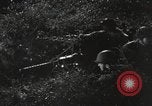
Japanese soldiers use different techniques of attack at night against U.S. Marines during World War II, Pacific Theater.
Deployment of U.S. Marine Corps on islands of Pacific and Japanese tricks of attack used against them during World War II. Re-enactment: Jungle warfare shows U.S. Marines with machine guns in foxhole at night. Japanese technique of attack shows U.S. Marines receive fake orders and being attacked by enemy. Another technique of attack as a U.S. Marine advance in jungle while second Marine gives him cover. Japanese soldier wearing an American helmet. Marine attacks Japanese soldier after hearing his footsteps. Dead Japanese soldier on ground. Japanese soldier slaps bamboo sticks together to simulate the sound of machine position. Marines fire machine guns from foxhole towards Japanese soldier camouflaged with foliage. Flares sent up in sky by Japanese soldiers. Japanese soldier acts as U.S. soldier and talks like one. Grenade explosion kills Japanese soldier. Marines counter the last Japanese trick.
CRITICALPAST.COM: About Us | Contact Us | FAQs - How to Order | License Agreement | My Account | My Lightboxes | Shopping Cart | Advanced Search | Featured Collections | Website Terms & Conditions | Privacy Policy ©2026 CriticalPast LLC.
License Agreement |
Terms & Conditions |
Privacy Policy
©2026 CriticalPast LLC.