


 Francais
 Deutsch
 Italiano

Refine Your Search
United States 1982 stock footage and images
- Showing 979 to 984 of 34981 results more
 Hide
Color Sound
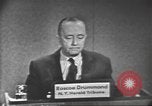
John Kennedy and Nixon debate over the prestige of America prior to the presidential elections in the United States.
Presidential election debate held between Democratic nominee Senator John F. Kennedy and Republican nominee U.S. Vice President Richard Nixon in the United States. New York Herald Tribune newspaper correspondent Roscoe Drummond asks Senator Kennedy that how can American prestige be measured abroad. Senator Kennedy responds stating that America is identified with the cause of freedom and if other countries have to choose between America and a Communist country, they would choose America. He further speaks that there are many indications that prestige of the United States is not as high as it once was. Kennedy summarizes some of these indications and relates to it by mentioning the example of Sputnik space program by the Soviet Union in 1957 (during the Space Race). Kennedy speaks about the economic development of the Soviet Union. He says the Soviet Union will be ahead of any other country scientifically and militarily by 1970. He mentions votes by different countries in the United Nations dealing with Red China. He says that Guinea and Ghana, two independent countries now are supporting Soviet foreign policy at the UN. NBC correspondent Bill Shadel asks Richard Nixon to speak on the topic. Vice President Nixon responds by speaking about the economic development of the Soviet Union. He speaks that the Soviet Union is a very primitive economy and that the United States is well ahead economically. He says that if the United States is going to maintain its strength and its prestige, they must not only be strong militarily and economically but must be firm diplomatically also. Bill Shadel says that an entire hour was devoted to answering questions from the reporters. He says that each candidate was questioned in turn and each had the opportunity to comment on the answer of his opponent. Shadel says that the reporters were free to ask any question on any subject, neither candidate was given any advance information on any question that would be asked. He says that the fourth debate is scheduled for Friday, October twenty-first.
A political advertisement in the U.S. promotes Nixon and speaks out against policies of the democratic party in 1968
A political advertisement in the United States prior to the 1968 Presidential Election promotes Republican party nominee Richard Nixon. Still images show U.S. Vice President Hubert Humphrey becoming a Democratic nominee at a tumultuous convention in Chicago, Illinois which was marred by disorder. Images of violent confrontations between antiwar protesters and police in the United States during the 1960s. Images depicting poverty in rural are urban areas of the United States. U.S. soldiers in Vietnam. (Vietnam War period).

The recruitment of women as Marines in the United States, during World War II.
A film titled: 'Lady Marines' on the recruitment of women in the United States Marine Corps, during World War 2. Views of Marines engaged in combat. U.S. Naval guns firing. A Marine dive bomber in action. Splashes in water from explosions. Marines in an amphibious assault on the beach. Paramarines making a jump. Tanks moving on the field. U.S. Marines firing machine guns. Paramarines boarding an airplane. Views of U.S. Marines in non-combat assignments in Washington, DC. Exterior of the U.S. Capitol building. Trucks being refueled. Marine mechanics maintaining vehicles. Marines engaged in administrative and logistical wartime support activities. A Marine typing a document on a typewriter. Comments about the need to free trained Marines for combat. A scene of Japanese soldiers celebrating a victory. A poster with the photograph of a woman reads: 'Be a Marine'. On February 13, 1943 the Marine Corps Womens Reserve is formed. Women are recruited to relieve Marines for combat. Women Marines salute.

Sailors undergo anti aircraft tracking drills aboard a ship underway at sea in the United States.
A film titled: 'Life at Sea' on the life of U.S. Navy sailors aboard ships. United States Navy ships in a harbor in the United States. A signalman near a signal light. The U.S. flag flying atop a flag pole. Sailors aboard ships. U.S. Navy Cruiser USS Macon (CA-132) underway at sea. An officer looks through binoculars. A Captain standing on a bridge with sailors. A sailor looks through binoculars. The sailors get ready for anti aircraft tracking drills. Sailors seated at a table. Ships underway. Men at an information center for tracking any enemy aircraft. They track the enemy aircraft and report to battle stations. They get ready for action. They look through binoculars. They aim anti aircraft guns as the aircraft fly in formation overhead. Men in a radio room keep in touch with the rest of the navy. The sailors aim the guns.
Modern agriculture machinery are used in farms and USDA conducts various program in the United States.
A film 'The Agriculture Story' showing various projects carried out by U.S. Department of Agriculture in the United States. Views of Capitol. Statue of Former U.S. President Abraham Lincoln. Views of farm. Agriculture machinery plow field. Horse drawn plow, plows field. Machinery work in farms. Dust storm in the background of farm land. Car being driven on road. Damaged agriculture machinery on barren land. Fire blazes in forest. U.S. Department of Agriculture showing loss in agriculture in papers. Seal of United States Department of Agriculture (USDA). It conducts programs including research, education, conservation, stabilization, regulatory functions, credit and marketing here and abroad.

Members appointed in the cabinet of President Roosevelt give brief speeches in the United States.
Members appointed in Roosevelt's cabinet in the United States. U.S. President Franklin D. Roosevelt appoints the members of his cabinet. Claude A. Swanson as U.S. Secretary of the Navy, Henry A. Wallace as the Secretary of Agriculture, George H. Dern as the Secretary of War, Harold L. Ickesas U.S. Secretary of the Interior and Daniel C. Roper as U.S. Secretary of Commerce are appointed. The new members of the cabinet give brief speeches.
CRITICALPAST.COM: About Us | Contact Us | FAQs - How to Order | License Agreement | My Account | My Lightboxes | Shopping Cart | Advanced Search | Featured Collections | Website Terms & Conditions | Privacy Policy ©2026 CriticalPast LLC.
License Agreement |
Terms & Conditions |
Privacy Policy
©2026 CriticalPast LLC.