


 Francais
 Deutsch
 Italiano

Refine Your Search
United States 1982 stock footage and images
- Showing 985 to 990 of 34981 results more
 Hide
Color Sound
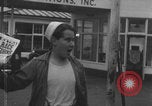
Roosevelt wins 1944 United States Presidential Election (WW2)
Newspaper boy peddling newspapers with headline "Nip and Tuck Race." View of Times Square in New York City during World War II. Shops in Times Square with barricades to prevent vandalism by crowds. View of Times Building. An Asian man and a White man standing together while checking for election updates from Times Building. Election officials and staff open a machine processing election returns from the small towns from the Eastern United States. Election official opens a Perfection ballot box. Radio announcer with CBS microphone, possibly Bob Trout, broadcasts updates as votes are tabulated. Volunteers tabulate results. Woman's hand seen turning on radio. United States soldiers based in Italy and France listen to radio to hear that current United States President and Democratic party candidate Franklin D. Roosevelt was leading race. Two United States soldiers smiling as they hear the news. WEAF Radio announcer broadcasts election returns from the west coast. An American family listening to the radio in their living room. An American family, with a picture of a serviceman on top of radio, listens to the news that Roosevelt won. Zipper marquee on Times building announcing election returns. Crowds gathering in Times Square New York. Americans celebrated the victory in New York. View of the Times Square at night. American civilians and soldiers celebrate the victory of United States President Franklin D. Roosevelt’s fourth term in office.

United States Air Force video debunking Roswell incident.
An anonymous UFO enthusiast talking. Aerial view of a deserted area near Roswell. Slate reads “Mufon 1992 International UFO Symposium Proceedings UFOs: The ultimate mystery of the millennia”. Anthropomorphic dummies mistaken as alien remains. Photographs of dummies used on high altitude experiments by the USAF. A Crash Test Dummies “Dummy Cam” PSA commercial by the United States Department of Transport and the Ad Council from the 80s-90s. A pair of crash test dummies inside a car. Vince the Crash Test Dummy adjusts his “Dummy Cam”. Car crashes into different places from crash test dummy’s perspective. Scientists prepare a crash test dummy in the 1950s. Two USAF personnel poses with an anthropomorphic test device (ATD). An ATD is released from a high altitude. A dummy is ejected from a fighter. An ATD descent with a parachute. A large high-altitude balloon is inflated and ascends. White balloon with dummies climbs upwards. A dummy is released from balloon. Camera attached to dummy shows its POV during descent. A dummy with a parachute land in a desert. USAF Test Pilot Captain Joseph William Kittinger II before a test flight. A high-altitude balloon ascends, carrying a module containing Captain Kittinger. A high-altitude balloon floats in the sky. A man opens a December 1960 National Geographic magazine. A page reads “The Long Lonely Leap” featuring Kittinger. LIFE, Collier’s, and TIME magazines covers feature Kittinger. Movie poster of 1956 drama “On the Threshold of Space”. Air Force personnel, aircraft, and other equipment are featured on film. A sign at the Holloman Air Force Base in New Mexico. Deflated high altitude balloons in the desert. A diagram depicts the size comparison of a balloon and a DC-9 airliner. High-altitude balloons carry scientific devices from the Holloman Air Force Base. A man prepares a payload attached to a high-altitude balloon. Space probes from NASA. A large container labeled “Viking Project Langley Research Center”. USAF high-altitude balloons carrying various NASA equipment (resembling “flying saucers”). Roswell Industrial Air Center. A “flying saucer”-like device lands in a desert. Payloads after landing in desert west of Roswell. Scientists read data from a large computer. Sign reads “Welcome to Holloman Air Development Center”. Recovery personnel hands over a permit. Photographs of United States Air Force trucks and recovery crews working on the ground and on aircraft. A bomber approaching a balloon. Photographs of USAF Balloon branch personnel with locals. Balloon branch personnel use tractors and pack mules. A dummy attached to a high-altitude balloon in flight. Crowds gather to watch descent of payload. Deflated high-altitude balloon hang on a grove of trees. A high-altitude balloon in flight over Phoenix, Arizona on June 13, 1985. The high-altitude balloon after landing on the Gila River Indian Community. A box attached to the parachute lands on the desert. A man inspects a scientific payload. USAF personnel arrive to the scene. Air Force personnel talks about the scientific payload. Low altitude tethered balloons launched from Holloman Air Force Base in flight. Men inspect a balloon on the runway of Holloman Air Force Base. A UFO book by Donald R. Schmitt and Kevin D. Randle. A drawing of a crashed “spaceship”. Comparison between the drawing and a photograph of an experimental tethered balloon. Airman uncovers the aluminum foil cover of a module (Project Man High June 2, 1957). Captain Kittinger waving. A photograph of Colonel Kittinger with President Eisenhower. Captain Kittinger performs a record-breaking parachute jump from Excelsior III (August 16, 1960). Captain Kittinger jumps from a gondola. Captain Kittinger climbs on an aircraft. Kittinger puts on an aviation headset. A McDonnell Douglas F-4 Phantom II in flight. An indicator locating target in flight during the Vietnam War. Target hits a Vietnamese fighter, exploding in flight. “Triple Nickel Phantom II” logo. Colonel Kittinger returns to the United States from Vietnam. Colonel Kittinger gives a speech after his return from captivity. Colonel Kittinger on his solo crossing of the Atlantic by balloon. Pallbearers hold the United States flag over a coffin during a full honors funeral. A Boeing KC-97G Stratofreighter towing another aircraft in flight. A Report of AF Aircraft Accident. Walker Air Force Base entrance near Roswell. USAF Hospital inside Walker Air Force Base. Project Excelsior backup pilots in gondola. Photograph of Captain Dan B. Fulgham, a survivor of a 1959 balloon accident near Roswell. A United States Air Force Chase Helicopter transporting patients to Walker Air Force Base. Sign reads “Warning Restricted Area”. Captain Kittinger speaks to instructor pilot at night. Captain Fulgham with head wrap due to injuries. Clinical record cover sheet for Captain Fulgham. Captain Fulgham in spacesuit. Captain Fulgham holding a ladder leaning on an aircraft.

U.S. President Eisenhower and Ambassador Henry Cabot Lodge speak about U.S. intervention in the Lebanon Crisis.
United States intervention in the Lebanon Crisis. U.S. Marines reaching the coastline of Lebanon. The Marines climb out of rafts. People watching the Marines. U.S. bomber aircraft in flight. Lebanese people on a beach. U.S. Marines unloading ammunition from the rafts. The Marines holding guns moving into the city of Beirut. The Marines guarding Beirut International Airport. U.S. President Dwight D. Eisenhower during a speech says that U.S. intervention could have serious effects. He says that the United States is neither looking for any material gain nor has it any emotional hostility against any government. The sole aim is the preservation of independence of every state. Several aircraft on an airfield. U.S. 2nd Marine Division enplaning at Cherry Point in North Carolina, U.S. Soldiers holding equipment beside the aircraft. The soldiers walking in columns. Several aircraft on the airfield. U.S. Army airborne troops beside the aircraft. The troops getting into the aircraft. Airborne troops from Germany at Adena air base in Turkey. British paratroops from Cyprus boarding aircraft bound for Jordan. A Royal Air Force aircraft takes off. U.S. aircraft carrier USS Leyte in a harbor. Supplies carried on cranes. U.S. sailors speaking over telephones in phone boxes. Sailors holding cartons moving on a ramp to a vessel. Officials at the United Nations building during a meeting. U.S. Ambassador to the UN Henry Cabot Lodge speaking into a microphone. Officials beside the Ambassador. The Ambassador calls for decisive action by the UN and says U.S. Marines will be withdrawn in accordance with the UN action.

U.S. Task Force ships battle Japanese aircraft and U.S. Marines land on an island in the Pacific Theater during World War II.
U.S. Task Force combat against enemy in the Pacific Theater depicts use of war bond money during World War II. Task force ships underway. A blinker signal is given from a ship. Formation of U.S. Army Air Force aircraft overhead. U.S. Navy officers discuss charts aboard a ship. U.S. sailors manning a gun. A U.S. submarine rises on water surface. Aircraft parked on the deck of a carrier. A U.S. aircraft takes off from the carrier to protect the advancing convoy. Navy guns aboard a ship are fired. U.S. aircraft peel off. Japanese bombers drop bombs on a U.S. convoy underway at sea. Ships burn after being attacked. A U.S. ship sinks. A Japanese pilot in the cockpit of a bomber. A Japanese bomber is downed by U.S. antiaircraft fire. U.S. Marines disembark from a ship and board a landing craft to assault a Japanese held island. A formation of aircraft. Marines wade ashore. The Marines advance on a beach. Japanese soldiers march on the beach. An aircraft crashes.

Gulf of Tonkin response: President Johnson announces U.S. action as United States soldiers and aircraft are rushed to Vietnam
United States planes and soldiers are rushed to Vietnam, responding to the Gulf of Tonkin crisis. U.S. Destroyer Maddox seen underway in the gulf of North Vietnam following reported skirmish with North Vietnamese torpedo boats (the "Maddox Incident.") Narrator indicates U.S. war planes from two carriers avenged the unwarranted Red communist assault with 64 sorties against North Vietnam. An airman boards a U.S. aircraft. Night view of the White House in Washington DC. President Lyndon Johnson addresses the American people in a midnight speech on August 4, 1964 describing U.S. actions in response to the Gulf of Tonkin incident. Scenes of South Vietnamese women and children evacuees looking exhausted and scared beside nearby American helicopters. The President's speech continues, including, "We Americans know, although others appear to forget, the risks of spreading conflict. We still seek no wider war." View of the United Nations building in New York and flags of various nations at the UN building. Ambassador Adlai Stevenson is seen making his report of the Gulf of Tonkin attacks to the UN Security Council and affirms U.S. position that it wants the people in Vietnam to be free of North Vietnamese intervention and agression. United States military advisors and U.S. Army soldiers board helicopters. A gunner aims at a target on the ground. Vietnamese troops accompany U.S. soldiers. South Vietnamese forces exit a helicopter and wade through water and rice paddies. U.S. soldiers advance in trucks with artillery. A Douglas TBD Devastator aircraft takes off armed with a torpedo. Another one lands at an airfield. A TBD plane, armed with a torpedo, taxis with wings folded. several TBD aircraft parked on a flight line. The President concludes his remarks referring to "firmness in the right" being indispensible for peace. (Vietnam War period).
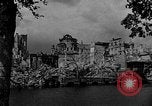
People in the U.S. listen as President Truman speaks during the United States flag raising ceremony in Berlin at end of World War 2
Filmed shortly before the Potsdam Conference in Berlin, Germany. A view of the devastated city of Berlin shortly after the end of World War 2 in Europe. Aerial views of bomb damaged Berlin and point of view shots from a moving car passing destruction, rubble, and skeletons of buildings from bomb damage. U.S. President Harry Truman surveying the damage from an open car, and view of his car approaching the Brandenburg Gate and driving on the Unter den Linden. Three flag towers each decorated at the base with an image of Truman, Stalin, and Churchill. U.S. President Harry S. Truman is riding through Berlin with General Secretary of the Communist Party of the Soviet Union Joseph Stalin and Soviet Foreign Minister Vyacheslav Mikhailovich Molotov. Flashback shows German Fuhrer Adolf Hitler parading in Berlin. People crowd on either side of a street to cheer. Close up back and side profile view of Hitler as he stands in a moving car waving to the crowd. Hitler speaking at a Nazi Rally, forcefully and animated, about Germany wiping out inferior races, and decrying America's society of mixed people, saying that it has a ridiculous notion of equality and freedom that cannot stand up against Germany. The German people in the hall applaud. Truman speaks into a microphone in Germany after the war. U.S. delegates stand in the background. A radio tower. A U.S. military serviceman operating controls for the radio broadcast. People in the U.S. listen to President Truman speaking from a Berlin Radio Station. A hand on a typewriter. People of the United States in groups listening to radio: Men gathered at a city store listening to the radio speech; a woman typist listening to the radio beside her typewriter; men in a rural general store gathered around a radio near a wood stove; farmers listening to a radio; office workers gathered around a radio; a family in a living room listens to the radio; group of U.S. Army soldiers gathered to listen to the radio . Truman speaking on the grounds of the United States Group Control Council Headquarters in Berlin. He is in a courtyard that had been the home of the German Air Defense for Berlin. An honor guard from Company 'E' of the 41st Infantry is present, along with Secretary Stimpson, Assistant Secretary McCloy, and Generals Eisenhower, Patton, Clay, and Bradley. Soldiers stand in formation in the background. He speaks about peace in the world during the ceremony raising the United States flag over the U.S. controlled area of Berlin. His words included the statement, "Let's not forget that we are fighting for peace and for the welfare of mankind. We're not fighting for conquest."
CRITICALPAST.COM: About Us | Contact Us | FAQs - How to Order | License Agreement | My Account | My Lightboxes | Shopping Cart | Advanced Search | Featured Collections | Website Terms & Conditions | Privacy Policy ©2026 CriticalPast LLC.
License Agreement |
Terms & Conditions |
Privacy Policy
©2026 CriticalPast LLC.