


 Francais
 Deutsch
 Italiano

Refine Your Search
United States 1982 stock footage and images
- Showing 1015 to 1020 of 34981 results more
 Hide
Color Sound
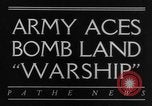
A-3's in formation flight and B-3A bombs on the ground beside the marked outline of a battleship in the United States.
Army aces bomb land warship during bombing practice in the United States. U.S. Army Air Corps Curtiss Falcon A-3's in formation flight over clouds. Wing of a B-3A in the foreground. Pilot and copilot of a U.S. Army Air Corps B-3A bombers. A B-3A bombardier releases a bomb. Bombs being released. Three bombs drop from a U.S. Army Air Corps B-3A, and pass out lower frame. Bombs dropping and exploding in a large circle on the ground. A-3s in flight and clouds in the background. A B-3A bombardier release bombs. Bomb drops from a B-3A, and descends out lower frame. Bombs descend and explode on the ground beside the marked outline of a battleship. Two B-3A's in flight. Bombs falling from a B-3A and a second B-3A in the background. Bombs drop and explode in the outline of a battleship marked on the ground.

French President Vincent Auriol accompanied by his wife and top French diplomats arrives in the United States for a state visit.
The United States welcomes French President Auriol during his state visit. President Jules-Vincent Auriol accompanied by his wife Michelle Aucoutuier and top French diplomats arrives in the United States for a state visit. He visits the Statue of Liberty in New York. President Auriol waves to the crowd. In Washington DC, U.S. President Harry S. Truman, and the members of the official family greet President Auriol. The motorcade of President Auriol is driven through the streets of the city. President Truman and Auriol seated in a car of the motorcade. People standing on both sides of the roads welcome President Auriol. Flags of the United States and France. President Auriol delivers a speech about his visit to help strengthen ties of Franco-American friendship.
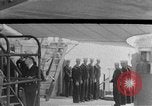
British Prime Minister Winston Churchill and top ranking British officials board USS Augusta to meet U.S. President Roosevelt
U.S. President Franklin Roosevelt and British Prime Minister Winston Churchill meet for the Atlantic Conference in World War 2 aboard USS Augusta in Placentia Bay, Argentia, Newfoundland. U.S. General George C. Marshall, Vice Admiral Ernest J. King, and Admiral Harold R. Stark, descend steps to main deck of U.S. Heavy Cruiser, USS Augusta, where they greet top ranking members of the British military establishment as they arrive for the Atlantic Conference. U.S. General Marshall is seen greeting British Field Marshall Sir John Dill. President Roosevelt is assisted by his son, Franklin, Jr. who helps him obtain a handhold on a fixture of the ship. (This is a rare shot of President Roosevelt where he is seen walking a few steps with his cane, assisted, as his disability was typically not captured on film to be shown to the public.) President Roosevelt greets British Admiral Sir Dudley Pound, Admiral of the Fleet, First Sea Lord and Chief of the Naval Staff. He also greets British Field Marshal Sir John Dill, Chief of the Imperial General Staff. British Prime Minister Winston Churchill arrives, salutes the President, and walks past. Franklin Roosevelt, Jr. steps forward and guides Churchill back to stand with President Roosevelt, for the camera.

Activities dependent upon weather forecasting in United States.
Weather Bureau forecasting operations and the activities dependent upon weather forecasting in United States. A pilot seated in the cockpit of an aircraft, aircraft takes off and in flight. Aircraft navigates air. Naval vessels underway in sea as a Navy aircraft flies over them. United States airship Shenandoah in flight, Shenandoah moored to the United States ship Patoka. United States airship Los Angeles in flight as crew members look down, airship flies over a bridge. Airships fly over Washington Monument and Capitol building in Washington DC.

Soviet Premier Nikita Khrushchev and President Eisenhower meet at Camp David in Maryland, United States.
Major events of the year 1959. United States Vice President Richard Nixon with Soviet Premier Nikita Khrushchev where they engaged in the so-called "Kitchen debate" at United States Trade and Cultural Fair in Moscow, Soviet Union. Nixon talks to Khrushchev leading to the former's visit to United States. Khrushchev arrives in United States and President Dwight D Eisenhower welcomes him at the airport. Soldiers march as the Presidential motorcade follows them. President Eisenhower and Premier Khrushchev after a meeting at Camp David in Maryland.
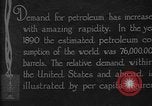
Total consumption and per capita consumption of petroleum of the United States is compared to that of the rest of the world.
The consumption of petroleum in the United States is compared to that of the rest of the world through an animation. The animation shows the population of the U.S. and the world outside of the United States in the year 1890. The animation also compares total consumption in barrels and per capita consumption in gallons of the U.S. and the rest of the world.
CRITICALPAST.COM: About Us | Contact Us | FAQs - How to Order | License Agreement | My Account | My Lightboxes | Shopping Cart | Advanced Search | Featured Collections | Website Terms & Conditions | Privacy Policy ©2026 CriticalPast LLC.
License Agreement |
Terms & Conditions |
Privacy Policy
©2026 CriticalPast LLC.