


 Francais
 Deutsch
 Italiano

Refine Your Search
United States 1982 stock footage and images
- Showing 121 to 126 of 34981 results more
 Hide
Color Sound
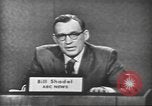
John Kennedy and Nixon talk about steps to improve U.S. economic growth during a presidential election debate in the U.S.
The third Kennedy-Nixon Presidential Debate in the United States. Roscoe Drummond of New York Herald Tribune asks Republican candidate U.S. Vice President Richard M Nixon to comment on declining economic growth and what steps he would take to improve it. Nixon answers that he is not satisfied with the economic growth of the U.S. He compares the nation's growth rate during the Truman Administration and the Eisenhower Administration. He urges for the development of private enterprise sector of the economy. He talks about his program of tax reform which would stimulate more investment in U.S. economy. He talks about the upliftment of the distressed areas and full utilization of resources of those areas. He talks about the adequate use of talents of the Americans and their civil rights. He concludes and states that there has been a continuous development of American economy in the past years. Democratic candidate Senator John F Kennedy states that Nixon has pointed a rise in food prices in his proposed agricultural program which is not true. He comments on the statement given by Nixon on aiding distressed areas and education. He says that the bills of these program have been opposed by the administration. He talks about the lowest rate of economic growth during this administration.
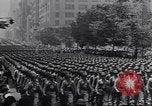
U.S. troops and WACs (Women's Army Corps) including African American soldiers parade along a street in the United States.
From a film about U.S. troops including African American soldiers who battled courageously during World War II. U.S. troops and WACs (Women's Army Corps) including African American soldiers parade along a street. An African American pilot. U.S. Army Major-General Clarence H Kells decorates Sergeant Joe Louis (famous boxer) with the Legion of Merit medal at Fort Hamilton, New York, in 1945. U.S. soldiers perform different tasks. Closing slates include a slate saying the film is not to be shown to the general public, and a second slate stating "Seized Enemy Material...under License Number LM-185"

U.S. bombers drop chalk bombs over air cadets during their training in the United States.
A training of U.S. air cadets in the United States during World War II. U.S. air cadets leave trucks on a field and dive for cover as U.S. bombers drop chalk bombs during the training. More bombs are dropped. The cadets lying on the ground.
U.S. Signal corps communications in war and in peace time in the United States.
A training film on the wartime and peacetime activities of the U.S. Signal Corps. U.S. Signal Corps recruits disembark on a beach from landing barges during World War 2. The soldiers set up communications equipment and operate a EE-8 field telephone, and morse code keyer to transmit range observations. U.S. Navy sailor sends signal lamp blinker signals from a U.S. Navy ship offshore. The signal corps soldiers lay telephone wires by aircraft and truck. The telegraph and telephone poles are erected. The Chief Signal Officer seated at his desk. Exterior view of the Pentagon, and then interior views inside the Pentagon at the Pentagon signal center. Soldiers working in the signal center of the Pentagon in Arlington, Virginia. Tape machines dispense paper tapes with encoded communications. Sign "Traffic Control Army Command and Administration System" written on a board in the center. The transmission system of the message.

A U.S. submarine along with a Destroyer escort underway at sea off the coast of the United States.
U.S. submarine underway at sea in the United States. Submarine heading out to sea off the coast of United States. Destroyer escort with them. Escorting airplane fly overhead. Bow of the submarine. U.S. flag flying atop flag pole on the submarine.

United States Navy Fleet Admiral Chester William Nimitz arrives aboard a submarine at the harbor in the United States.
United States Navy Fleet Admiral Chester William Nimitz aboard a submarine at harbor in the United States. Adm Nimitz coming aboard the U.S. submarine. Officers and sailors standing aboard the submarine. Ships and other vessels underway at sea in the foreground. Admiral Nimitz presenting citations. He talks to the sailors. U.S. flag flying atop the conning tower.
CRITICALPAST.COM: About Us | Contact Us | FAQs - How to Order | License Agreement | My Account | My Lightboxes | Shopping Cart | Advanced Search | Featured Collections | Website Terms & Conditions | Privacy Policy ©2026 CriticalPast LLC.
License Agreement |
Terms & Conditions |
Privacy Policy
©2026 CriticalPast LLC.