


 Francais
 Deutsch
 Italiano

Refine Your Search
United States 1982 stock footage and images
- Showing 1441 to 1446 of 34981 results more
 Hide
Color Sound

President Eisenhower addresses the nation and lights a spruce during the Annual Christmas Tree Lighting Ceremony in the U.S.
The Annual Christmas Tree Lighting Ceremony in the United States. The President of the United States Dwight D. Eisenhower and his wife Mamie Eisenhower arrive for the ceremony. An officer greets and receives them. The Vice President of the United States Richard Nixon and his wife Pat Nixon also arrive for the ceremony. The President addresses the nation that world peace is up to Russia. He lights a 60-foot spruce which is a symbol of world's hope for peace.
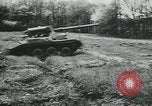
U.S. experimental tank undergoing field test. Army instructors explain new weapon systems. Captured German rockets.Soviet parade
A U.S. experimental tank undergoing field tests in the United States. Soldiers test weapons on a field. An officer demonstrates use of mortar. A flame thrower being fired. Instructors explaining new Army weapon systems. U.S. soldiers pull a captured German V-1 buzz bomb from a shed, for testing. A captured German V-2 rocket is rolled out for testing. The rocket is launched successfully from a launch pad. Soviet Leader Joeseph Stalin and Foreign Minister Minister Vyacheslav M. Molotov together, with two Soviet Generals,are seen on a reviewing balcony, above Lenin's tomb, as they watch a Military parade in Red Square, Moscow. Soldiers holding guns march through streets. Tanks and missiles mounted on flat cars move. Buildings in the background. Russian revolutionary Vladimir Llyich Lenin's poster on a wall.
New U.S. infantrymen learn to fire rifles, make trenches and advance on a battlefield, in preparation for going to war in France
Training of U.S. Army infantrymen in the United States. A newspaper headline reads ' infantrymen arrive in France'. The infantrymen are taught to advance on a battlefield. Recruits in New York's Rainbow Division are seen marching in the mud, at Camp Mills, Long Island, They undergo physical training at the camp. They learn to fire rifles and dig trenches. They inhabit a tent city at the camp. Scenes of Rainbow Division soldiers on a chow line at Camp Mills. After basic training, the soldiers board ships and trains for France. Loved ones give them a sendoff. Upon arrival in France, they are given a warm welcome.They resume training in France, until they are ordered to the Front. Scenes of U.S. infantry in trenches wearing gas masks and firing rifles. Tanks advancing across the trenches. View of the 7th Regiment World War I memorial statue in Central Park, New York City.
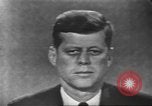
During an election debate in the US, John F Kennedy and Richard Nixon talk about the conduct, temperament, and speech of the U.S. President.
The third Kennedy-Nixon Presidential Debate in the United States. Charles Van Fremd from CBS News asks Democratic candidate Senator John F Kennedy whether he owed an apology to Vice President Nixon and the Republican Party, on behalf of Democrats, after former President Harry Truman "bluntly suggested where the Vice President and the Republican Party could go." Kennedy answers that President Harry S Truman has his methods of expressing things and he has been in politics for fifty years. He says that he could not tell President Truman to change his particular speaking manner, and perhaps only Mrs Truman could. Republican candidate Vice President Richard M Nixon says that U.S. President has an obligation not to lose his temper in public. He speaks of the importance of the standing of the office of the President, and how children all over America are influenced by the behavior and words of the President. He states that he is proud that President Eisenhower has restored dignity and good language to the conduct of U.S. Presidency. He implies that if he wins the election he would be the right kind of role model for children.
John F Kennedy and Richard Nixon contrast costs of their party platforms during a presidential election debate in the U.S.
The third Kennedy-Nixon Presidential Debate in the United States. Douglass Cater of Reporter magazine asks Democratic candidate Senator John F Kennedy to comment on costing of party platforms calculated by U.S. Vice President Nixon. Kennedy states that he believes in a balanced budget and an unbalanced budget is warranted during a recession or a national emergency. He comments on the cost of his budget and compares it with that of Nixon. He talks about high interest-rate policy that has added huge amounts to interest on debt. He talks about a different monetary policy to reduce the interest-rate burden. He talks about the bill passed by the Congress for the medical care for the aged. He says that more money would be spend on aid to education, housing and defense in his programs. Republican candidate U.S. Vice President Richard M Nixon comments on Kennedy's medical care for aged program under social security. He talks about the cost of his agricultural program and points out resulting rise in food prices. He concludes and states that following Kennedy's program would lead to inflation.
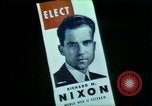
Prior to U.S. Presidential Election of 1968, Richard Nixon recounts his past and tells how he got into politics.
Self-portrait of Richard Nixon aired during his 1968 presidential run against Hubert Humphrey and George Wallace in the United States. An interviewer asks Richard Nixon that how he got into becoming a member of U.S. House of Representatives in 1947. Nixon replies that soon after World War II ended some Whittier Republicans approached him about running for a seat in the United States House of Representatives and he accepted. A picture of Nixon during his campaign in 1946. He says America is a great country because American people are competitive and it does not mean competition in the destructive sense. He considers America a great country in terms of competitive people and says that competitive spirit is a great driving force in any nation. And he says it is the reason why politics appeals to him.
CRITICALPAST.COM: About Us | Contact Us | FAQs - How to Order | License Agreement | My Account | My Lightboxes | Shopping Cart | Advanced Search | Featured Collections | Website Terms & Conditions | Privacy Policy ©2026 CriticalPast LLC.
License Agreement |
Terms & Conditions |
Privacy Policy
©2026 CriticalPast LLC.