


 Francais
 Deutsch
 Italiano
Refine Your Search
United States 1982 stock footage and images
- Showing 25837 to 25842 of 26494 results more
more Hide
Hide
Crew of the U.S. B-17 "Memphis Belle" begin their 25th (final) mission from Bassingbourn airfield, England, during World War 2
Scenes regarding the U.S. 8th Air Force B-17 named Memphis Belle, the first American bomber and crew to complete twenty-five missions over enemy territory in Europe during World War Two. Views of the peaceful English countryside around the British Royal Air Force Bassingbourn airfield, home base of the U.S. 8th Air Force 91st Heavy Bombardment Group. B-17s parked all around on the airfield. Views of Bassingbourn Church, graveyard, horse-drawn wagon, fields of grain, and farm buildings. On the airfield, ground crews clean canopies, refuel aircraft, and perform maintenance on the B-17s. Bombs seen stacked in munitions dump. Airmen ride on bombs aboard trolleys pulled by tugs. One plays the harmonica. Arriving at B-17s, they begin inserting nose fuzes in bombs. Pilots, Navigators, and bombardiers attend morning mission briefing and learn that their target is Wilhelmshaven. Chaplain prays over several crew members. Bombs are loaded on the B-17s. Crew of the 324th Bomb Squadron B-17, "Memphis Belle," arrives at the aircraft aboard a jeep. Pilot, Captain Robert K. Morgan gives last minute briefing and the crew boards the aircraft for their 25th bombing mission. Their airplane has 24 bombs painted on its side (one for each mission). They start their engines.
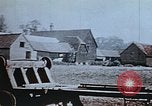
B-17s of the U.S. 91st Bomb Group take off from Bassingbourn Airfield, England on a mission.
Views of the area around RAF Bassingbourn airfield, as B-17s of the U.S. 8th Air Force, 91st Bomb Group, line up for takeoff on a mission to bomb German-held port of Wilhelmshaven, during World War Two. among the named aircraft seen taking off are: "Dame Satan," "Hitler's Gremlin," "Helno-gal," "Royal Flush," "Der Fuehrer's Face," "Old Bill," "Peggy, my little Waaf," and "Desperate Journey."
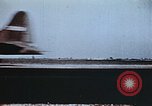
U.S. B-17s of 91st Bomb Group (including the "Memphis Belle") leave Bassingbourn Airfield on bombing mission in World War 2
B-17 bombers of the U.S. 8th Air Force, 91st Bomb Group, take off from their base at RAF Bassingbourn. Views from inside the B-17, "Memphis Belle." The landing gear of the "Memphis Belle" retracting into the wheel well. Views of English countryside, including many RAF airfields. B-17s in close formation. Crew members of the "Memphis Belle" are seen at their duty stations inside the aircraft, including: Captain Robert Morgan,Pilot; Captain Jim Vernis,Co-Pilot; Sergeant Robert Hanson,Radio operator and gunner; Captain Chuck Leighton, Navigator; Sergeant Harold Loch,Flight Engineer and Top Turret Gunner; Sergeant John Quinlan, Tail-Gunner; Sergeant Cecil Scott, ball turret gunner; Captain Vince Evans,Bombardier ; Sergeants Bill Winchell and Tony Nastal, Waist gunners. Pilot , Captain Morgan, alerts crew and dons his oxygen mask as they climb through ten thousand feet. View of coast of England as they leave. Temperatures drop and contrails form as the formation of B-17s climbs to 25 thousand feet.
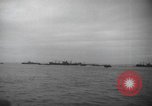
Exercise Fabius I, Rehearsal for invasion of Normandy in World War II. Transport ships and landing craft practice amphibious landings with American troops of the 16th Infantry Regiment.
At start of film, several American transport ships are seen manuevering in waters surrounded by some of their landing craft (Higgins Boats) on a foggy day off Slapton Sands, England during World War 2. They are participating in Exercise Fabius I, a rehearsal for the invasion of Normandy. Several Landing Craft Infantry (LCI) are seen approaching the shore. Troops of the U.S. Army 16th Infantry Regiment have already landed and are making their way inward on the beachhead. Higgins boats maneuver about as well. One, from the transport ship, USS Samuel Chase (APS-26) is seen approaching the shore. Views of troops leaving beached LCIs and Higgins Boats at the shore. Troops boarding a Higgins boat. It heads toward the shore.
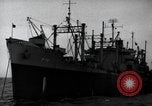
Exercise Fabius I, U.S. amphibious forces prepare for the invasion of Normandy in World War II. Transport ships and landing craft practice amphibious operations with American troops of the 16th Infantry Regiment.
Film begins showing closeup of the American transport ship, USS Anne Arundel (AP-76) anchored off shore at Slapton Sands, England. A landing ship (LCI-590) passes by her and several Higgins boats maneuver in waters nearby. Stern view of the Anne Arundel from an LCI. Closeup of an LCI pulling up next to the transport ship. Next, troops of the 16th Infantry Regiment are seen descending rope net from the transport ship and boarding the LCI. Closeup from the LCI of the troops reaching the deck of the LCI and walking forward. The number on the LCI is "88." Several views from different angles of the troops descending the rope net from the transport ship. View of the USS Anne Arundel with Higgins boats moving all around her. Closeup of LCI moving away from a transport ship. More views of troops descending from a transport ship to a Landing Craft Infantry.View from an LCI headed for the beach, where many troops have already landed. The LCI continues and beaches. Troops and various exercise markers are seen in the background Troops leave the LCI via her side ramps and join many others already ashore.
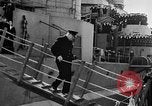
Winston Churchill disembarks from British battleship Prince of Wales in Scotland.
Atlantic conference during World War II. British Prime Minister Winston Churchill arrives after the Atlantic Conference and disembarks from the Royal Navy battleship Prince of Wales at Scapa Flow in Scotland. He takes off his hat and waves to the sailors on board the ship. Sailors on the deck wave back at the Prime Minister.
CRITICALPAST.COM: About Us | Contact Us | FAQs - How to Order | License Agreement | My Account | My Lightboxes | Shopping Cart | Advanced Search | Featured Collections | Website Terms & Conditions | Privacy Policy ©2026 CriticalPast LLC.
License Agreement |
Terms & Conditions |
Privacy Policy
©2026 CriticalPast LLC.