


 Francais
 Deutsch
 Italiano

Refine Your Search
United States 1982 stock footage and images
- Showing 31285 to 31290 of 34981 results more
 Hide
Color Sound

Company E, 1st Training Regiment trainees learn to use weapons and shoot targets by firing rifles at Fort Dix in New Jersey.
Trainees of Company E, 1st Training Regiment at Fort Dix in New Jersey, United States. Trainees climb on obstacle course. An instructor gives first aid lesson to trainees.. The trainees learn to locate and identify a target on a battlefield. They learn to use weapons and fire rifles at targets. They learn 'train fire technique'. A trainee shoots as he gets the feel of a target during his training. Lined up trainees walk and arrive at their center. They relax in their rooms. A trainee arrives home. He talks with his parents. A woman gets tea for them. The trainees receive electrical training at their center.
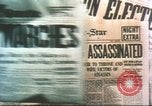
Hall of Heroes in the Pentagon and Medal of Honor recipients from World War I
The U.S. Medal of Honor and World War 1. A flurry of Newspapers covering Election of Woodrow Wilson; the assassination of Archduke Ferdinand; German troops on the march; the sinking of the Lusitania by a German submarine; and outbreak of a World War. Film reenactments of armed soldiers marching quietly through a town in the evening; soldiers in trenches of No-mans-land; an American soldier in a trench during enemy shelling; German soldiers firing machine guns; American troops charging through obstacles and smoke; and hunkered down in a deep trench. Scene shifts to the Hall of Heroes in the Pentagon, Arlington, Virginia, where names of 95 Medal of Honor recipients from World War 1 is highlighted. John Charles Daly mentions several of these heroes, and points to the name of Alvin C. York, who as a Corporal,acting alone, brought in 132 prisoners during that war.

Barbara Randolph serves as host disc jockey for American Forces Radio and Television Service in Los Angeles, California.
American Forces Radio and Television Service (AFRTS) facility in Los Angeles, California. U.S. Army personnel, in uniform, operate an AFRTS broadcast studio. Recording artist, actress, and singer Barbara Randolph seated in the sound room and working as the disc jockey for a radio program. She introduces a song and plays it for listeners. 45 rpm record playing on turntable. 1/4" reel to reel audio tape deck playing. Scene shifts to actor Robert Strauss, preparing to be filmed giving a promotional and public service message for American service personnel. Camera is ready. A man strikes a clapper, and the filming begins.
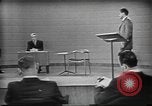
Senator John F Kennedy answers a panel of correspondents during a presidential election debate in Chicago, Illinois.
The first Kennedy-Nixon Presidential Debate in Chicago, Illinois. Moderator Howard K. Smith thanks Republican candidate U.S. Vice President Richard M. Nixon and Democratic candidate Senator John F. Kennedy for their opening statements. The Moderator the panel of correspondents: Sander Vanocur from NBC News, Charles Warren from Mutual News, Stuart Novins from CBS News and Bob Fleming from ABC News. Mr Fleming directs his first question to Senator Kennedy. He asks him why does he think that people should vote for him rather than Vice President Nixon. Kennedy answers and tells about his 14 years of experience in the Labor Committee. He compares the programs being advocated by the Democratic party and the Republican party. He states that the Republican leadership has opposed federal aid for education, medical care for the aged and development of country's natural resources in the past few years.
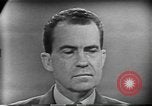
During a debate in Chicago, Illinois Nixon talks about his major recommendations which were adopted by the administration.
The first Kennedy-Nixon Presidential Debate in Chicago, Illinois. Stuart Novins from CBS News asks Republican candidate U.S. Vice President Richard M. Nixon about his major proposals in last eight years that have been adopted by the administration. Nixon answers and states that his major recommendations and proposals that have being adopted by the administration include: increase in the exchange programs like exchange of persons of leaders in the labor and information field. He further talks about his proposals like setting up of separate inter-American lending agency, his recommendations for the Hungarian refugee situation and price stability and economic growth that had been adopted. Democratic candidate Senator John F. Kennedy states his points on that question. He says that he disagrees with progress figures used by Nixon in his speech regarding the Truman Administration. He disagrees with the recommendations made by Nixon like price stability, exchange of students and labor unions being adopted by the administration.
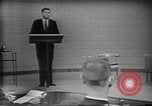
Kennedy talks about federal government assistance for farm surpluses during a presidential election debate in Chicago.
The first Kennedy-Nixon Presidential Debate in Chicago, Illinois. Charles Warren from Mutual News asks Democratic candidate Senator John F Kennedy about the need of assistance by the federal government for farm surpluses. Kennedy answers and states that the federal government supports farmers, as farmers cannot control their market because they lack bargaining power. He states that the overall economy depends on the agricultural economy. He talks about the interdependency of agriculture with other sectors. He further talks about farm policy, support price mechanism and tax load from the Treasury for the farmer. He says the policy for balancing effective supply and demand can only be carried out through governmental action. Republican candidate U.S. Vice President Richard M. Nixon presents his views and states that he disagrees with Kennedy that the farmers need more governmental control. He blames that the farmer is in problem because of the government which asks the farmer to produce surplus to meet emergency. He tells about holding up of farm income by paying the farmer in kind and indemnifying the farmer.
CRITICALPAST.COM: About Us | Contact Us | FAQs - How to Order | License Agreement | My Account | My Lightboxes | Shopping Cart | Advanced Search | Featured Collections | Website Terms & Conditions | Privacy Policy ©2026 CriticalPast LLC.
License Agreement |
Terms & Conditions |
Privacy Policy
©2026 CriticalPast LLC.