


 Francais
 Deutsch
 Italiano
Refine Your Search
V2 stock footage and images
- Showing 8587 to 8592 of 9862 results more
more Hide
Hide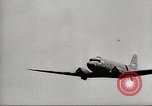
U.S. troops and their improvised movie theaters in combat zones during World War II
A U.S. Army Air Forces C-47 airplane carrying movies among its cargo bound from New Caledonia to troops stationed at Bougainville, Solomon Islands, during World War 2. Views inside the airplane cabin, where troops sit alongside the cargo. Glimpse from cockpit of aircraft on final approach to land on the airfield. Troops unloading canisters of movie films from the C-47. (Handing the movie reels out of the C-47 is Russ Laming of the 13th Troop Carrier Squadron, a.k.a the Thirsty 13th.) Army truck carrying mail bags and movie films driving away from the airfield. U.S. soldiers walk to their makeshift movie tent from foxholes and fortified positions. Sign on the tent reads: "Bougainville Roxy, Tonights feature." Movie projector seen inside the tent, as soldiers enter. Views of movie theaters made out of logs and other available materials at various locations in the Pacific theater of operations. They range from simple and rugged to more elaborate, at rear locations, away from the front lines. U.S. servicemen racing to get the best seats in a theater, as the doors open for a movie. Servicemen walking into an open air theater. They are called to attention as the unit commander arrives and takes his seat. View of wounded soldiers recuperating in a hospital,where a movie camera is being set up in the ward. They are tended by a French nurse wearing a "flying nun" hat (possibly North Africa). Servicemen and women being seated in an outdoor theater, and other places, waiting to watch movies. Allied troops join Americans to watch U.S. movies. A theater sign announcing the week's movie program at a Royal New Zealand Air Force post in the jungles. Courier carrying film canister from a jeep into a jungle theater. Soldier mounting the film on projector. U.S. troops watching a movie outdoors, during rain storm.
U.S. service personnel watch movies in various parts of the world during World War II
Audiences of U.S. servicemen and women watching Hollywood movies in a regular base theaters and outdoors in jungle combat settings, during World War 2. Views of the faces of audience members and their reactions as they watch movies on screen. Soldiers leaving a large elaborate movie theater after seeing a movie. Lieutenant General Brehon Burke Somervell, U.S. Army Chief of Logistics, expressing the Army's appreciation to the motion picture industry as he accepts the 10 thousandth Hollywood movie for exhibition to troops overseas. General Somervell mentions visiting troops in Australia, India, China, and Africa and comments on the way movies boost their morale.
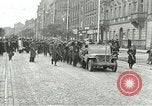
Czech partisans and U.S. soldiers round up German soldiers and civilians in Pilsen, at the end of World War II
A U.S. Army jeep rolls slowly in front of a group of civilians with their hands raised in Pilsen, Czechoslovakia, at the end of World War 2, in Europe. They are guarded by Czech partisans and Czech citizens. (The civilians are likely German civilians during expulsion of Germans from Czechoslovia at the end of the war. They may also include Czech civilians accused of collaboration with the Germans.) Two U.S. soldiers walk on sidewalk with a Czech policeman. The soldiers stand in front of a group of civilians on the sidewalk, looking upward. An elderly Czech civilian man with a rifle looks upward from edge of a building. A German officer is seen in window of a building. A white cloth (as flag of surrender) hangs from adjacent window. Armed U.S. soldiers escort high-ranking German officers, from their local headquarters, to a vehicle, as local citizens watch. U.S. soldiers and Czech partisans in a backyard, look for snipers in building nearby. German military prisoners, guarded by Czech partisans, stand with hands raised on a sidewalk. The partisans search German soldiers as they come out of a building. Some civilian women are held with the German soldiers.
A Pentagon messenger performs his duties in Arlington, Virginia unaware of the vital information he carries.
Contribution of messengers during World War II. Wrecked tanks and equipment on a field. U.S. Army soldiers guarding prisoner of war German soldiers as they march. View of German prisoners at an encampment. Duties of an African American messenger at the Pentagon in Arlington, Virginia. Augustus Johnson walks in various corridors of the Pentagon building, carrying messages. He talks to an African American dispatching supervisor. He places an envelope carrying information on a rack. A sign board reads: 'Army Air Forces'. He meets a visiting official and escorts him to his destination. Narrator extols importance of the messenger job during World War 2.
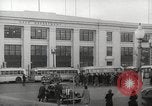
Soldiers and people stand outside and enter the buildings of the Navy Department and War Department in Washington DC.
Activities of civilian workers and soldiers at the War Department and Navy Department buildings in Washington DC, early in World War 2. Exterior of a building. 'Navy Department' written on the building. A crowd enters the building. Buses and other vehicles drive past along a street. 'War Department' written on a building. Soldiers stand outside the building. Soldiers and marines near a truck. Soldiers in front of the Munitions Department. Women come out of the building. Armed guards stand outside a building.
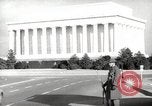
A soldier stands and walks on Arlington Memorial Bridge in Washington DC.
The Lincoln Memorial in Washington DC, United States. A soldier stands outside the building. Cars drive past along the street in front of the building. A soldier walks on Arlington Memorial Bridge, monitoring traffic entering the city early during World War 2. Buildings and trees in the background. The U.S. flags flying atop flag poles on a building.
CRITICALPAST.COM: About Us | Contact Us | FAQs - How to Order | License Agreement | My Account | My Lightboxes | Shopping Cart | Advanced Search | Featured Collections | Website Terms & Conditions | Privacy Policy ©2026 CriticalPast LLC.
License Agreement |
Terms & Conditions |
Privacy Policy
©2026 CriticalPast LLC.