


 Francais
 Deutsch
 Italiano
Refine Your Search
V2 stock footage and images
- Showing 421 to 426 of 9857 results more
more Hide
Hide
Workers make and assemble robot bomb parts and undertake bomb testing in Dearborn, Michigan and Toledo, Ohio
American robot bombs, America's answer to the German V-1 buzzbomb, being prepared in Dearborn, Michigan during World War 2. War production workers in armament factory weld bomb casing at Ford robot bomb factory. The workers move long tube like bombs with jet engines. They are known by nickname "Flying Chimney". The flying bombs on wheels. Men with ear protection in a testing area as the engines are fired during testing. Buildings in the background. Flame shooting from the jet engines. Workers including some women assemble the bombs at a plant in Toledo, Ohio, where wings and warheads are also built. A woman war production worker lying inside the body of a robot bomb and working on its assembly. The bombs take off from a launch pad in a gully at an Army Air Force test site. A booster cuts loose from the American Robot Bomb and hits water at a distance as the buzz bomb flies through the air, with an estimate 200 mile range. The bombs in flight. The booster hits water.
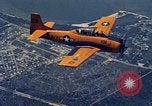
Film showing the type of Naval aviation training and kinds of assignments experienced by U.S. Marine officer, John Glenn, before his service as an astronaut.
Film that illustrates the kind of aviation training and early career experiences of American Astronaut John Glenn. Narrator discusses this throughout, but there are no images of John Glenn, himself in the film, which begins showing a formation of North American T-28 training planes from the U.S. Navy flight school at Pensacola, Florida, flying over water. Closeup of one doing a roll. Glimpse of instructor discussing Navy Mark 8-A Weems navigational computer in a classroom.. Cadets at Corpus Christi, Texas, in Altitude Chamber experiencing the effects of high altitude flight and learning about their individual symptoms of hypoxia onset. A cadet in the cockpit of an airplane as instructor standing on its wing points out features of the aircraft controls. A cadet using a sextant to shoot sun lines in daylight. Cadets engaged in calisthenics, and playing volley ball on a court set up on a flight line. A line of Navy Douglas AD Skyraider aircraft, with folded wings are parked in the near background. Cadets in dress whites leave a chapel following a service. Graduation parade and exercises in which the cadets are awarded their Navy wings of gold. A formation of four Navy Grumman F9F/F-9 Cougar aircraft in formation, viewed from above. Closeup of pilots in several parked Vought F4U Corsair aircraft, followed by Formation of several in the air ostensibly blasting enemy targets below, raising white smoke. A U.S. Navy Lockheed T-2V Seastar jet training aircraft performing a roll in flight at high altitude with condensation trails visible behind its wingtip tanks. Brief views of air combat during the korean War. Navy Vought F8U supersonic Crusader aircraft in flight. An X-15 aircraft being dropped from underneath a U.S. Air Force B-52 jet bomber. It rockets away rapidly from the Bomber.
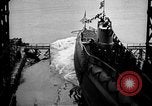
A mix of submarines from World War I to 1925
Sequence 1; The launching of the USS V-1 (later Barracuda SS-163) on July 17, 1924 from the Portsmouth Naval Shipyard in Kittery, Maine. Sequence 2; Two surrendered German U-Boats, most likely the U-117 (L) and the UB-148 (R) circa 1918/19. Sequence 3; The USS S-19 circa 1925 either looking to moor or pulling away to sea. Sequence 4; U.S. "L" class submarines ay Bantry Bay, Queenstown, Ireland circa 1918 World War 1, American submarines had to place an "A" before there name to avoid confusion with the British "L" class submarines. L to R are L-11 (bow), L-1, L-10, L-4 and L-9.
M-4 tank with dozer blade clearing snow from road and U.S. soldiers hit by gunfire in Belgium during World War II.
U.S. Army 3rd Armored Division advances in Sterpigny, Belgium during World War 2. M-4 tank with dozer blade clearing snow from road. It moves past damaged German Mark V Panther tank. Photographer with a camera taking pictures, while lying in snow. Across the road behind him, U.S. soldiers, in a parked 3/4 ton truck, are hit by gunfire from unseen source, and tumble from the truck,to the ground, where they writhe in pain. One of their unhurt companions runs for help, as a jeep stops near the truck. Next, soldiers are seen lifting the wounded from the truck, on litters. Medics carry them into a building.
U.S. Navy and Marine personnel recover after the battle of Midway in World War II
Recovery actions by U.S. Navy and Marine personnel in the wake of the Battle of Midway in World War 2. Opening scene shows religiious services being held by a bomb crater that had once been a chapel on Midway Island. That evening, marines are assembled near flag-covered coffins of fallen comrades, in a burial ceremony. A marine chaplain conducts a funeral service, as Marines stand, with their rifles, at parade rest Several views from different perspectives of the event. An honor guard fires a volley with rifles. The American flag is at half staff, in the background. Among the officers seen is Marine Major James Roosevelt, son of the U.S. President, Franklin Roosevelt. Next, Navy boats are seen offshore, carrying the fallen for burial at sea. U.S. Navy aircraft fly in formation overhead. A marine scans the sky with binoculars as dense black smoke continues to billow from the petroleum facility bombed by the Japanese several days ago, and hangs like a pall over Midway Island. The American flag on a tall pole, is highlighted against the black smoke. Film ends with series of Slates summarizing Japanese losses in the Battle of Midway. The first shows 4 Japanese Carriers sunk. It is painted over by a brush containing red paint. Another slate announces 28 Japanese Battleships, Cruisers, Destroyers sunk or damaged. A paint brush places a large black cross over that slate. A final slate states 300 Japanese aircraft destroyed. The red paint brush appears again, but this time it marks a big “V” for Victory across the slate.
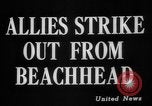
Allies bring reinforcements and supplies following the succesful establishment of beachheads during the invasion of Normandy, France, in World War II
Beachhead at Normandy, France, following the Allied invasion in June, 1944 during World War 2. Numerous supply ships are in the water offshore. Landing craft are all along the beach. Military vehicles fill the beach itself. British and American troops, ashore, observe ship maneuvering near a floating dock. British infantry pour from the open ramp of large British landing craft, behind some American troops already landed and walking along the shore. American soldiers aboard a landing craft next to a transport ship. Closeup of one of the soldiers in the craft, who wears "Screaming Eagle" patch of 101st Airborne Division. The open deck of an exceptionally large landing craft is seen jammed with U.S. troops, ready to depart from a transport ship. They wave for the camera. An American army truck driving out of British Landing Ship Tank (HM 415) onto a floating dock. It makes its way behind others headed toward the shore. Closeup of soldier wielding a sledge hammer to secure pierced steel plank (Marsden Matting) onto the beach. A DUKW (duck amphibious truck). German prisoners of war, disarmed and under guard, marching casually toward the beach. Closeups of some passing the camera. View from the beach of some wading out to a waiting landing craft. View on the beach of others approaching the beach for evacuation. View shifts to captured German film depicting German coastal defenses and structures of the so-called "Atlantic Wall." German Field Marshal, Erwin Rommel, accompanied by Field Marshal, Gerd von Rundstedt, as they inspect the fortifications. Views of coastal guns. Several German soldiers, using a 4-wheel dolly, roll a huge shell and powder charge out of a bunker. They roll it toward a camouflaged railway gun. German soldiers climbing steel stairs up to the railway gun and hand-cranking the barrel into firing elevation. Marshal Rommel accompanied by a Navy admiral and a soldier, walks up to the twin barrels of a coastal defense gun. the pause directly in front of the barrels and converse. The Admiral and the soldier both salute, perhaps acknowledging a comment or order from Rommel. Extreme closeup of the gun barrels.Next, back on the beachhead, Briitish soldiers are seen walking along the beach past knocked out German fortifications and standing near other abandoned ones. A British soldier swings a sledge hammer a reinforced concrete structure on the beach. A French man and woman waving at American troops passing them. British soldiers riding in a British Universal Personnel Carrier, MK II. Two Frenchmen wave at the troops. In nearby town, British soldiers are happily greeted by local inhabitants, including a woman with a baby on the sidewalk; children looking out a window; and people gathered at a street corner. A British soldier holds a French boy and offers him a piece of candy. An American M7 ("Priest") self-propelled 105mm howitzer and armed with a 12.7mm anti-aircraft machine gun. It moves through an intersection controlled by an MP (military policeman). Another one named "Apache" follows it. Local French inhabitants cheering the Americans as they pass through the town. An American soldier stands near several children as a DUKW amphibious truck veers somewhat, to avoid them while passing. He bends down to talk to the children and shares some candy with them. Infantrymen walk into a town, keeping close to buildings on both sides of the street. French men,women, and children wave and show "V for Victory" signs as some military policemen walk past.
CRITICALPAST.COM: About Us | Contact Us | FAQs - How to Order | License Agreement | My Account | My Lightboxes | Shopping Cart | Advanced Search | Featured Collections | Website Terms & Conditions | Privacy Policy ©2026 CriticalPast LLC.
License Agreement |
Terms & Conditions |
Privacy Policy
©2026 CriticalPast LLC.