


 Francais
 Deutsch
 Italiano
Refine Your Search
V2 stock footage and images
- Showing 5089 to 5094 of 9941 results more
more Hide
Hide
United States Destroyer underway supporting Operation Shingle in World War II
Operation Shingle (invasion of Anzio, Italy) during World War 2. View from underneath a gun position aboard a U.S. Destroyer in an invasion convoy of Operation Shingle (Anzio, Italy) during World War 2. Camera pans underneath multiple torpedo tubes. Officer in battle gear looks toward the sky with binoculars. One of the Destroyer's guns fires. View down from upper deck shows many expended naval gun shell casings on main deck. Small boats seen in far distance. Several landing craft seen closer in a line followed by a Destroyer Escort. The destroyer's guns firing and raising clouds of smoke. More views of spent shell casings on deck. Sailors in combat gear and life preservers taking a nap on deck. Sailors examining some of the spent shell casings. Camera pans up to the Destroyer's bridge, showing a gun and American flag flying just above it. Large group of sailors looking over the piles of spent shell casings on the deck. A Mahan Dunlop Class destroyer seen nearby. Sailors looking through binoculars. Glimpse of enemy aircraft maneuvering high overhead.Glimpse of Anzio shoreline in distance.

Montage of scenes, in random order, involving U. S President and Congress, and Navy aircraft carriers. Covers 1920s through 1930s prior to U.S. involvement in World War II
Opening slate reads: "U.S. Seeks Neutrality."Glimpse of the U.S. Capitol building. Speaker of the House of Representatives, William Bankhead, gavels the assembly to order. President Franklin D. Roosevelt in his office signs the Neutrality Act, or Senate Joint Resolution No. 173, on August 31, 1935. Afterwards he chats with Senators who attended his signing. Among those seen in closeup are James F Byrnes, John Nance Garner, and John H. Bankhead II. The Senators shake hands with the President as they leave. Scene changes to German aircraft in flight including Messersmitt Bf 109s and Dornier 17 bombers. A crowd, including civilians and military personnel, stand about the site of a crashed airplane, in Europe. View shifts to U.S. Navy warships at sea. View from one of the Aircraft Carrier, USS Lexington (CV-2) where a Boeing F2B bi-wing fighter airplane is landing on her deck. Closeup of the plane landing on Lexington's flight deck and sailors rushing to arrest and control it. Somewhat fuzzy view of a ship sinking in rough waters. Clear view of an injured sailor in a ship's infirmary. Rescued sailors eating on deck of the rescue ship. One of the sinking victims covered by an American flag, is buried at sea. View of a burning ship.
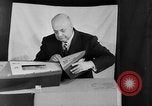
Assembly of liberty ships at Kaiser Shipyards, assembly of airplanes at aircraft factories in America during World War II
Opening scene shows U.S. Industrialist Henry J. Kaiser, demonstrating, on a scale model, how prefabricated parts are assembled into a Liberty Ship, in World war 2. Closeup shows each section of ship labeled by number and name, such as, “Transverse Bulkhead, number 44.” Scene shifts to Permanente Metals Corporation No. 2 shipyard in Richmond, California, where Liberty ships are seen in various stages of construction. Views of keels being laid, superstructures being raised into position, View from interior as skeleton of a ship is being completed. Sign atop the Liberty Ship, Robert E. Peary, as it is being launched, announces that it was completed from keel laying, to launch, in 4 days, 15 hours and 29 minutes. (This was a record for shortest time.) Camera view of the Robert E. Peary, from across the yard area where she was built. A brief view of shipyard activity at night, followed by camera panning over shipyard in daytime. Change of scene to an aircraft factory where B-17 bomber aircraft are being built. Women are seen riveting inside a plane’s fuselage. Other women work on a vertical stabilizer and still others work inside airplane structural members Men assemble an aircraft engine. Women fasten parts of engines together. Engines move through the plant on overhead cranes. An engine and propeller being placed into position on a wing with use of a crane. A right wing with two engines installed is moved into position for installation on a B-17 aircraft. Scene shifts to other aircraft factories building Martin Marauder B-26 aircraft; P-47 fighter aircraft;Navy Catalina aircraft; Douglas A-20 fighter bomber aircraft; and more B-17 bomber aircraft.
Launching of the USS Iowa (BB-61) in New York, and of her sister ship, USS New Jersey (BB-62),in Philadelphia, during World War II..
Camera pans vertically from top to bottom over the bow of the USS Iowa (BB-61) as she is ready for launching at the Brooklyn Navy yard in New York City, on August 22, 1942. Sponsor of the ship, Ilo Browne Wallace, wife of Vice President Henry A. Wallace, Christens the Iowa by breaking a bottle of champagne over her bow, and the ship moves down the ways toward the East River. The Williamsburg Bridge is seen dimly in the background, as the Iowa plunges into the water. Camera focuses, next, on the USS New Jersey (BB-62) ready for launching at the Philadelphia Navy Yard on December 7, 1942. Men knock supports from below the New Jersey, in preparation for her launching. Next, she is seen moving down the ways. Closeups of some shipyard workers smiling as the New Jersey is launched. The New Jersey is seen well out into the Delaware River, with some smoke rising from one of her funnels. (World War 2, WWII, WW2)
Lend Lease materials transported across the world by convoys of American and British ships in World War II
Opening scene shows Lend Lease military equipment covered with canvas, at a port in the United States, during World War 2. A B-26 bomber with wings removed outboard of its engines, is being maneuvered for shipment at a port in the United States. A Lockheed P-38 airplane is moved on a crane and then rolled along a pier toward the stern of the U.S. Light Cruiser, USS Phoenix (CL-46) which is docked there. Wings of a Curtiss SOC-1 Seagull scout plane can be seen on the Phoenix. Two more P-38 aircraft are rolled along the pier, past another Brooklyn class Light Cruiser at the end of the pier. (Her triple 6-inch gun turrets are noticeable.) Crated supplies are seen being lowered into ship cargo holds. An American M2 light tank being lowered from a crane. An American M3 Lee tank being secured in a ship. Numerous tanks in a ship’s cargo hold. Next, a convoy of ships carrying war materiel overseas is seen at sea. A U.S. Cruiser plunging through heavy seas. View from her bridge overlooking her triple gun turrets, as her bow is awash in waves. A formation of U.S. battleships, led by a Nevada class Battle Ship armed with twin over triple forward gun turrets. She is followed by what appears to be a modernized Pennsylvania class Battleship and other battleships. A British Battle Cruiser followed by another British warship. Various Allied battleships firing their heavy guns. Animated map tracing the “Lend-Lease” routes across the North Atlantic to Iceland, the British Isles, and Murmansk. Map also shows routes by sea and air to the West Indies, Brazil, and South Africa and West Africa, and then by air across Africa, to egypt and the Middle East. Other routes are shown to Suez, Iran, India, and China, as well as trans-Pacific routes to various places. American soldiers crowd the upper deck of a troop transport ship. A military chaplain conducts religious services aboard ship at sea. More views of ships in convoys. A U.S. Navy Kingfisher float plane in flight over the water. A barrage balloon aloft. A U.S. Navy Catalina PBY flying boat in the air above a fleet of supply ships in a vast convoy.
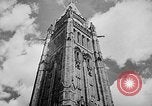
President Roosevelt speaks to crowd in Ottawa. Montage of World War II milestones and military action.
President Franklin D Roosevelt speaking from steps of Parliament, in Ottawa, Canada, during World War 2. Behind him stands Canadian Prime Minister, William Lyon Mackenzie King. Large crowd gathered. Crowd waves at the President. The sequence then shifts to a montage of World War 2 milestones shown in newspaper headlines and battle scenes such as American battleships and destroyers firing on coastal targets; .troops in an amphibious assault; U.S.marines wading ashore, after leaving landing craft. Field artillery firing. Newspaper reads 'Italy Quits'. Newspaper slowly burns. The sequence returns to Roosevelt speaking on steps of Canadian Parliament. US, British and Canadian flags side by side. View of a very large gathering of Canadians at the event.
CRITICALPAST.COM: About Us | Contact Us | FAQs - How to Order | License Agreement | My Account | My Lightboxes | Shopping Cart | Advanced Search | Featured Collections | Website Terms & Conditions | Privacy Policy ©2026 CriticalPast LLC.
License Agreement |
Terms & Conditions |
Privacy Policy
©2026 CriticalPast LLC.