


 Francais
 Deutsch
 Italiano
Refine Your Search
V2 stock footage and images
- Showing 5083 to 5088 of 9941 results more
more Hide
Hide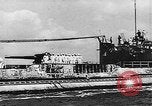
The Japanese submarine I-30, on a mission to German-occupied Lorient,France, during World War II
Scenes from a Japanese Yanagi (Willow) submarine mission that carried war-essential minerals and materiel to German-occupied Lorient, France, in World War 2. The submarine (I-30) code-named Cherry Blossom (Sakura in Japanese and Kirschblüte in German) is the first to travel on a visit from the Pacific to Europe during World War 2. Opening scene shows I-30 underway on the surface, with its crew in dress uniforms on deck and officers in the conning tower. Several German Kriegsmarine (Navy) officers, including Admiral Karl Dönitz, Commander of the German U-boat fleet, and another Admiral, are seen rendering classic military (not nazi) salutes. Closeup of some Japanese officers and men standing on the deck of their submarine as it glides past the pier. Local seamen, all giving the Nazi salute, crowd the deck of a nearby ship. Glimpse of Doenitz and the other Admiral walking a gangplank to board the I-30, where they greet officer delegation of the submarine, as the Japanese Naval Attaché to Germany, Captain Yokoi Tadao, and the I-30's Captain,Commander Endo Shinobu, stand nearby. Doenitz, and the two Japanese officers are seen conversing, on deck amidst gathering of German naval officers. Scene shifts to the land, where German Grand Admiral,Erich Raeder (4-striped admiral insignia on sleeve) speaks with Commander Endo Shinobu, as Captain Yokoi Tadao, stands nearby. Next, Officers and sailors are seen saluting from the conning tower of the I-30. A closeup of Commander Endo Shinobu saluting. The I-30 slowly moves away from the pier.
Assembling an electric locomotive at Baldwin Locomotive Works, Pennsylvania
A film regarding Electric Railroading in the United States. The assembly of electric locomotives at the Baldwin Locomotive Works in Philadelphia, Pennsylvania. This is a joint venture with the Westinghouse Electric and Manufacturing Company of Pittsburgh, Pennsylvania. Twin Armature Motors for electric locomotives being assembled. Workers at machines as they assemble the armatures into the motors. Men attach an iron chain to a motor and place in onto a part of the locomotive. Railroad cab being placed on wheels. Seen is Locomotive number 10300. This is a Class EP-3 electric Quill locomotive, Type: 2C-1-1-C2 (passenger), Drivers: 68" diameter. It displays lettering: "C M & St. P," and will run on the Milwaukee Road (Chicago Milwaukee St. Paul and Pacific Railroad). A different locomotive: Pennsylvania Railroad Class DD1, runs down a railroad track.
U.S. forces searching Saipan for holdout Japanese defenders in World War II
Camera follows American troops as they comb through hiding places at the end of the battle for Saipan in World War 2. Small children hiding among some boulders. Next a Japanese woman and four small children are seen seated on the ground. A U.S. soldier bandages the arm of one child. A group of American soldiers searches for Japanese soldiers near a cave. Two soldiers seen firing at a suspected Japanese enemy position. Next, they search the underbrush and retrieve a box of canned goods next to the body of a dead Japanese soldier. A dead Japanese soldier floating in a stream. U.S. infantrymen continuing their search for Japanese holdouts. One retrieves an abandoned Japanese rifle. Another holds a Japanese grenade. One GI displays a Japanese long Arisaka Type 38 rifle with a Type 30 bayonet. (The rifle is 4 feet, 2 inches long and the bayonet 20 inches, making it almost 5-feet in overall length.) Camera pans across misty landscape near the shore, with so-called "suicide cliff" in background. A woman and small girl sitting beneath a rough shelter.
Airmen wheel equipment on dollies out of and back into an Operations Building in the United States.
Preparations for reconnaissance activities by Strategic Air Command (SAC) Lockheed U-2 aircraft during the Cuban Crisis. A Lockheed U-2 aircraft on a runway in the United States. It takes off and climbs into clouds. Airmen wheel equipment on dollies out of an Operations Building. The dollies are pushed back into the Operations Building.
United States soldiers return to their Troop ship after practicing amphibious assaults off Scottish coast during World War II.
Opening scene shows the American transport ship, USS Thomas Jefferson (APA-30) anchored in a bay off Scotland in March, 1944 during World War 2. View from deck of the USS Thomas Jefferson, as some of her Higgins boats return from maneuvers to bring soldiers back on board. The troops climb up landing nets at the side of the ship, with help from U.S. Coastguard crewmen. View from directly overhead shows the landing net clearly. Various views of the Coastguard crewmen helping the soldiers. (World War II; WW II; World War 2; World War Two)
In England, U.S. Amphibious forces (in Exercise Tiger) practice for the invasion of Normandy, during World War II
U.S. troops descending from a pier, in England to board an LCI (L)- landing craft infantry, Large, during World War 2. Other LCIs are docked along the pier, including LCI -21. Ships and landing craft maneuver off shore from Slapton Sands, Devon, England, where U.S amphibious forces practice for the invasion of Normandy in World War 2. Closeup of troops underway in a Higgins boat landing craft. View from camera ship's deck, of a Transport ship, nearby and of several LCI(L)s in the distance. Closeup of U.S. Landing Craft Tank, LCT(5)-305, passing the camera ship. USS LST-30 and another ship are seen nearby. USS LST-310 is seen with a long floating dock in front of it. Next, the floating dock is turned sideways to her front hatch and soldiers are seen clearly on the dock. U.S. Landing Ship Tank - LCT(5)-305, passes behind. Next, the floating dock is seen moving away from LST-30. A ship, armed with guns, that appears to be numbered US 12F6. Closeup of LCI(L)-87 with Coast Guard Commander Miles Hopkins Imlay, seen on her bridge. (She is the flagship of his command, Flotilla 10.) View from ship beached on Slapton Sands, of Markers set up on the beach and Sign reading: "B." View from ship looking down on the sand where several officers are discussing the exercise. A truck driving out of beached landing ship.
CRITICALPAST.COM: About Us | Contact Us | FAQs - How to Order | License Agreement | My Account | My Lightboxes | Shopping Cart | Advanced Search | Featured Collections | Website Terms & Conditions | Privacy Policy ©2026 CriticalPast LLC.
License Agreement |
Terms & Conditions |
Privacy Policy
©2026 CriticalPast LLC.