


 Francais
 Deutsch
 Italiano
Refine Your Search
V2 stock footage and images
- Showing 5161 to 5166 of 9941 results more
more Hide
Hide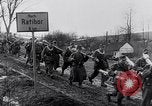
Germans defend against advancing Soviet forces in Silesia during World War II
Germany defending against Soviet offensives along the Oder River in in Silesia, during World War 2. German infantry slogging through mud, past sign pointing back 6 Km to Ratibor,Germany, (present-day Racibórz, Poland) during World War 2. They are proceeding to reinforce defenses at Breslau. They carry many panzerfaust antitank weapons. Scene shifts to German officers conversing with General Hermann Niehoff, Commander of Breslau defenses. German gunners firing a Heavy 21 cm Mörser 18 gun at near-zero elevation. (General Niehoff holds his ears as it fires.) Shell explodes with large fireball in distance. Niehoff speaks with a smiling German officer and pats him on the shoulder, at an informal award ceremony on a street in outlying area of Breslau. German soldiers riding atop an Auto Union Kätzchen (armored personnel carrier) .It is towing a conveyance in which two soldiers ride.
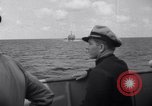
Convoy for the Sicily Invasion- Operation Husky- Convoy UGF.9.
Filmed from the Destroyer USS Nelson, DD-623, in convoy of warships headed for the invasion of Sicily in World War 2 ( Operation Husky- Convoy UGF.9). Officers on the bridge of the destroyer, USS Nelson with convoy in background. USS Nelson, Signalmen on starboard side signal light reading signals. Starboard side of the repair ship USS Vulcan, AR-5. Aft view of the USS Nelson with USS Vulcan in background. Aft starboard quarter of the light crusier USS Philidelphia, CL-41 with SOC-3 observation scout bi-plane on port catapult. USS Nelson's crew handling lines for ship to ship transfer of material. Inside the USS Nelson's bridge. Officer taking bearing measurements with a pelorus stand. Forward view from the USS Nelson's of number 2 turret with fleet in background. Refueling operations, stern view of the fleet oiler USS Chemung, AO-30, fueling the light cruiser USS Boise, CL-47 on the USS Chemung's port side. Starboard side of the USS Chemung. Lines are secured between the USS Nelson and USS Chemung. Fuel lines connected between the USS Nelson and USS Chemung. Starboard aft quarter of the amphibious force flag ship USS Ancon, AGC-4, and crewmen of the USS Nelson securing ship to ship written communications and or mail via highline between the two ships.
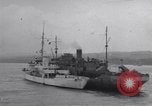
USCGC Campbell rides along supply ship in the UK, during World War II
USS Campbell tying up to a supply ship in the United Kingdom, during World War 2. Views of the USCGC (US Coast Guard Cutter) Campbell, tying up to an anchored British supply vessel in the UK, during World War 2. A British Flower Class Corvette, in camouflage paint, seen briefly passing behind the two ships. Hills in the near background. Crew members on both ships raising hawser out of the water.
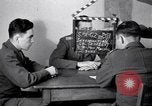
Colonel Skorzeny interrogated by a United States army captain in Germany, following Skorzeny's surrender to U.S. forces
Part 1 of a 2 part interrogation of Colonel Otto Skorzeny, a German officer, by a United States Army captain in Germany at the conclusion of World War 2 in Europe. The United States Army Captain interrogates him through an American enlisted man serving as interpreter. They talk amongst themselves. They discuss a paper.
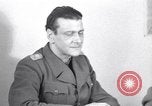
German Colonel Otto Skorzeny interrogated by a U.S. Army captain in Germany; discusses liberation rescue of Mussolini
Part 2 of a 2 part Interrogation of Colonel Otto Skorzeny, a famous German Colonel, by a United States Army captain in Germany. The United States army captain interrogates him through an American enlisted man serving as interpreter. The Colonel speaks about the liberation of Benito Mussolini and his rescue by plane. He also tells about the meeting of Adolf Hitler and Mussolini and the Italian dictators return to the Lake Garda area. These were accomplished by the Panzer brigade. Skorzeny takes off his wrist watch commemorating the event and they discuss the information inscribed on its back. The wrist watch lies on the table.
Fall of Minsk and first Battle of Smolensk in Operation Barbarossa, World War II. German forces advance to the Dnieper River
German forces take Minsk and advance to the Soviet Union early in their World War 2 Operation Barbarossa. German soldiers dive for cover as a shell explodes, during their house-to-house operations. One waves unarmed surrendering Soviet soldiers forward. Several other surrendering Soviet soldiers run along a dirt roadside. Some are also seen at a German field red cross tent where German medical corpsmen are standing. Soldiers hit the dirt as more shells strike nearby. Closeups of some Soviet prisoners. German Ju 87 Dive bombers are seen high above, and then closeup as they dive. Glimpse of German pilot in cockpit. Bombs striking ground. Dive bombers pulling out. Bombs exploding. Camera focuses on bomb falling from a Ju 87, and tracks it until it explodes on the ground. A German artillery spotter watches as a gun crew fires a 10.5cm le FH 18 howitzer. The shell explodes with white smoke and debris flies into the air. Glimpse of German soldiers watching as a gunner fires a 2cm Flak 38 antiaircraft gun at zero elevation. More artillery firing. A farm building is completely destroyed by an exploding heavy artillery shell. German troops walk past burning armor. Knocked out and burning tanks and other vehicles line the sides of the road to Minsk. But it is now open and a line of German troops with horse-drawn supply wagons moves ahead. Some mounted officers proceed as well. Trucks and armor follow, including a StuG III self-propelled gun armed with a short-barreled 75-mm gun. Scenes of total destruction. German long guns firing in flat lands as they continue advance to the Dnieper River. German 17 Cm Kanone 18 guns firing toward Stalin Line fortifications. Huge explosions seen as shells explode in distance. A fire raging in distance. More German artillery firing. German infantry advancing after the artillery barrages. Obstacles at Soviet lines of defense that German infantry must breach or bypass. German infantry entering a village. One throws a hand grenade and they both drop to the ground as it explodes on a small building. German soldier firing a light machine gun. Sounds of heavy artillery and views of battle damaged buildings and fortifications. Captured Soviet prisoners walk with hands above their heads. Closeups of some. Aerial view of a destroyed fort on the Stalin line and destroyed buildings all around it.
CRITICALPAST.COM: About Us | Contact Us | FAQs - How to Order | License Agreement | My Account | My Lightboxes | Shopping Cart | Advanced Search | Featured Collections | Website Terms & Conditions | Privacy Policy ©2026 CriticalPast LLC.
License Agreement |
Terms & Conditions |
Privacy Policy
©2026 CriticalPast LLC.