


 Francais
 Deutsch
 Italiano
Refine Your Search
Walcheren Island Netherlands 1944 stock footage and images
- Showing 151 to 156 of 9704 results more
more Hide
Hide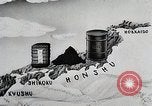
Japanese natural resources related to Second Sino-Japanese war and World War II
Animated map illustrating shortage of indigenous raw materials in Japan. As stockpiles vanish during Second Sino-Japanese war, Japan's domestic sources supply only 10% of the nation's needs for war. Animated sequence shows lack of steel, aluminum, copper, and power generation for the conduct of war. But one of the nation's greatest resources is the population of skilled Japanese workers, who are shown at various high tech jobs, as well as on the farms and in the fishing industry. Japanese workers are seen who work for the Zaibatsu (four ruling families of Japan). Banks of Japanese women typists and women in a factory. Young women painting faces on a "Kewpie doll." A Japanese family at dinner time. Women engaged in fabric spinning. Animated graphic illustrates Japan's war-related resources for World War 2, by showing a Japanese soldier standing astride map of Japan with lines extending to sources of needed raw materials from Japanese possessions in Korea, Manchuria,Formosa, China,Indochina,Malaya, and its network of Pacific Islands. Final scene displays copy of Los Angeles Times newspaper with headline reading: "Jap Supply Lines Blasted." It also features a story that appears to refer to the U.S. 6th Army invasion of Leyte in the Philippines, in October, 1944 (when General MacArthur waded ashore and stated,"I have returned"). (Note: Although produced during World War 2, this film shows prewar scenes of Japan. The animated illustrations and maps and, of course, the newspaper shown at the end, date from World War II.)
Shows the importance and application of camouflage techniques during combat in World War 2.
A film 'Camouflage in Combat' underlines the importance of tactical exploitation and counteraction of shadows and use of nets, underbrush and other camouflage during World War II. The film shows U.S. soldiers going into a theater in the United States and watching a movie 'Camouflage'. The movie shows a soldier in a forest. He is shot down. A soldier approaches him. He looks skywards. He applies mud on his face to camouflage himself. Soldiers paint each other's faces with GI paint. On 5th June 1944, fully camouflaged Airborne and pathfinder U.S. paratroopers preparing for D-Day invasion jump over Normandy, France. Soldiers with camouflaged helmets. A soldier camouflages his helmet with grass and twigs. A soldier on an island with his helmet camouflaged with grass and twigs found in the area which gives him a perfect blend. U.S. soldiers with camouflaged helmets in France. A camouflaged tank rolls. An officer inspects soldiers standing in a line. Their helmets are camouflaged. A U.S. soldier hiding in shadows in Casino, Italy fires his gun. His ring sparkles. A soldier in a prone position fires. A New Zealand soldier fires while in shadows.
Japanese 1931 aggression in Manchuria condemned by the League of Nations. Continued Japanese aggression in the Pacific, through World War II
Japanese international activities during 1931-1945. Opening scene shows Japanese troops embarking on ships bound for an invasion of Manchuria, in 1931. Officers walking on the dock, amongst the departing troops. Scenes of explosions and destruction. Views of Shanghai during Japanese attacks in 1937. Destroyed buildings. Civilian dead lying in the streets. Japanese soldiers racing along a street in a three wheeled motorcycle vehicle. Change of scene shows Japanese diplomat Yosuke Matsuoka addressing a League of Nations meeting in 1933, after that body adopted a report blaming Japan for events in Manchuria. He objects to that action and then leads his delegation in walking out of the meeting. View of Japanese delegates in top hats and bowler hats exiting the building. Scene shifts to Japanese forces firing artillery and machine guns in Manchuria.They wave large Japanese flag victoriously after a battle. The next scene shows Italian forces occupying Ethiopia and raising the flag of the Kingdom of Italy, as Italian troops salute, presenting arms of rifles with fixed bayonets. Axis leaders celebrate the 1940 Tripartite Pact between German, Italy and Japan. The festivities take place in a hall displaying the three nation's flags on the walls. A large number of persons attend including Japan's Prime Minister, General Hideki Tojo, seen with two celebrants. Scene reverts to China with Chinese civilian people trying to escape from invading Japanese forces. The refugees carry their belongings as they flee. Occasional shell burst is seen among advancing Japanese troops as Chinese soldiers put up resistance. Chinese soldiers firing artillery. In the U.S., Japanese envoys Kichisaburō Nomura and Saburō Kurusu are seen walking together into a building and entering a room inside. Next, are views of the Japanese attack on Pearl Harbor, with huge plumes of smoke obscuring the bombed U.S. battleships in the harbor. U.S. battleships in line formation in the Pacific during World War 2. Aerial view of U.S. warships moving in parallel. British ships augmenting the U.S. warships. Naval guns firing. U.S. amphibious assaults on Japanese held islands in the Pacific. Prisoners of the Japanese who suffered in the Philippines. General Douglas MacArthur mingling with former prisoners and internees upon his return to Manila in 1944. Aerial views of Iwo Jima. Naval bombardment and amphibious assault of Iwo Jima. Numerous fallen Japanese soldiers. The iconic American flag raising by U.S. Marines on Iwo Jima. View of Lieutenant General Simon Bolivar Buckner Jr. during the campaign on Okinawa, where he was killed in action. A Soldier being carried on a stretcher. Another throwing a hand grenade. U.S. soldier firing at a Japanese defender who falls out of his bunker. Large numbers of Japanese prisoners of war assembled in a field. Japanese Kamikaze attacking U.S. warships off Okinawa. The sky filled with antiaircraft flak clouds. View of 40mm Bofors antiaircraft cannon firing and a Japanese plane falling and exploding on impact in the ocean.
United States troops landing and fighting with Japanese troops in Leyte, Philippines (WW2)
U.S. Third Fleet underway at sea, heads for Leyte in October 1944 during World War II. Warships fire heavy guns at Leyte. Ships advance under naval bombardment. Explosions on ship. U.S. troops aboard landing crafts. Japanese troops and defense during the barrage. They take positions and begin to attack. U.S. landing crafts attacked. Dramatic close up views of faces and expressions of many U.S. soldiers as they prepare for the invasion. U.S. troops leave landing craft and wade through water on to beaches. Japanese troops firing at incoming American forces with rifles and machine gun fire. American soldier raises American flag on island. Artillery fired and U.S. Army tanks advance. Wounded U.S. soldiers carried on litters. U.S. Army soldiers staying low and crawling on beach to avoid enemy fire. U.S. Army soldiers advancing, using rifle fire, hand grenades, and flamethrowers to attack entrenched Japanese enemy positions. Dead Japanese soldiers. Smoke arising from explosions in jungle.
Events of World War 2, and creation of United Nations Organization following the surrender of Germany and Japan
Summary of World War II events and formation of the United Nations Organization. Soviet troops on Eastern Front of Europe fire artillery on German positions in 1944. Russian troops advance. German soldiers come out of buildings and surrender. Allied Forces land in France on D-Day. Allied troops and tanks fight Germans on streets in towns and villages of France. U.S. Army tanks fire at German positions. Various groups of German prisoners of war march along roads and are herded into prison camps operated by American and British forces. In 1945, the Allied leaders meet at Yalta on the Crimean Peninsula to discuss Allied military strategy in the final months of WWII. Leaders included British PM Winston Churchill, U.S. President Franklin D Roosevelt and Soviet Premier Joseph Stalin. The meeting of U.S. and Soviet Russian troops at the Elbe River. German Nazi Swastika symbol blown up in explosion atop Zeppelinfeld Nazi party rally grounds in Nuremberg. Aerial view of Berlin in ruins, as seen from low-flying aircraft flying directly over the Unter den Linden boulevard and the Brandenburg Gate. Wrecked and bombed German buildings seen everywhere. German officials signing surrender instrument at Rheims. U.S. President Harry S Truman, Winston Churchill and Joseph Stalin at Potsdam Conference. U.S. Marines battling on beaches of Pacific Islands. Iconic shot of U.S. Marines raising the American flag on Mount Suribachi at Iwo Jima. Aerial view of bombed and ruined city of Tokyo, Japan. The Japanese surrender to MacArthur aboard the battleship USS Missouri. General MacArthur speaks aboard Missouri. Victory celebrations all across the world, with some scenes from earlier V-E Day (Victory in Europe) day in May 1945, including crowds celebrating in Paris, France, and some scenes on V-J Day (Victory over Japan day) in August 1945. Crowds on streets celebrate. Happy crowds jam streets. Delegates of Nations, among them Andrei Gromyko and Vyascheslav Molotov meet in San Francisco and create a United Nations organization. Truman arrives at signing of UN charter. Various delegates sign charter. U.S. troops disembark troop carrier ships at U.S. ports and are discharged after completing military service in World War 2. Group of U.S. Army soldiers exits a church (the Chapel at Fort Dix, New Jersey), waving their discharge papers in hand.
FBI agent William Sebold (posing as Harry Sawyer), and successful filming of members of Duquesne spy ring in the United States.
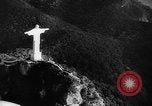
Aerial view of Christ Redeemer Statue on Mount Corcovado, Brazil. The director of the Federal Bureau of Investigation (FBI), John Edgar Hoover, narrates this 1944 clip and talks about enemy agents in the United States during World War II, before America's entrance into the war. German and Japanese suspects seen in South America. A German fleet carries German agents aboard merchant and cargo ships. German agents in formation on deck of ship, shown debarking the ship after receiving instructions. Japanese and Nazi German colonies being established in South America in large cities and in remote areas of Patagonia. Automobile industries, hotels, shops, and other industries established by Nazi German agents. German signs and Nazi Swastikas and Nazi flags shown on some buildings in South American countries including Brazil. A Nazi flag. A view of German factories in South America. Photographs of Adolf Hitler in a school building where young boys and girls are being instructed by their teacher. German pilot shown operating a passenger airliner; aerial view of from aircraft of Rio de Janeiro Brazil, including port and city areas. A dramatization depicts well planned accidents in the factories and sabotage attempts to slow production of goods bound for the United States. The Federal Bureau of Investigation (FBI) receives reports about planning of German attack on the Panama Canal. A woman watching a teletype machine as a report arrives. A man in a radio room of the Federal Bureau of Investigation receives information and turns to type out a report on his typewriter. Men and women convicted as spies are seen together in a room with U.S. federal agents. The spies are taken in a police van. Man serving as projectionist seen running a film projector. A film of Fritz Duquesne case in the FBI office shows FBI Agents' successful secret filming of members of the Duquesne spy ring. The film is shown being loaded onto a projector and then played. FBI agent William Sebold (posing as spy Harry Sawyer) is seen with Fritz Duquesne and other spy ring members: Pedestrians and vehicular traffic on a New York street corner as Sawyer and Duquesne prepare to meet. German spies sit together in a hotel room in New York City, recorded by hidden camera. Heinrich Clausing, a spy ring member and former cook on the cruise ship SS Argentine is seen. Also seen is Hartwig Richard Kleiss putting on his hat and smoking a cigar. He's shown giving money to Sawyer for purchase of a spy camera, according to narration. J Edgar Hoover notes that German agents communicated through a Long Island radio station that was secretly controlled by the FBI. Hartwig Kleiss is seen showing the blueprint plans of the steamship SS America, including plans for its secret gun emplacements. Fritz Duquesne is shown in the film, removing diagrams of various American arms that he had concealed in his sock Japanese agent Takeo Ezima, of the Imperial Japanese Navy, is also seen meeting in the hotel with Harry Sawyer.
CRITICALPAST.COM: About Us | Contact Us | FAQs - How to Order | License Agreement | My Account | My Lightboxes | Shopping Cart | Advanced Search | Featured Collections | Website Terms & Conditions | Privacy Policy ©2026 CriticalPast LLC.
License Agreement |
Terms & Conditions |
Privacy Policy
©2026 CriticalPast LLC.