


 Francais
 Deutsch
 Italiano
Refine Your Search
Worms Germany 1945 stock footage and images
- Showing 4741 to 4746 of 10470 results more
more Hide
Hide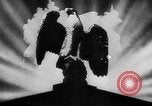
German factory workers manufacturing arms including rifles, artillery, shells, aircraft, and tanks during World War II
Manufacturing of German weapons in Germany during World War 2. Opening scene shows steam and smoke rising from a German industrial complex in 1941. Inside the plant, men and women are at work in arms manufacture. A woman rides on a traveling crane, moving a large steel wheel suspended by a chain. Another woman operates a grinder from which sparks fly. A woman welder uses a torch on slabs of steel and another removes parts from a machine press. An array of new rifles moves past the camera, revealing men fitting barrels into rifle stocks. Closeup of a worker examining a rifle stock for symmetry. A man in protective clothing uses a long pole near a steel furnace. Bessemer-type furnaces emit flames as they are charged with oxygen. Caldrons filled with molten steel move while suspended below an overhead conveyer. A machinist turns the nose section of a large shell. A man uses white tape to tie finished munitions for shipment. Men working on several 122mm field pieces and others working on a line of 88mm anti-aircraft guns. Camera pans over assortment of shiny finished artillery shells. A container is raised up from an annealing operation. Men tend others where flame can be seen. Many workers walk in unison to a row of Junkers JU-88 aircraft fuselages. A 1,340 Junkers Jumo 211J twelve-cylinder engine for one is seen moving on an overhead conveyer. Assembled and painted Ju-88s are rolled through a hangar. One sits at the door of the hangar. A production line of Panzer tanks in various stages of completion. One moves through the plant on an overhead conveyer.

B-17 aircraft of the U.S. 351st Bomb Group run gauntlet of attacks from German fighters and Flak in World War II
View inside a B-17 of the U.S. 351st Bomb Group, enroute to target in Germany during World War 2. Gunners looking out their window as escorting P-47 fighters of the U.S. 487th Fighter Squadron (352nd Fighter Group) turn back (for lack of fuel endurance) and head home to their base at RAF Station Bodney. The B-17s continuing unescorted in tight formation, displaying high altitude contrails. German fighters are spotted at 9 O'Clock high. Contrails from German fighters are seen. Gunners rotating their turrets as they look out for enemy attacks. American gunner fire at attacking German fighters. Sky filled with swirling contrails from the attackers. German fighter disables lead ship which begins to descend with number 4 engine smoking. Crew inside B-17 watches as some of the stricken crew bail out with parachutes. German fighters continue relentless attacks on the B-17s. B-17 Flying Fortress is seen falling into a flat spin and descending rapidly toward the ground, out of control. German FW-190 fighter join in the attack. B-17 gunners hit one and it explodes and falls. Another B-17 is hit and falls out of control. German fighters regroup in formation as the B-17s enter an area of concentrated antiaircraft ground fire. Black bursts of flak surround the B-17s. Soon the German fighter attacks resume.
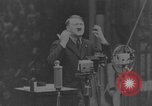
Several brief scenes of Adolf Hitler making impassioned speeches to the German people.
Hitler speaking (in civilian clothes) as he seeks appointment as Chancellor of Germany, in 1933, and speaking outdoors, against backdrop of massed flags, as he pledges to fight for the German people.
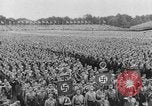
Adolf Hitler is appointed Chancellor. German President Hindenburg is honored with a military parade
Opening scene shows many thousands gathered in a Nazi rally at Zeppelin Field in Nuremberg. Adolf Hitler shakes hands with some Nazi Storm Troopers (Sturmabteilung). Next, Hitler is seen on stage with German President, Paul von Hindenburg, when he was appointed Chancellor of Germany on 30 January 1933. German troops and some sailors parade, in honor of Hindenburg, along Unter den Linden in Berlin. A contingent does goosestep march past Neue Wache. Camera records various views of the parade. A military band plays for the marchers, while standing in formation in the center of the avenue.

Glider rockets designed by German rocket pioneer, Reinhold Tilling
Workshop of German rocket pioneer, Reinhold Tilling, in Ahrenshorst or at Osnabruck, Germany. Various models of his postal rockets (recoverable rocket for mail delivery) are seen in the shop. A sketch and stringed models show how the wings fold about the rocket for launching and unfold for gliding descent after the rocket has finished firing. Next, a number of similar-looking rockets or gliders are seen on the ground in a field. Their wings appear to fixed open. The closest one appears to have a radio antenna attached at its wing root. Several young men are occupied with one of the gliders on the ground. Another holds a kite. What is possibly a rocket launching tube sits on a tripod in the background. Closeup of one of the gliders on the ground. Change of scene shows a cylindrical solid fuel rocket on a tripod launcher. The rocket nose is shown without the lower portion. Next, the rocket is seen set up on a beach next to a body of water, where is is ignited and launches at a low angle, in a cloud of white smoke.
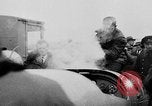
German rocket car of Max Valier is fueled with liquid oxygen and driven at an airport
Rocket propulsion history in Germany. Men gather around a liquid oxygen tank during fueling of rocket car driven by Max Valier. He drives his white car along an airport ramp, past a twin engine high-wing monoplane. In the final scene, from April 1930, Valier is shown smiling as he sits in his liquid rocket propelled car, surrounded by spectators.
CRITICALPAST.COM: About Us | Contact Us | FAQs - How to Order | License Agreement | My Account | My Lightboxes | Shopping Cart | Advanced Search | Featured Collections | Website Terms & Conditions | Privacy Policy ©2026 CriticalPast LLC.
License Agreement |
Terms & Conditions |
Privacy Policy
©2026 CriticalPast LLC.