


 Francais
 Deutsch
 Italiano
Refine Your Search
Yokohama Japan 1945 stock footage and images
- Showing 43 to 48 of 7988 results more
more Hide
Hide
Events of World War 2, and creation of United Nations Organization following the surrender of Germany and Japan
Summary of World War II events and formation of the United Nations Organization. Soviet troops on Eastern Front of Europe fire artillery on German positions in 1944. Russian troops advance. German soldiers come out of buildings and surrender. Allied Forces land in France on D-Day. Allied troops and tanks fight Germans on streets in towns and villages of France. U.S. Army tanks fire at German positions. Various groups of German prisoners of war march along roads and are herded into prison camps operated by American and British forces. In 1945, the Allied leaders meet at Yalta on the Crimean Peninsula to discuss Allied military strategy in the final months of WWII. Leaders included British PM Winston Churchill, U.S. President Franklin D Roosevelt and Soviet Premier Joseph Stalin. The meeting of U.S. and Soviet Russian troops at the Elbe River. German Nazi Swastika symbol blown up in explosion atop Zeppelinfeld Nazi party rally grounds in Nuremberg. Aerial view of Berlin in ruins, as seen from low-flying aircraft flying directly over the Unter den Linden boulevard and the Brandenburg Gate. Wrecked and bombed German buildings seen everywhere. German officials signing surrender instrument at Rheims. U.S. President Harry S Truman, Winston Churchill and Joseph Stalin at Potsdam Conference. U.S. Marines battling on beaches of Pacific Islands. Iconic shot of U.S. Marines raising the American flag on Mount Suribachi at Iwo Jima. Aerial view of bombed and ruined city of Tokyo, Japan. The Japanese surrender to MacArthur aboard the battleship USS Missouri. General MacArthur speaks aboard Missouri. Victory celebrations all across the world, with some scenes from earlier V-E Day (Victory in Europe) day in May 1945, including crowds celebrating in Paris, France, and some scenes on V-J Day (Victory over Japan day) in August 1945. Crowds on streets celebrate. Happy crowds jam streets. Delegates of Nations, among them Andrei Gromyko and Vyascheslav Molotov meet in San Francisco and create a United Nations organization. Truman arrives at signing of UN charter. Various delegates sign charter. U.S. troops disembark troop carrier ships at U.S. ports and are discharged after completing military service in World War 2. Group of U.S. Army soldiers exits a church (the Chapel at Fort Dix, New Jersey), waving their discharge papers in hand.
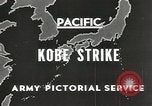
United States B-29 bombers drop incendiary bombs over Kobe, Japan
"Kobe strike" shows United States B-29 bomber aicraft dropping 3200 tons of incendiary bombs over industrial targets in Kobe, Japan during World War 2. Firebombing causes pillars of smoke to rise up. Narrator speaks of strikes on other Japanese cities also and relates statement by General Arnold that beginning July 1945, industrial Japan will be hit by bombs at the rate of 2 million tons per year, or 5480 tons per day, adding that "by the end of 1946, Japan will have ceased to exist as a bombing target."
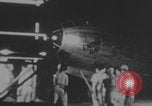
Enola Gay mission to drop “Little Boy” atomic bomb over Hiroshima, Japan (World War 2)
Enola Gay atomic bomb mission over Hiroshima, Japan during World War 2. The Enola Gay, a Boeing B-29 Superfortress bomber, prepares to leave for the Hiroshima mission. Army Armed Forces maintenance men and Enola Gay crew prepare the Enola Gay in Tinian, Northern Mariana Islands, checking their watches as the glance at the horizon. Maintenance men check bomb bay doors before closing. Pilot Colonel Paul Tibbets looks out of cockpit window of Enola Gay. Nose art of Enola Gay is seen. Close up of controls with hand show "starter" and "engine primer." Enola Gay engine starts and one of it propellers turns. The Enola Gay takes off from North Field, in the Northern Mariana Islands. Point of view through B-29 cockpit window as plane speeds down runway. Motion picture cameraman films the take off. The Enola Gay seen overhead as it leaves for Japan. Aerial View of Iwo Jima Island in Japan. The Enola Gay begins slow climb to bombing altitude over Iwo Jima. Crew member, possibly Tibbets, uses a pair of binoculars. Aerial view of Hiroshima. Enola Gay crew check instruments last time before dropping. The Enola Gay begins its bomb run. Crew bombardier turning a dial on a bomb site. View of Enola Gay with bomb bay doors open. Moving gauge pointer as bomb is dropped and seen exiting bomb bay. The Enola Gay banks away from Hiroshima at high speed. Aerial view in color of mushroom cloud forming over Hiroshima after the atomic bomb detonates in the city. (This actually shows the Nagasaki bomb blast from August 9, 1945, not the Hiroshima blast, despite the statements of the narrator in this edited film). Gigantic mushroom cloud from atomic bombing.
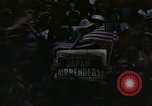
French General Charles de Gaulle is feted in Chicago during his visit to the United States in 1945
Film opens showing people in an American city (possibly Chicago) celebrating the Allied victory over Japan on VJ Day, August 15th, 1945. Scene shifts abruptly to Chicago, Illinois, where French General Charles de Gaulle is seen saluting in a reviewing stand at Victory Plaza near Lasalle Street entrance to City Hall. (On August 24th, he had accepted an invitation from Mayor Edward Kelly to stop in Chicago on August 27-28, 1945, during his visit to the U.S. and Canada.) Next, general de Gaulle and Mayor Kelly are seen in an open car in a motorcade amidst crowds of well-wishers. Enthusiastic spectators run along side their car. Glimpse of a dense crowd of people, including a contingent of sailors in dress whites. Final scene shows General de Gaulle speaking with reporters and photographers near a sign reading "W-G-N." (A Chicago radio station). (World War II period).
Surrender of Japan, ending World War II; imprisoned Japanese officials; German concentration camp scenes
View of first atomic explosion (Trinity) on July 16, 1945, at New Mexico, United States. View of the battleship, USS Missouri, in Tokyo Bay, Japan, with entire ship's company on deck in dress whites, Japanese military high command and several formally dressed Japanese diplomats standing on the ship's deck. Brief closeup of General Douglas MacArthur. Japanese foreign minister, Mamoru Shigemitsu, bending to sign the instrument of surrender ending World War 2, on September 2, 1945. Supreme Commander, General Douglas MacArthur, seated, signing the document. Lieutenant General Jonathan M. Wainwright and British Lieutenant-General Arthur Ernest Percival stand behind MacArthur. General Hsu Yung-chang signs for China. View of sailors observing the historic moment from every possible place aboard the ship. Large numbers of aircraft flying over the ship. Scene shifts in flashback to Manila, Philippines, where dead bodies of civilians litter the streets in silent witness of Japanese wartime atrocities. Some have hands tied behind their backs. Views of destitute Filipino mothers and children wandering through the rubble. A sign identifies the 98th Evacuation Hospital. Inside, a doctor and a nurse stand over the bed of Japanese Prime Minister, Hideki Tōjō, who attempted suicide by pistol, when apprehended, but was taken for treatment and is seen resting in his bed. View of Japanese Adrmiral Shigetarō Shimada, Minister of the Navy, behind bars in prison. Also seen in prison are Japanese general of the Japanese Imperial Army and Governor-General of the Philippines, Shigenori Kuroda;. General Masaharu Homma; and militarist Colonel Kingoro Hashimoto. Scene shifts to bodies of numerous victims of German death camps. American Army medics attend to some survivors rescued from the camps.
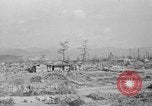
Devastation in Hiroshima and Nagasaki following atomic bomb attacks in World War 2, and view of atomic bomb blast over Nagasaki
Devastated area in north eastern Hiroshima following August 6, 1945 atomic bomb attack in World War 2. Simple shacks and buildings are being built using rubble material after the devastation of Hiroshima. Damage at Higashi station. Newspaper headlines about the atomic bomb attack on Hiroshima, and the warning to Japan by the President of the United States. A map of Japan shows the location of Nagasaki. Scenes of Japanese workers in arms factories building torpedoes and munitions, some wearing kokumin-fuku worker uniform. Workers in an assembly line munitions factory of Mitsubishi. A map shows a torpedo plant in the north and a steel and an arms plant in the south, then plots the center point between them as the U.S. target for the "Fat Man" atomic bomb attack. View of the atomic bomb explosion over Nagasaki on August 9, 1945, as seen from the B-29 bomber "Bockscar" (sometime called Bock's Car or Bocks Car). Mushroom cloud rises up to the sky. Wing of the B-29 bomber in the foreground. An aerial view of rubble and destroyed buildings in Nagasaki following the atomic bomb attack. Destroyed Mitsubishi steel plants beside the sea.
CRITICALPAST.COM: About Us | Contact Us | FAQs - How to Order | License Agreement | My Account | My Lightboxes | Shopping Cart | Advanced Search | Featured Collections | Website Terms & Conditions | Privacy Policy ©2026 CriticalPast LLC.
License Agreement |
Terms & Conditions |
Privacy Policy
©2026 CriticalPast LLC.