


 Francais
 Deutsch
 Italiano
Refine Your Search
Italy airfields stock footage and images
- Showing 2821 to 2826 of 3777 results more
more Hide
Hide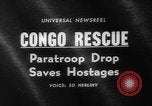
U.S. Air Force Aircraft transport 600 Belgian Para-Commando troopers, on rescue mission to Stanleville, Congo
View from behind the pilot in cockpit of a U.S.Air Force C-130 transport aircraft of the 322nd Air Division, U.S. Air Forces Europe, approaching Stanleyville, Congo, on a mercy mission to save lives of Belgian hostages held by Congolese rebels who threaten to kill them. View from tarmac on the airport, as Belgian paratroopers exit the aircraft while its engines are still running. They secure the airfield, unload supplies and ammunition, and start moving toward the center of Stanleyville. View from moving vehicle traveling along deserted street in Stanleyville. After hearing shots, the paratroopers come upon a courtyard where they find numerous Belgian dead. View of courtyard and bodies covered with cloth. Another dozen, or so, bodies are seen lying in another group. One dead seen lying in the roadway. Bullet-riddled car at side of road. Local Congolese residents (non-rebels) board trucks for transport to the airport. Hundreds of rescued Belgian people are gathered at the airport. A C-46 transport aircraft is parked in the background. A Belgian trooper walks past. Next, a view, again, from behind the pilot in a USAF C-130 aircraft, this time, approaching Leopoldville. Ground crewman guides the aircraft to a parking place on the Leopoldville airport ramp. Rescued people walk across the ramp. U.S. Air Force airmen carry body of a victim,on a stretcher, down the rear ramp of a C-130. Bodies of those killed, are laid out across the entrance of a hangar at the airport. Two U.S. Marines place American flags on the bodies of medical missionary, Dr. Paul Earle Carlson, and missionary, Phyllis Rine. More views of rescued persons walking with some belongings, across the tarmac and gathered around the open rear door of a C-130. Tail number of the C-130 is 40499. A USAF C-119 aircraft; a C-97 (of the Military Airlift Command); and a C-54 aircraft are parked in the background.
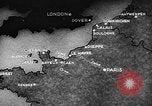
German fighter planes and antiaircraft battle Allied bombers during Allied invasion of Normandy, France, in World War II
Map shows French coast, English Channel and principal cities of interest, during the Allied invasion in World War 2. German Messerschitt Bf 109 aircraft on a flight line are starting up. Pilots getting buckled into cockpits and ME 109s taxiing for takeoff. Switch to German Focke-Wulf FW 190 aircraft taking off in formation from forward airfield. Contrails seen from high flying aircraft. Formations of American aircraft overhead, are fired at by German antiaircraft gun from hidden position. German antiaircraft batteries in operation. Wreckage of downed Allied aircraft, showing two left engines of a B-17; an A-20 or B-26, in D-day white stripes, with tail number 30148; and a crash-landed B-17 of the USAAF 96th Bombardment Group, 339th Bomb Squadron, with left horizontal stabilizer and elevator shot to pieces. Three surviving crew members stand behind the aircraft as they are approached by two German soldiers who check them for weapons.
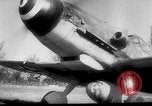
Luftwaffe planes take off on strafing missions and German Army battles Allies in a ruined French village during World War II.
German forces battle against invading Allies in France, during World War 2. German German ME-109 and FW-190 aircraft starting engines on an airfield. Three ME-109s take. Pilot point of view from inside cockpit as aircraft strafes ground targets. An FW-190 in flight. View from cockpit during strafing run. View of pilot's hand on control stick. View from cockpit of strafing run against targets on village streets. German machine gunners in trenches look through binoculars. Huge explosions nearby from Allied counterfire. German artillerymen fire heavy guns, at zero elevation, from positions in forest. Germans in assault guns and tanks covered with foliage camouflage. View from inside a tank as it crushes foliage in its way. Tank commander in Tiger tank of s.SS.Pz.Abt.101 talks on radio. Panther tanks firing. Marder III tank destroyer. Tiger tank of s.Pz.Abt.505 fires. Destroyed and disabled Allied armor, including Assault guns and Sherman tanks. GermanTanks and infantry fire at Allied positions. German infantry engaged in house-to-house battles and using flame thrower, in ruins of a French town. German rocket launchers obscured by smoke as they fire rapidly.
Allied forces in Britain airlift paratroopers and weapons from England to border of Holland, during World War II.
United States Army and British forces conduct airlift operations in Europe during World War II. They airlift paratroopers from England to Arnhem Netherlands. Large number of Allied transport planes at a British airfield in England loaded with weapons, artillery and equipment. The planes and gliders take off one after the other. Fighter aircraft accompany transport planes guarding them from Luftwaffe. View from ground in town in Belgium as a mass of many Allied aircraft fly over towns of Belgium towards Holland's border. Large number of paratroopers of the Anglo-American Army jump from the airplanes. Sky is filled with paratroopers descending. Paratroopers quickly arrange themselves and start their operation. Soldiers fire mortars and rifles at the enemy.

Red Devil paratroopers of British 1st Airborne Division, drop into Holland to outflank the German Siegfried Line in World War II
At start, the film shows a formation of American C-47 transport aircraft with paratroopers starting to jump from them during World War 2. Viewed moments later from the ground, the sky is filled with trooper' open chutes, descending. An animated map shows Netherlands, Belgium, Luxembourg, and Germany. It shows location of the Allied paratroopers drop in Holland, intended to spearhead a drive around the Main River into Germany. The map then shows German forces encircling the paratroopers and the Second British Army heading North to the rescue. Next, a huge number of American Soldiers are seen assembled out of doors in England. Closeup of General Dwight D. Eisenhower speaking in a microphone to the assembly. Closeups of soldiers including some who are American Army Air Corps pilots, and other aircrew members, mostly Lieutenants. Senior Paratrooper officers stand at attention in front of formation of troopers with American flag beside them.(Narrator says these were the men who made up the "lost division," heroes who fought alone for seven terrible days.) General Eisenhower makes his way between close ranks of the paratroopers. He is followed by Brigadier General and a Colonel. Lieutenant General Lewis H Bereton also makes his way through the ranks. Scene shifts to a base in England where many British Airspeed AS.51 Horsa gliders are seen with paratroopers heading across the airfield to board. American C-47 aircraft are seen in the background. All aircraft are painted with D-Day stripes. Several British and American paratroop officers review a map together. At a tent camp, A military policeman and two U.S. paratroopers checking their weapons and ammunition. Some troopers sharpen their knives. A trooper is issued Dutch and German money. A British and and American trooper in camouflaged helmets, pose before a glider with a huge British roundel on its side. British paratroopers boarding a Horsa glider, named "Gertie." A Horsa glider moving as it is towed by a British Whitley twin-engine bomber. View from side of runway as the bomber takes off with its towed glider behind. (Narrator comments: "Destination, Holland.") Formations of tow planes and gliders in flight. View of pilot in cockpit of a Whitley bomber. Formations of fighter aircraft in flight overhead. View from inside an aircraft as paratroopers exit through a side door. Sky filled with paratroopers in chutes descending. (Note: This Allied thrust into Holland to launch a drive around the German Siegfried Line was known as the Allied joint American-British "Operation Market Garden," which took place 17 to 25 September 1944, the 7 days referred to by the film Narrator. )
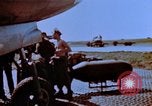
Aircrews of USAAF 323rd Bomb Group prepare to depart on mission to bomb German targets during World War II
Opening scene shows ground crew loading bombs on a Martin B-26 Marauder aircraft of the USAAF 323rd Bombardment Group at Denain-Prouvy Airdrome, France (A-83) in World War 2. The aircraft is parked on pierced steel planking (Marsden Matting). Glimpse of aircrew members, carrying their parachutes, as they climb into the back of an open truck. Next, ground crewman steadies a bomb as another man operates controls to lower it from an M6 bomb service truck. Ground crewman screws fins on the bomb. View shifts to inside the truck carrying aircrew members, as more climb aboard it. Several crew members climb down from the truck, as it arrives at their aircraft. Others are seen already at their respective aircraft parked nearby. Rough slate identifies the airfield as A-83, and day as 22 April. An officer, bombardier, is seen strapping himself into the nose of a B-26. Bombardier makes adjustments to his bomb sight. Pilot and copilot close their respective canopies. Name: "Wild-Bill" seen painted below copilot's window.
CRITICALPAST.COM: About Us | Contact Us | FAQs - How to Order | License Agreement | My Account | My Lightboxes | Shopping Cart | Advanced Search | Featured Collections | Website Terms & Conditions | Privacy Policy ©2026 CriticalPast LLC.
License Agreement |
Terms & Conditions |
Privacy Policy
©2026 CriticalPast LLC.