


 Francais
 Deutsch
 Italiano
Refine Your Search
Japanese-martial-arts stock footage and images
- Showing 751 to 756 of 4336 results more
more Hide
Hide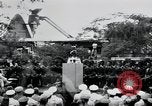
Highlights in career of Chester W Nimitz. U.S. naval campaigns against Japanese forces during World War II.
Fleet Admiral Chester W Nimitz speaks to naval officers and civilians, on third anniversary of the Japanese attack on Pearl Harbor. Sailors salute as he boards a ship. Admiral Nimitz with Admiral Halsey. Fleet of The United States ships underway to attack Japanese enemy. Battleships fire guns at enemy. Rockets being fired from U.S. ships. U.S. amphibious landing at Leyte. Japanese military show their commitment to fight. U.S. Navy crews at work aboard ships preparing to engage Japanese fleet at Leyte Gulf. Heavy U.S. naval gunfire. U.S. navy aircraft take off from carrier and engage Japanese in aerial combat. U.S. aircraft bomb Japanese ships and U.S. ships defend against Japanese air attacks. Japanese survivors floating on debris and life rafts in the ocean. U.S. wounded in stretcher. Dead Americans honored at sea by their comrades in an official ceremony.
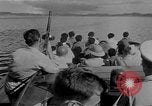
Japanese prisoners on PT boats and being marched under American guards in Guadalcanal, Solomon islands.
Captured Japanese aviators by U.S. Marines in Guadalcanal, Solomon islands during World War II. Japanese aviators captured, in PT (Patrol Torpedo) boats enroute to Guadalcanal. Stern of PT boats with wake and guards. Japanese prisoners on PT boats. Japanese prisoners disembark from Higgins boat. Japanese prisoners stand about. American give Japanese prisoners cigarette and a light. Japanese prisoners march to stockade. Japanese prisoners wait for a boat. Prisoners being marched to boat. Guards with tommy guns as they watch prisoners on boats. Prisoners sit idly. Prisoners seated on stern of a PT boat. Prisoners march on road. Prisoners stand idle. Prisoners stand in a group as Marines guard them. Prisoners stand in a double line as Marines guard them.
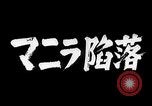
Japanese tanks and infantry enter Manila, Philippines
Japanese attack and occupation of the Philippines during World War II. Map shows Japanese positions and Manila, the capital of the Philippines, in Luzon Island. Japanese tanks and infantry wade river and march past wrecked bridge and ruined homes in Luzon. Soldiers cross river on bridge to Manila. Soldiers move forward. Trucks and artillery. Wrecked U.S. plane left by retreating forces. Smoke column from fire. Soldiers march in the foreground. Buildings in city. Vehicles of Japanese troops enter the city of Manila. They march past the United States consulate. Ruins of Manila after Japanese bombardment. Smoke rises from city. Civilians stand and talk. Japanese forces enter Manila. Car driving past San Miguel Pale Pilsen and Royal Tru Orange softdrink billboard in Quiapo. Quezon Bridge in Quiapo (TULAY NG QUEZON MANILA, Quezon Bridge, Quiapo, Manila, Metro Manila). People stand with the Japanese flag in hand. Soldiers enter city on tank. Women wave Japanese flag.
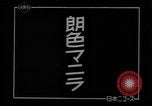
Scenes of Manila, Philippines, early during the Japanese occupation in World War II
Title card with title “Roaring color Manila” in Japanese. A street corner in Manila after the Japanese invasion and occupation in World War 2. Japanese flag in storefront as Filipinos walk pass store. Closeup of the statue of St. Anthony of Padua with a kneeling woman and child, in front of the Church of St. Francis (the former San Francisco Church, now site is occupied by Mapúa University), Church of Our Lady of Angels, Intramuros, Manila, Philippines. Camera pans down over the statue. View from above, at a short distance, of parishioners going in and out of the church. (This church was destroyed in the battle of Manila, 1945, but the statue survived.) A Japanese sign outside of a building. View inside the building, where many school children are seen walking through an exhibit of artwork and other displays of school projects. Closeup of one drawing on display, depicting a Spanish Toreador. Several displays of Japanese calligraphy. A model of two small structures. Closeup of several schoolboys interested in small objects on display. A group of schoolgirls at exhibits of clothing designs and patterns. A cartoon sign in the building, in Japanese but mostly in English. It shows two small girls and a boy in different exercise poses and two ducks walking past them near their feet. The sign announces in Japanese and English, "Radio Taisou Daily Calisthenics on the air." It also reads: "Health First" and "Mass exercise at Luneta Park." A man conducts calisthenics in the open in front of a rotunda. Jorge B. Vargas, chairman of the Japanese-sponsored Philippine Executive Commission, sits inside the rotunda observing a vast field filled with school children following the lead of the exercise director, as they perform calisthenics. The Rizal Monument (1225 Roxas Blvd, Ermita, Manila, 1000 Metro Manila) is seen far in the background. Some closeups of the children as they exercise. Wide view of the children organized in lines across the field. The French renaissance-style Luneta Hotel (414 Kalaw Ave, Ermita, Manila, 1045 Metro Manila, 1000 Metro Manila) is seen in the background.
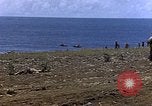
American forces dealing with prisoners and bodies of dead Japanese after the battle of Saipan during World War II
Camera pans past body of fallen Japanese soldier to U.S. Marines spread out along a shoreline as landing craft maneuver nearby and an American aircraft flies low overhead. Japanese prisoners along with women and children walk in a line. Glimpse of body of a dead Japanese soldier. Another group of Japanese prisoners and civilians. Several stand near American soldiers looking out at the small craft maneuvering offshore. A man (interpreter) speaks into a microphone, giving instructions to the Japanese persons on the shore. Body of dead Japanese woman. Bodies of numerous dead Japanese soldiers along the shore. Japanese prisoners with shovels begin recovering the bodies, placing them on makeshift litters and carrying them away.
U.S. Navy successfully engages Japanese fleet at Battle of Coral Sea and Battle of Midway early in World War II.
U. S Mahon class destroyers speed through the water in the Pacific Theater in World War II. Closeup of one passing the camera ship. Distant head-on view of a North Carolina class U.S. Battleship. The American aircraft carrier, USS Enterprise (CV-6), with aircraft on her deck. Animated map shows the Coral Sea and Midway Island, in the Pacific, where the U.S. Navy successfully engaged the Japanese in major naval battles. Glimpse of sailor with binoculars at railing of an aircraft carrier with many Douglas Dauntless dive bomber aircraft on her deck. View, looking back from an airplane, toward the aircraft carrier, USS Intrepid (CV-11) underway in the Pacific, with aircraft crowded forward on her deck. A South Dakota class battleship underway and firing guns astern while defending against attacking Japanese aircraft Black flak clouds are visible low in the sky. Aircraft carrier and other U.S. warships under aerial attack. An American aircraft carrier tilting as she maneuvers sharply under fire. U.S. ships firing 1.1 inch quad anti-aircraft guns. Japanese bombers maneuvering and attacking amidst numerous black flak clouds. Skies filled with tracer rounds of ammunition. An airplane crashes into the water. Sailors reloading their quad anti-aircraft guns. Glimpse of a destroyer firing her anti-aircraft guns while racing behind an aircraft carrier. A Japanese bomber heading toward a U.S. ship, through heavy fire, is hit in the left wing and plunges into the sea. Black smoke marks its impact. Two Japanese aircraft hit by anti-aircraft fire, trail fire as the aircraft crash into the sea. More scenes of combat. Glimpse of a disabled Navy F4F airplane on a carrier deck. Sky littered with black flak smoke clouds. The sound of an engine on one Japanese aircraft begins cutting out. Two observers with binoculars point toward the plane as it falls into the sea. A PT boat is seen underway carrying Japanese airmen rescued from the sea. A sailor guards them with a Thompson machine gun. More rescued Japanese airmen are seen stepping from a Higgins boat, and then walking , while trying to avoid the cameras. Some prisoners crouched together smoking cigarettes provided by a U.S. soldier. At end of film, Admiral Chester W. Nimitz, Commander in Chief of the U.S. Pacific Fleet, decorates American aviators and sailors at a formal award ceremony aboard an aircraft carrier.