


 Francais
 Deutsch
 Italiano
Refine Your Search
Japanese-martial-arts stock footage and images
- Showing 793 to 798 of 4336 results more
more Hide
Hide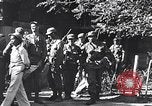
U.S. Rangers and Filipino guerrillas rescue Allied prisoners from Japanese prison camp in Philippines during World War II.
On January 30, 1945, 121 members of the 6th Ranger Battalion and 286 Filipino guerrillas are seen setting out on a 30 mile trek behind Japanese lines, to free Allied prisoners of war (POWs) and civilians from a Japanese camp near Cabanatuan City, in the Philippines, during World War 2. They stretch out in a long, informal column as they traverse low flat lands and ford a wide shallow river. The men carry weapons and supplies (some on their heads) as they move along, almost like a Safari. Scene shifts to rescued prisoner, Major Emil P. Reed, U.s. Army Medical Corps,26th Cavalry. He was the senior officer among prisoners at the Cabanatuan prison camp number 1. He recounts being told by the Japanese Commandant that commencing January 7th, they were free at their own risk, but also assured them they would not be molested by the Japanese if they stayed within their regular camp area. Sergeant Samuel E. Goldy, Signal Corps, also speaks a few words about that period when Japanese were departing. Next the camera records the Rangers and Filipino guerillas returning with the approximately 500 freed POWs. Some Filipino women and children watch them return. At one point, the cadre climb aboard army trucks and continue their journey in a convoy. The POWs climb down from their trucks at the 92nd Evacuation Hospital, in Guimba, Luzon. Some take pleasure is simply lying down on the grass at the site. Many gather around hospital staff handing out packages of treats, including cigarettes, candy and the like. A couple of them express pleasure as they smoke cigarettes. Two frail and injured are seen hobbling with canes. Some appear seriously malnourished. A group are seen trying on new clothes. A British prisoner, Sergeant Robert Bell, Manchester Regiment, British Army, speaks of his experience. He was taken prisoner in Singapore and sent to Thailand where he worked to build a railway for the Japanese. Many prisoners died there from disease and malnutrition. He was one of a small number who survived after being on a Japanese ship with other prisoners when it was sunk by American dive bombers. Sergeant Walter Ring, of San Roque, Luzon, is seated, relaxed on a chair, as he recounts his experiences. Two young Filipino boys sit on the grass at his feet. He reaches to one, whom he says is his son Louis and to the other, his son Sam. His captivity began on Bataan in 1942. Finally, after rest and rehabilitation, the former POWs are seen heading away from the battle fronts to be transported back to the U.S.A.
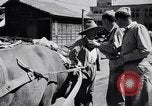
Japanese enjoy movies,baseball games in Japan after World War 2
American soldiers talk to Japanese people. American soldiers speak to a Japanese farmer. An American soldier buys wares from a Japanese man. A man plays with wooden trinket attached to a box. Sign reads “Can you open this box? Please try!”. They visit Japanese Buddhist temple. Soldiers plant incense into container as offering. A statue of Buddha. Movie theaters are seen. A sign reads “boys town” (Shonen no machi) in Japanese. An advertisement for “A Medal for Benny”. A movie theater called “Everyday Hall” (Mainichi no hooru) in Japanese. An advertisement for “Rumba”. Japanese play a game of baseball. People vote at the first elections
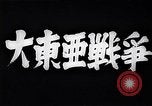
Japanese fleet moving toward Pearl Harbor in Hawaii for attack on Pearl Harbor
Japanese propaganda footage showing Japanese forces heading for attack on Pearl Harbor in World War 2. Turrets of a Japanese battle ship being trained starboard. Japanese Navy flag flying. Bow of battleship and Imperial crest seen. Three Japanese crewmen use binoculars. Japanese fleet underway. Admiral Yamamoto on bridge. Scale ruler used on a navigation map. Japanese title slates seen at beginning of clip.

Japanese warplanes take off from Philippine airfield to attack U.S. Naval Task Force
Japanese propaganda newsreel, in English, released from the Philippines during World War 2: Closeup views of Japanese pilots as they are briefed and take off in their aircraft from a Filipino airfield to attack United States Task Force 58 in World War 2. A variety of Japanese warplanes take off to attack the U.S. Naval Task Force. Among those seen are: Nakajima Ki-84 Hayate (Frank) fighters; Yokosuka D4Y Suise (Comet) dive bombers; and twin engine G4M1 (Betty) bombers. Aircraft are directed from a Control tower made of wood and bamboo with camouflage covering. Formations of the Japanese warplanes are seen flying overhead. Japanese battleships at sea firing their guns, planes in the air, and torpedoes being launched. Japanese trucks distribute newspapers telling of the Japanese victory over the American Naval Task Force. Filipinos reading the papers.
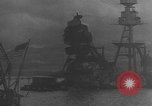
Japanese bombard Pearl Harbor and the Island of Oahu, Hawaii.
Dramatized documentary released during World War II depicting Japanese attack on Pearl Harbor during World War II. Aerial view of Island of Oahu, Hawaii. A goods train moves on a railway track. Military trucks enter Hickam Air Force Base. Aircraft parked on an air field. A native fishes on the riverside. A naval officer speaks to a group of United States sailors. A clock on the Alho Tower. A fleet of Japanese aircraft advance towards the island. Japanese aircraft bombard the island and attack United States ships. Explosions on buildings and Wheeler Field. Japanese fighter planes bomb Pearl Harbor. The battleship USS Arizona goes up in flames on being hit by a Japanese bomb. United States crew members prepare to fight. U.S. sailors fire at Japanese aircraft. Japanese aircraft leave wreckage and destruction.
Attack on Pearl Harbor by Japanese, and President Roosevelt asks for war declaration on Japan in 'date of infamy' speech.
United States Government film entitled "The World At War" dealing with World War 2. Film opens showing Japanese warplanes in formation above a Japanese military installation. Slate reads: "Pearl Harbor December 7, 1941. An airfield is seen filled with parked U.S. Army Air Forces B-17 bombers. Two Boeing XB-17 (Model 299) bombers are parked next to each other on the ramp. Derricks and ships are shown at the Pearl Harbor naval base. A formation of Japanese Mitsubishi G3M bombers is seen in flight. They are seen overhead as bombs explode on the U.S. Navy Air Station at Ford Island destroying hangars and aircraft. Next, is shown the famous image of the USS Arizona burning, listing, and sinking, after being bombed. Film continues, panning over post-air raid views of destruction. On December 8, 1941, U.S. President Franklin D. Roosevelt, addresses the Congress, delivering his declaration of war message. He calls December 7, 1941 "a date which will live in infamy." Roosevelt recounts that the United States was at peace with japan and in conversation with its government and Emperor, in the interest of maintaining peace.in the Pacific. even at the time of the attack. Japanese ambassador and his colleagues seen visiting State Department offices to meet with U.S. Secretary of State prior and even during the initial attack operations by Japan.Roosevelt recounts that the United States was still in conversation with Japan even at the time of the attack. Japanese ambassador and his colleagues seen visiting State Department offices to meet with U.S. Secretary of State prior and even during the initial attack operations by Japan. Photographers take pictures of the visiting Japanese delegation. President Roosevelt asks Congress to affirm that a state of War exists between the United States and the Japanese Empire.