


 Francais
 Deutsch
 Italiano
Refine Your Search
Japanese-martial-arts stock footage and images
- Showing 787 to 792 of 4336 results more
more Hide
Hide
Japanese troops break through near Zhongshan Gate and mount the walls of Nanking in China.
Japanese troops fight outside the walls of Nanking, China during the Second Sino-Japanese War. Japanese soldiers on tanks. Smoke arises from explosions in the fields. Troops fire from behind bushes. Soldiers with a flag in the field. They fire artillery, advance, and take cover. Soldiers walk along the Zhongshan wall (China, Jiangsu, Nanjing, Bai Xia Qu). Explosions near the wall. A destroyed part of the wall. Japanese soldiers carry a ladder. They break through near Zhongshan Gate and mount the wall. Soldiers climb up the wall and enter tunnels. Soldiers seated by a barricade of sandbags. Japanese writing on the wall. The Japanese troops give a 'Banzai Cheer' as they wave Japanese flags atop the wall.
U.S. Liberator bomber planes destroy the Japanese planes and ships on Makin Islands and reinforcements land in Bougainville.
The U.S. turns offensive against Japanese in the Pacific during World War II. U.S. Liberator bomber planes fly towards island of New Britain. Map of New Britain. Pilots in the cockpit pull a trigger and drop bombs on the island. An invasion fleet moves towards the island. U.S. Marines land on the island and move forward. A map shows Makin Islands. U.S. Planes drop bombs on a Japanese ship. The planes drop bombs on a Japanese airstrip causing the destruction of the Japanese planes. The 6th U.S. Army General and Lieutenant Colonel James Roosevelt on a ship with other officers. Sailors climb down step ladders and move into a boat. A Japanese bomber is driven off and another is hit. Amphibious Forces land on the beach. Dead Japanese soldiers on the island. Japanese are defeated and Prisoners of War taken. A map shows Bougainville in the Solomons Islands. Troop reinforcements land.
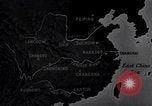
Bombing of Chungking (Chongqing), China, by Japan, in Second Sino-Japanese war
The Republic of China establishes its wartime capital at Chungking (Chongqing), China during the Second Sino-Japanese War. Animated map depicts areas of Japanese occupation and highlights cities including Lanchow (Lanzhou), Chengtu (Chengdu), and Kunming. It highlights Chungking (Chongqing) as the Nationalist Republic of China. Chiang Kai-Shek is seen leading a group of Chinese leaders as they walk through an arched gate in Chungking (Chongqing). A busy street with shops and apartment houses in a commercial district. Busy scene of pedestrians, cart traffic, and automobiles in the road center. Boats on the Yangtze River are seen below long steep steps leading up to the streets above. Houses along the cliffs. Chinese workers digging bomb shelters into the cliffs. View from inside a shelter being hollowed out of the rock. Back in the Japanese occupied area, a car brings a Japanese Air Force leader who addresses a large group of fliers at an airbase. Next, Japanese aviator crews are seen running to their aircraft from their camp on the airfield. They take off in Mitsubishi G3M bombers to attack Chungking (Chongqing). Nakajima Ki-27 airplanes take off from the field and join in large formations overhead. A formation of Chinese World War 1 era aircraft is seen in flight to engage incoming Japanese bombers. Japanese crew member in a bomber sees the Chinese fighters and gunners in the bombers get ready to fire on them. The Chinese fighter planes dive at the bombers but are intercepted by Nakajima Ki-27 airplanes flying cover. Dogfights ensue with Chinese aircraft being shot down, and the bombers continuing their way. Air raid sirens sound in Chungking (Chongqing) and people run to their shelters, including school children. Views of bomber crews at their stations and then of bombs falling with the Yangtze River below. Bombs exploding along the riverfront and inland, along the cliffs. View of machinery operating, and Chinese workers occupied in underground factories in Chungking (Chongqing). Fires burning throughout the city from the bombing, and Chinese fire fighters with hoses working to extinguish fires.
Wrecked British fortifications, captured British soldiers, and cheering Japanese soldiers after victory in Hong Kong during World War II.
Japanese propaganda film touting victory of Japanese forces over British forces in Hong Kong. Contains Japanese-accented narration in English. Shows scenes of fall of Hong Kong to Japanese forces during World War II. Wrecked British fortifications in Hong Kong. Japanese soldier cheer after surrender of Britain. Views of British tanks and artillery captured during this war. British soldiers taken as prisoner, are seen seated in groups outside building where surrender takes place. British officers emerge after signing surrender of city, and shake hands with Japanese officers. Number of warplane aircraft from Imperial Japan fly over Hong Kong. Cavalier officers of Japanese military patrol on streets of Hong Kong.
Documentary titled 'Challenge to Democracy' depicts homes for Japanese people relocated during World War II, in United States.
Documentary titled 'Challenge to Democracy' depicts relocation of Japanese Americans and people of Japanese ancestry due to perceived security reasons, in United States during World War II. People of Japanese origin moved by railroad train to a relocation house in Arkansas and at Heart Mountains, Wyoming (internment camps). Japanese civilians walk out of the railroad train at a station, carrying their luggage. Houses, barracks and Quonset huts at the relocation center. A military police guard with rifle on duty. A Japanese family enters its compartment and finds fully furnished comfortable house inside. A Japanese worker works on lumber. A small family inside a house. People dine together at a large mess hall. A car moves in the desert to plan a site for relocation center. Workers clear bush, level soil and do plantation using tractors. Farmers produce vegetables and fruits. Tractors plow farmlands. Farmers hoe crops and collect harvest. Harvest loaded in trucks and sent to mess of relocation house. Japanese mechanic repairs truck, lumbers at work. Workers paid for their work done at relocation house at an office. People inside a Community Enterprise Business Store.
U.S. Army battles against fortified Japanese forces during World War II, in Manila, Philippines
Wartime news film entitled: "Manila Cleanup." View of the Pasig River, dividing North and South Manila. American tanks and tank destroyers on North bank, firing at Japanese positions on the South side of the river. Exploding shells on South side. U.S. troops fire 155mm howitzers at low elevation, blasting the walls of Intramuros and adjacent buildings. The 540th Field Artillery fire 240mm guns point blank against the ancient walls. Troops firing machine guns at the Colegio de San Juan de Letran and Manila Post Office buildings. Troops of the 3rd Battalion, 129th Infantry, 337th Division, crossing the river in small assault boats, under covering fire. Landing on the South Bank, troops fan out around and about the walled city. Japanese forces resist from fortified pill boxes and machine gun nests near the public buildings. U.S. troops breach a section of the wall and elements of the 37th Division enter Intramuros on February 23, 1945. U.S. soldiers sheltered behind wall as others employ flame throwers. U.S. Soldiers prepares a TNT charge to blow up walls and seal underground passageways. A destroyed Japanese pill box at base of wall with many dead Japanese soldiers are seen. U.S. artillerymen firing 155mm howitzers directly at Japanese troops holed up in the Legislative, agricultural and finance buildings. Troops of B Company, 148th Infantry Regiment, advance from the Manila City Hall, towards the Legislative building. They direct flame throwers at Japanese fortifications under the wall. Soldier with flame thrower passes through group of riflemen and fires into hole in wall. U.S. soldiers fighting room to room in the walled city. On February 24th U.S. troops defeat the last Japanese resistors of Manila in World War II.