


 Francais
 Deutsch
 Italiano
Refine Your Search
Japanese-martial-arts stock footage and images
- Showing 2701 to 2706 of 4328 results more
more Hide
Hide
Surrender of Japan after atomic bombings of Hiroshima and Nagasaki, Japan.
Surrender of Japanese Imperial forces leads to end of World War II. V-J Day (Victory over Japan) celebrations in August 1945. Americans celebrate as newspaper headlines announce V-J Day. Close up view of man holding Boston Post with headline "War Is Over." Teeming crowds in New York City's Times Square celebrating the news. Crowd of citizens, soldiers, and sailors in uniform surrounds a newspaper with headline "U.S. Announces Jap Surrender." Happy crowds of people waving, jumping, and smiling in jubilation. People show V signs. U.S. warships underway at sea. U.S. soldiers aboard ship. Japanese troops parading in Japan. Japanese aircraft lined up in flight line ready for take off to defend the Japanese mainland. Japanese amphibian tanks lined up ready for use against a possible allied invasion. Aerial view of actual atomic bomb explosion over Hiroshima as seen from second B-29 aircraft accompanying the Enola Gay on the bombing run on August 6, 1945. Ruins of twisted metal and debris in Hiroshima and Nagasaki and civilians walking among the devastation. Japanese civilians along road. Japanese Generals deplaning and meeting U.S. General MacArthur on an airfield. Troops of 11th Airborne Division land in Japan. Marines reach Japanese shores at Yokosuka Naval Base in Landing crafts. American soldier raises American flag in Japan. American troops aboard Japanese battleship Nagato after Japanese surrender. View of the Nagato (later used as a target ship during Operation Crossroads).
A6M Zeros, D3A Vals and B5N Kates take off from an aircraft carrier to attack Pearl Harbor in Hawaii during World War II
Japanese attack on Pearl Harbor, Hawaii during World War II. Animated map shows Manila, Singapore, Hong Kong, Nippon, Pacific Ocean and the USA. An arrow points out from Nippon to Pearl Harbor, Hawaii. Two Japanese aircraft carriers, the Kaga and the Zuikaku underway at sea as seen from the carrier Akagi. Waves of water dash over a deck. Japanese crew on the deck. Japanese Naval officers look through binoculars. An officer briefs Japanese pilots. A chart drawn on a blackboard. Japanese aircraft in flight. The pilots being briefed . The pilots run towards their aircraft and get ready for a take off. A signal flag is waved. The first Imperial Japanese Navy Air Service B5N (Kate) bomber takes off. A formation of nine A6M Zeros in flight. The mast of a ship. Japanese aircraft in flight. Three Kates in flight. Ford Island and airfield seen below. Aircraft dropping bombs. Honolulu smoking due to the bombardment. 3 PBY (Patrol Bomber Consolidated Aircraft) Catalinas. Bomb bursts near airplanes on the field. Pearl Harbor smokes. Animation shows war losses suffered by the U.S. A formation of A6M Zeros in flight. A Japanese war ship underway in the Pacific Ocean. Three Japanese warships underway. (Note: The attack began about 8AM December 7th, Honolulu time, which was 3AM, December 8th, Tokyo time.)
Battle for Okinawa in World War II
U.S. infantry and M4 Sherman tanks move against heavily fortified Japanese positions on Okinawa during World War 2. American soldiers use flame throwers to dislodge Japanese defenders. Two soldiers run as an explosion occurs behind them. U.S. artillery firing from under camouflage netting. Glimpse of soldier walking past a burning building. Okinawan women and children seek refuge behind the U.S.Tenth Army lines. A soldier carries a naked baby to safety. View of Okinawan refugees (Ryukyuan people), mostly women and children and some old people, seated together where they are to be cared for by the Army's Civil Affairs Command. Wounded American soldiers being placed aboard a U.S. Air Transport Command C-47 aircraft number 42-72383. Change of scene to the battlefield where a U.S. Army soldiers throw a hand grenades that explode on a Japanese caves. A Japanese soldier is shot as he stumbles out of his cave. Another Japanese soldier is take prisoner. U.S. soldier fires his rifle and a Japanese soldier falls to the ground. Scenes shift to the sea off of Okinawa, where a Benson-Livermore class destroyer is seen under a sky full of black flak clouds. Closeup of the destroyer. A Japanese aircraft is shot down as it flies toward a U.S. New Orleans class heavy cruiser. It crashes into the sea near another U.S. capital ship. An attacking Japanese plane is shot down by anti-aircraft fire and crashes into the sea. More flak filled skies and bombs exploding along with machine gun fire raking the waters. Anti-aircraft tracer bullets firing from ships. A Japanese plane hit, is burning, and then explodes in the air. A Douglas dauntless aircraft lands on an aircraft carrier. Another aircraft doesn't make it to the carrier, and ditches in the water nearby. The pilot is seen standing on the plane's right wing, awaiting pick up. A Navy F4U Corsair plane approaches its carrier to land but loses control and crashes into the carrier's island. Firefighters direct streams of water on it's burning wreckage.
Allied planning for the final invasion of Japan in World War II
Scene opens with a map illustrating one possible Allied path for invasion of Japan. It proceeds from India and Burma to China and thence to Japan. A U.S. B-24 bomber is seen landing at a Far East Air field. Next, the Supreme Allied Commander of South-East Command (SEAC) Admiral Lord Mountbatten, is seen posing with Chinese General Li Zongren (AKA Li Tsung-jen) and other high ranking Chinese officers, and then walking with them. Next are views of U.S. General Joseph Stillwell working with staff as they consult maps. Then, Chinese laborers are seen engaged in construction of a bridge over a riverbed, that is to be part of the "Ledo Road,"traversing Burma and providing a highway from India to Chunking, China. Trucks moving over the already completed segments of the road, carry men and war materiel. One truck passes a local native drawing water from a well using a long counterbalanced pole. At the frontier of the roadbuilding, Chinese soldiers chop their way through dense jungles and battle Japanese forces firing at them. A fallen soldier. Allied soldiers shouting as run into a village engaging Japanese forces. Structures in the village burning and spreading in the area. Scene shifts abruptly to an animated map illustrating what are believed to be the Japanese plan for its last desparate defense. It shows them falling back to highly defensible boundaries encompassing sources of supplies needed to sustain their defense. Aerial views of Manchurian landscape. Japanese officials are seen at their administrative offices in Manchuria. Large numbers of Manchurian workers are seen headed to work near a factory. Others are engaged in open pit mining, where explosives are used to expose and ready ores for extraction. Views inside a Manchurian steel plant supporting the Japanese war effort. Japanese military forces are shown moving by horseback in the area, ostensibly to push further into China and add more protection against potential Allied offensives. Likewise, Japanese warships are shown at sea maneuvering to defensive locations. This is all summed up in a map showing the expected disposition and status of military defensives for Japan's final defense (Fortress Japan). Street traffic on a city street in Japan. A large group of Japanese women in traditional dress, carry banners and quietly bow. View of the Japanese Diet Building (Parliament) and political and Military leaders inside, including Prime Minister Tojo, Hideki.
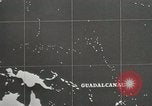
The Guadalcanal campaign in the Pacific during World War II.
Animated map shows Guadalcanal, where Japanese were building up a base to interdict Allied supply routes to Australia, in World War 2. U.S. marines in full battle gear board a troop transport ship. Convoy of transport ships headed to Guadalcanal. A Benham class destroyer bombarding the island from close range. On 8 August, 1942, the day after the amphibious assault on Guadalcanal, U.S. marines of the 3rd Defense Battalion, are seen descending rope net from the Transport ship USS Zeilin (AP-9, later designated APA-3) to enter landing craft headed ashore to reinforce marines fighting Japanese defenders on Tulagi, Gavutu, and Tanambogo, in the Solomon Islands. U.S. ship firing its guns. U.S. marines wading ashore, relatively unapposed at Guadalcanal, on 7 August, 1942. U.S. Douglas SBD Dauntless dive bomber taking off from Henderson Field on Guadalcanal. Two officers with large binoculars are seen aboard a Japanese warship flying her Naval ensign. A Japanese Nakajima B5N torpedo bomber (Kate) taking off from carrier. A formation of Japanese Nakajima Ki-43 Hayabusa (Oscar) or Ki-44 Shōki (Tojo) aircraft in flight. Closeup of two overhead in silhouette. Glimpse of U.S. carrier (USS Wasp?) taking evasive action. Sky filled with puffs of black Flak at low altitude and contrails from dogfights at high altitude. Closeup of a Japanese Mitsubishi B5M Type 97 Carrier Attack Bomber (Mabel) with others in formation in background. Bombs falling. View from carrier island of sailors running across deck of U.S. Carrier with smoke rising at site of bomb strike. Smoke obscuring the deck and beginning to clear. View from different U.S. carrier deck, past parked aircraft, to a camouflaged U.S. destroyer approaching astern. Carrier deck with Douglas SBD Dauntless dive bombers parked at its end, and black flak clouds overhead. Several night naval gun battle scenes followed by view of burning Japanese ship. Closeup of the wreck of the Japanese transport ship, Kinugawa Maru and views of other Japanese ships burning. U.S. army troops are seen marching along the sides of a road as they arrive in December, 1942, to relieve the marines on Guadalcanal. View of the embarkation operation on the shore as marines prepare to depart. Marines getting aboard Higgins boats (landing craft) for transport out to their transport ship, the USS Neville (AP-16, later redesignated APA-9).
United States Army 187th Airborne Regimental Combat Team returns to Japan from Korea and is welcomed by City of Beppu, Oita
Clip opens with rapid changing scenes: American troops in trench in Korea during the Korean War. American tank on street in Germany. American Ski troops in Alaska. Amphibian assault training in Puerto Rico. Rotating Globe shows: U.S. Army on alert to defend against aggression. Sergeant Stuart introduces episdoe and states that U.S. Army has come to Japan to know their culture and make friends after war and occupation. U.S. Army troops of the 187th Airborne Regimental Combat Team, are seen arriving by railroad train at a train stateion near their base near Beppu,Oita on the island of Kyushu, Japan. U.S. Army soldiers, including white and African American soldiers, exit train cars. They receive a warm welcome from Japanese population. Banner reads:" Welcome Pala Troop comin back from Korea, City of Beppu."[sic] Women holding flowers and families with small children waving American and Japanese flags, welcome them on the train station. A sign over the train station platform reads: "Welcome 187 Para Troop Coming Back From Korea, City of Beppu." The troops stand in formation on the platform while the unit's officers receive the flowers from the women. Japanese men in fraternal uniforms and the general population all join in the welcoming ceremonies. The troops march off the train station under another sign reading: Welcome Home 187 RCT." and march down the main street of Beppu under a swirl of paper confetti. Next scenes are from autumn of 1945, as U.S. soldiers march through streets of Japan during occupation following the end of World War 2. U.S. troops seen marching behind Japanese police to occupy Japan, in 1945, amidst the aftermath of suffering and destruction of the war. The local population standing at road sides and watching with worry and concern. Scenes of postwar destruction in Japan. Rubble of bombed buildings. Scene of simple wooden dwelling shacks and wreckage nearby. A Japanese boy with his baby brother on his back. The baby is crying. Next scene moves again to circa 1950 in streets of a Japanese city, possibly Tokyo, rebuilt and with busy scenes of traffic on streets and commerce. Large outdoor rally with a Communist speaker addressing large crowd of Japanese people who sit and listen. Scenes from a what the narrator describes as a Communist rally in Japan, against America, which turns violent. Protestors running in streets during demonstration, with signboards and police and fire fighters extinguish flames at scene of an overturned, burning car. Flashback again to 1945 or 1946 as U.S. Army soldiers use tractors and heavy equipment to clear and level an area of war rubble and debris during rebuilding efforts after World War 2. Japanese citizens look on, watching the machines at work.