


 Francais
 Deutsch
 Italiano
Refine Your Search
Japanese-martial-arts stock footage and images
- Showing 2719 to 2724 of 4327 results more
more Hide
Hide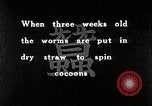
Women harvest silkworm cocoons, mother breastfeeds her baby, children playing jump rope in Japan
Sericulture in Japan. Japanese workers pick up three-week-old silkworms from a tray. The workers place silkworms in dry straw to spin cocoons. Japanese women picking cocoons from dry straw. Women harvest cocoons after five days for silk production. A Japanese woman breastfeeding her baby. A Japanese girl ties harness on her body to carry an infant behind her back. The infant’s mother helps the girl tie her harness. Other children sit nearby. Japanese girl smiles while carrying a baby behind her back. Japanese children playing jump rope. One of the girls swinging jump rope is carrying an infant on her back. April 1934.
Women working inside their homes, put on traditional kimono dress in Japan
A Japanese woman follows her husband. Man sits to read a newspaper beside a tokonoma (Japanese alcove). The woman touches the hair of a girl in kimono. The man looks up to his wife. The woman tidies the girl’s kimono while the girl stands. Two Japanese boys in Western clothing read books. The woman sits beside her husband. The two boys stand up. Children bow down to their parents. Japanese woman wiping the wooden floors of the engawa (veranda), create ikebana (floral arrangement), and places ikebana on the alcove. Her daughter joins her in chores. Various kinds of traditional Tsugegushi wooden combs are placed on the table. A hairdresser combs the hair of a Japanese woman. Japanese woman shows her traditional yuiwata hairstyle. The hairdresser places a kangashi comb ornament on top of woman’s hair. A woman puts on a kimono with the help of a girl. Girl puts obi sash on woman. Woman shows off her kimono.
Third United States World Trade Fair at the Coliseum, in Manhattan, New York City, 1964
Scenes of fire works. New York city in America. Views of Manhattan skyline and 5th Avenue in New York City. The Third United States World trade fair at the Coliseum on Columbus Circle in New York city. Flags hang on walls in the building. Stalls from various countries around the world like France,Germany,Norway,Italy,India,Venezuela, Japan,Luxembourg and China. Two men ride up on escalator. Men greeted by a Japanese woman at Japanese stall. Japanese woman adjusts flowers kept in a porcelain vase. Japanese Noritake China crockery and furniture on display along with other Japanese merchandise like vase,bowls,scissors. American women check Japanese leather bags made by Matsutaki Company. Bamboo merchandise on display. Silk clothes made by Kanegafuchi spinning company are also on display. 1964-65.
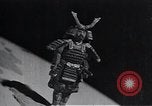
Tracing the opening of Japan to the outside world, from the time of the Shogun, to the modern era.
Symbolically Japanese Shogun secured the island empire from the outside world, as illustrated by a model with a fence around Japan. A model of early steamship and figures represent the visit to Japan of Commodore Matthew Perry, of the United States, in 1853, which resulted in a treaty opening Japan to broader commerce with the outside world. Japanese women read newspapers. Japanese Prime minister Hideki Tojo. Japanese Women as recruits. Japanese troops march. Japanese men and women queue up to vote.1950.

General Douglas MacArthur returns to the Philippines (WW2)
General MacArthur returns to the Philippines in World War II. Gun footage show Allied airplanes bombard Japanese ships in Mindanao, Philippines. Allied airplane in dogfight with a Japanese airplane. Japanese airplane gets hit and goes down. Allied airplanes attack a Japanese anti-aircraft tower. Allied airplanes bombard Japanese airfield on Mindanao. Allied ships bombard Leyte in Philippines and carrier-based plane bombard the Island. United States prisoners of war captured by the Japanese. General Douglas MacArthur and General Jonathan Mayhew 'Skinny' Wainwright VI and Admiral William Frederick Halsey can be seen. General Douglas MacArthur and his men after landing on Leyte beach.

Devastation from atomic bomb dropped on Hiroshima Japan in World War II
U.S. War Department film showing devastation from atomic bomb dropped on Hiroshima, Japan, during World War 2. Opening scene is darkness of predawn in Alamogordo, New Mexico, on 16, July, 1945, at 5:29:45 AM. Suddenly, a huge explosion lights up the sky. A fireball and mushroom shaped cloud form. Closer view of the explosion from another camera. Following the initial explosion, the ensuing sound is a continuous roar. Another view is shown, from a third camera location. It highlights the boiling fire and smoke of the explosion. These scenes document the first successful test of a nuclear weapon, code named "Trinity". Change of scene shows glimpse of the Manhattan Project B Reactor site at Hanford, Washington, as viewed from a car driving past. Closeup of the facility, from right up against a boundary fence. Glimpses of other Manhattan Project facilities in New Mexico, Oak Ridge, Tennessee, and another view of the Hanford, Washington facility. Next, a rough topographical map of Japan is shown. Closeup of elevated railroad train traveling in Hiroshima, Japan. Imperial Japanese Army motorized vehicles are shown on parade, including fully tracked open personnel carriers with soldiers aboard and Type 94 Tankettes being driven by individual soldiers. Japanese infantry marching in full field gear including shouldered rifles with fixed bayonets. Closeup of a Japanese Army officer. Glimpse of Japanese support troops, such as quartermaster elements, in black uniforms. Japanese technicians in white lab coats at a wartime facility. Japanese Navy Warships being launched from Hiroshima ship yards. A lone B-29 bomber seen in flight over clouds. Its tail number, 42-63735 is clearly seen. It displays a large "05" on it upper tail. (This is not the "Enola Gay" whose tail number was 44-86292.) Closeup of one of the aircraft's engines with propeller turning. Glimpse upward from interior of the aircraft. Scene shifts to aerial photograph of Hiroshima with overlay depicting the bomb strike zone. Animated map showing explosion and precise point ot detonation above the junction of the Motoyasu and Ota Rivers. A view at the ground of destruction from the atomic explosion. An American soldier stands in the midst of the destruction. Slabs of heavy concrete are destroyed. View looking East from ground zero, past a burned tree trunk in the foreground, where the shells of several stronger buildings still stand amidst a sea of rubble. To the South, hardly anything is left standing. Looking West, everything is essentially leveled.
CRITICALPAST.COM: About Us | Contact Us | FAQs - How to Order | License Agreement | My Account | My Lightboxes | Shopping Cart | Advanced Search | Featured Collections | Website Terms & Conditions | Privacy Policy ©2026 CriticalPast LLC.
License Agreement |
Terms & Conditions |
Privacy Policy
©2026 CriticalPast LLC.