


 Francais
 Deutsch
 Italiano
Refine Your Search
Japanese-martial-arts stock footage and images
- Showing 2725 to 2730 of 4327 results more
more Hide
Hide
Film about Allied bombing campaigns against the Axis powers and Japan all over the world during World War II.
Opening scene shows British Avro Manchester bombers lined up on a field in England during World War 2. British air crew board a bomber that taxis out for takeoff. View from inside the aircraft as it lifts off on takeoff and then towards its tail on climb out. Gunner seen manning machine guns as his turret rotates during flight. Formation of Manchester bombers en route to Axis military targets in German occupied France. View from bombardiers position of ground below. The bombardier seen and bombs dropping, as viewed from another bomber in the formation. View from a bomber of railroad yard and an airport with bombs exploding on the ground. Manchester bombers on return flight home over the English Channel. They pass below formation of U.S. B-17 flying Fortresses heading toward France. Close aerial view, from below, of the formation of B-17s overhead. Scene shifts to North Africa, where American Captain Eddie Rickenbacker, famous aviator of World War I, talks pilots of Major General Jimmie Doolittle's Bomber Command. Closeup of General Doolittle smiling outside a tent. A B-17 takes off. An Army cameraman seen inside at a window of the B-17. He is to record an attack on the Sicilian port of Marsala. View from a bomber of bombs exploding along the Port's coast, and of bombs passing the camera as they fall to earth. View from below of a B-17 with battle damage to its left elevator. View from a returning B-17 as it lands at its base in North Africa. Airmen walk around a B-17 that crash landed. One airman walks under part of a bomber tail destroyed by Axis gunfire. Scene shifts to the South Pacific and Allied air attacks against Japanese targets. A formation of B-24 Liberator bombers headed toward the Japanese held island of Nauru. Views of bombs striking the island. Scene shifts again, this time to Attu in the Aleutian Islands. A U.S. Navy PBY Catalina flying boat seen in flight. A task force of U.S. Navy warships in Aleutian waters. American amphibious landing on Attu. Arms and supplies piled up on a beachhead. American forces firing artillery. Infantry search for Japanese soldiers in hiding. Bodies of dead Japanese soldiers. American wounded carried on litters. A formation of B-24 bombers headed toward the Aleutian island of Kiska. Closeups of crew members in a B-24. View of glaciers and volcanic mountains below. A bombardier releasing bombs on a Japanese submarine base and airdrome. view of bombs falling. Formation of B-24s releasing their bombs. A gunner in a B-24 firing at attacking Japanese planes and then firing in a low level strafing attack. A U.S. fighter plane lands back at its base on a water-covered runway, raising waves of water that cover cover it.
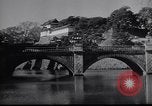
Film tracing activities of General Douglas MacArthur from defeat of Japan in World War II through Korean War (1950)
Highlights covering General Douglas MacArthur, from 1945 through 1950. The Imperial Palace in Tokyo, Japan. Several Japanese bowing towards the Palace. General Douglas MacArthur exits a car in Tokyo and walks up steps to enter his headquarters in Japan. Emperor Hirohito walks between two U.S. sentries, as he leaves a building and enters his limousine. Japanese citizens form lines on streets to cast ballots in election.Several Japanese women voting. Exterior of the Japanese National Diet building. Interior with representatives seated. A farmer behind a cultivator, pulled by an ox, in a rice paddy. Japanese school children waving American and Japanese flags together, as MacArthur leaves his Tokyo headquarters, walks down steps, and enters car. MacArthur saluting at a military ceremony, where his wife, Jean MacArthur, and son Arthur are spectators. Explosions in hills, from American Patton tank shelling North Korean positions in Korean War. American soldiers firing a mortar; infantry advancing along sides of road; and American tank commander rendering first aid to wounded comrade. United States Air Force (USAF) C-47 transport aircraft ferrying American troops into Korea, from Japan. American infantry marching across a bridge; firing mortars and rifles; and advancing on foot across fields. American troops on trucks followed by a Patton medium tank. MacArthur meeting troops on river boat; riding in a jeep; being briefed by U.S. officer in the field; examining a knocked out tank; and decorating U.S. troops in winter. Closeup of MacArthur in winter gear with his circle of five stars pined into a fur cap. Views of U.S. amphibious landing at Inchon (or Incheon) in Korean War. MacArthur watching from a ship offshore. Syngman Rhee, President of South Korea, reading message of appreciation to General MacArthur and shaking hands with him at the podium. U.S. President Harry S. Truman, pinning a medal on General MacArthur,on Wake Island in October, 1950.
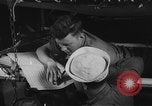
Navy aircrew operations during World War 2
Navy enlisted aircrew in their bunks aboard a ship. One reads a newspaper. Another reads a magazine and looks at a picture of a model and discusses it with other man. An emergency arises. Navy Grumman TBF Avenger planes are ready on the flight deck. The U.S. Navy pilots scramble and rush towards the planes. A flight of five aircraft takeoff and fly in formation towards the target. Reenactment of battles on ground between U.S. and Japanese forces. Navy aircraft bomb the Japanese forces. Japanese fire antiaircraft guns. Navy aircraft gunners fire at Japanese. The Aircraft piloted by Lieutenant Grant Evans, played by Hollywood Actor Robert Stack, is damaged by Japanese gunfire. As the aircraft and crew limp home, they are attacked by a Japanese fighter, but shoot it down and successfully return to land on their aircraft carrier. After recovering from his wounds, Lieutenant Grant Evans (Robert Stack) is interviewed in a building. Large numbers of Navy aircraft flying in formations.
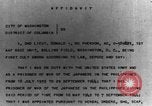
The Fall of Corregidor in World War II
Opening shows affidavits attesting to the authenticity of source films. Views of the island fortress of Corregidor, as Japanese troops occupy it while Americans and Filipinos stand with hands up, in surrender. Japanese and American Army officers having discussions. Scene shifts to Lieutenant General Jonathan Wainwright with members of his staff: Brigadier General Lewis C. Beebe; Lieutenant Colonel John R. Pugh; Major William Lawrence; and Major Tom Dooley, as they arrive at the Japanese headquarters building on Bataan to discuss surrender. They line up outside the wooden building and are saluted by the Commander of the 14th Japanese Imperial Army, General Masaharu Homma, as he climbs the steps of the building. Next, the Americans are seen seated at a table on the porch, opposite General Homma, who has General Wachi at his left and Colonel Nakayama, to his right. Reporters, an interpreter, newsreel camera men and others are also on the porch. General Homma and Wainwright discuss surrender. (These discussions proved fruitless, as Homma demanded surrender of the entire Philippine Garrison, and Wainwright tried to avoid that, citing lack of authority. Accordingly, Homma curtailed the meeting, and Wainright and staff returned to Corregidor, where, on May 6, 1942, he finally surrendered all forces in the Philippines to Japanese Colonel Sato, commander of the 61st Infantry.) Camera outdoor pans over Corregidor Island. Scenes of prisoners standing in the so-called Garage area of Corregidor, where American and Filipino POWs were interred, following their surrender on May 6th. The remainder of the film shows various scenes of POWs on Bataan, moving under Japanese guard. A makeshift sign points the way to Mariveles, where the infamous Bataan Death March commenced.
United States troops take over Tokashiki and Geruama Island prior to invasion of Okinawa.
Invasion of Okinawa. U.S. naval bombardment and shelling on island of Kerama Group. Landing crafts approach beach. LVT (Landing Vechicle, Tracked) move up on beaches of Okinawa. Infantry and armored units of 3rd Battalion, 305th Regimental Combat Team takes immediate control of beach. Japanese caves shelled by howitzers. Troops move inland and further. Japanese suicide boats along caves on shores destroyed by bombs. Japanese interpreter of U.S. 3rd Battalion asks a Korean prisoner in fields to go up hill and persuade Japanese for surrender. Korean prisoner goes towards hill with truce flag. Japanese come down hill. Surrendered Japanese Lieutenant sits with other men. American forces land on another island on Kerama Group where no civilian or military resistance is encountered. Flag rose at captured island. Troops plan invasion of another Kerama Group island aboard ship. Invasion of Tokashiki by U.S. troops. U.S. troops move inland. Troops march along trails on hill. Wrecked houses in town. Officer looks through binocular from observation post. American flag behind officer. Artillery fire shelling Tokashiki Island. (World War II period).
United States 27th Infantry Division in Makin Islands, Kirabati during World War II.
Supplements from a film called 'Fighting Lady' about the United States campaign against the Japanese in the Pacific Theater during World War 2 Beach at Makin island with damaged palm trees and debris. Hulks of sunken Japanese ships in water. A damaged Japanese building at the coast. A fuel dump camouflaged by palm trees. Wrecked Japanese buildings. United States troops, of the 27th Infantry Division gathered in a wrecked Japanese building. A soldier stands near a medium caliber Japanese coastal gun. He picks up a shell and holds it over his head.