


 Francais
 Deutsch
 Italiano
Refine Your Search
Japanese-martial-arts stock footage and images
- Showing 469 to 474 of 4336 results more
more Hide
Hide
Training and life of a Japanese soldier. Boyhood indoctrination; fighting in Nanking, China. American casualties in Marianas
Life and indoctrination of Japanese troops during World War II. Newspaper headline reads 'Germany Collapses'. People celebrate and have drinks at bar. Table with few glasses and a liquor bottle. A Japanese soldier lay dead. Japanese flag and Koinobori carp windsock on pole. Japanese boys being indoctrinated to militarism, marching, drilling, in organized play, with model artillery pieces. Young Japanese soldiers in regiment commencing Japanese assault on Nanking, China. Scenes of Chinese civilians suffering at hands of Japanese soldiers. Views of Japanese atrocities perpetrated in Nanking. Japanese ships underway to Mariana Islands. Dead Japanese soldier. American troops attacking Japanese soldiers holed up in jungles. Staged enactment of last surviving Japanese soldier in a cave, who, instead of surrendering, seizes pistol of his slain officer and attacks Americans with it. Actual scenes of American wounded soldiers being carried out of jungle on stretchers following a battle with Japanese forces. Vast numbers of Japanese soldiers parading. American military dead being buried at sea, with a scene of many caskets draped in American flags poised for release into the ocean during the ceremony. Clip closes with Anti-Japanese propaganda message on screen "Get the Jap -- And Get it Over" directed at U.S. soldiers viewing the film.
Japanese people in various occupations and financial institutions and schools in Honolulu, Hawaii.
Japanese people and Japanese Americans in Honolulu, Hawaii before the attack on Pearl Harbor during World War II. Japanese workers. Narrator discusses origins of Japanese workers and various trades and businesses in which they work. A street with houses on either sides and clothes hanging. Japanese people walking on the street. People walk in front of shops. Automobile traffic in the background. Japanese men pour from a container. People in a flower shop. Children outside their houses. Clothes drying on ropes. Japanese children outside a school. The 1941 telephone book in Japanese. A daily newspaper printed on machines. Stacked newspapers. Japanese workers work in a sugarcane field. They load cargo on a cart. Boards of the various Japanese financial institutions. People enter a bank. Women fishing and boats in a river. Japanese people work as shopkeepers. A Japanese doctor. Workers carry cargo on a trolley. A man sits in a dentist clinic. The dentist opens a door. Japanese nurses come out of a building. People on a street. Exterior of a Japanese hotel. Boards read Japanese people in various occupation.
United States troops firing Long Tom inland, shoot down Kamikaze Japanese fighters during the Battle of Leyte Gulf (WWII)
United States troops secure the island of Leyte, Philippines from Japanese control during World War II. apprehend an injured Japanese soldier found in a jungle. The Japanese soldier is taken to a tent. Two semi-naked Japanese soldiers raise their arms upon surrendering. General Douglas MacArthur discussing plans to take over the rest of the Philippines from Japanese occupation. Map of the Philippines. Japanese soldiers arriving in Leyte, with scenes of Japanese troops climbing down ladders from a ship during landing. A hand points to a map as other soldiers surround it. Two soldiers sitting on the mud as they work. United States troops with 155mm Howitzer “Long Toms” firing at enemy positions. Coconut trees lined behind the artillery. Soldier uses a telephone. Artillery fire both at daytime and night. Soldiers cover their ears. Troops begin to move through the jungles of Leyte. Imperial Japanese Navy flag waving. A fleet of Japanese ships heading to Leyte Gulf. Soldiers with binoculars on the lookout. Animated map of the Philippines shows Japanese and United States fleet. United States Navy ships sailing to Leyte Gulf. United States Navy sailors at fire control station. Sailor opens valve. Gun crew removes gunpowder bags from magazine. Hand squeezes fire control trigger. Torpedo released into water. Naval artillery firing during the Battle of Leyte Gulf. United States troops reading maps and reports inland. A soldier talks on the telephone. A general (Likely General Walter Krueger) inspects a map while smoking a cigarette. A 155mm Howitzer “Long Tom” is taken to the shore. Shirtless soldiers adjust the position of the howitzer. Howitzer barrel moves upwards. United States carriers sail to Leyte Gulf. A soldier pointing while other uses binoculars. Japanese land-based bombers and fighters flying to participate in the Battle of Leyte Gulf. A Japanese aircraft is shot down, falling to the sea. Naval anti-aircraft guns firing at enemy bombers and kamikaze fighters. A shot down kamikaze Japanese fighter bursts into flames. Inferno of shot-down Japanese aircraft burning. Anti-aircraft guns strafing at Japanese fighters. Thick smoke rises from bombed United States aircraft carriers on Leyte Gulf. Two United States fighters still flying with little gas. A Grumman F4F “Wildcat” fighter struggles to land on wet runway of Leyte airfield. The F4F stumbles and turns upside down. Another F4F skids off the runway and crashes into another aircraft. Medics carry a wounded pilot on a stretcher.
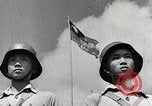
Battle of Changsha in China during the Second Sino-Japanese War (WW2)
Closeup of two Nationalist Chinese soldiers with their flag flying on tall flagpole in background. Next, countless numbers of Chinese soldiers are seen marching along the Great Wall during the Second Sino-Japanese War (World War II). Newspaper article reads: "52,000 Japanese fall at Changsha." Animated map depicts China and environs, with major cities. Areas of Japanese occupation are shown in black. The city of Changsha is highlighted by a circle. Japanese force is shown massing at Yueyang (Yochow), near Dongting Lake (Ting Tung Hu Lake), and advancing on 24 December 1941, toward Changsha. The map shows Chinses forces putting up token resistance and retreating to the East (rather than toward Changsha) and Japanese forces beginning assault on Changsha, New Year’s Day, 1942. Map shows the Chinese forces from the East attacking and cutting the Japanese supply lines. Japanese forces besieging Changsha are forced to retreat under counterattack by the Chinese. A field artillery piece being fired by Chinese forces and explosion and smoke from its shell striking. More field artillery being fired. Japanese forces carrying their Rising Sun flag as they retreat under fire. Chinese infantry firing from a berm A Japanese soldier falls to gunfire. Japanese soldiers retreating across a narrow-improvised bridge across a swamp. Chinese soldier next to a building, firing a Czech ZB vz. 26 light machine gun. Japanese running with horses through a village. Chinese gunner firing Japanese Type 92 machine gun down on Japanese troops retreating across a bridge below. Another Chinese soldier firing a Czech 26 light machine gun, from hill overlooking retreating Japanese troops, below. Victorious Nationalist Chinese troops parading in celebration along a road high above buildings of a town below in background. Men in Khaki pants and white shirts parading. Girls in white dresses, carrying Chinese flags. Soldiers marching (without weapons) celebrating.
Japanese forces capture Corregidor, Philippines; Bataan Death March; Pacific supply lines to allies in Australia in World War II
Japanese forces fire artillery at Corregidor Island, during Japanese occupation of Philippines during World War II. Smoke rising from Corregidor under bombardment. Japanese troops land on Corregidor, the Philippines, on May 5 1942. A soldier watches enemies' action through binoculars. Soldiers fire artillery in the field. General Wainwright surrenders. He sits with other officers and Japanese officers and discusses. Japanese soldiers lower the American flag. Japanese troops Banzai cheer and celebrate their victory. They raise the Japanese flag. Captured Americans and Filipino prisoners of war departing Mariveles during the Bataan Death March, under Japanese guard. Map shows Japanese targets for invasion in other areas like Malay, Borneo, and New Guinea. Close up view of Japanese soldier's face. Briefing documents labeled Secret are opened and reviewed. Airplanes on the ground. U.S. And Australian troops march in Australia. Animated globe shows different countries. View of armament and artillery production factory operation in the United States supplying war materiel. Close up views of faces of war production workers. Animation and models show a supply line through which supplies are transferred to Australia. Lockheed P-38 Lightning wrapped in camouflage is lowered onto a transport ship deck. U.S. Army tank loaded onto ship and American troops go ashore in Australia. United States planes bomb and sink Japanese ships in the Bismarck Sea on March 2, 1943. View of American machine gunner firing machine gun from aircraft in flight toward enemy Japanese ships. Cockpit point of view shot out of American aircraft as it bombs and strafes Japanese ship. Bombs away view as U.S. aircraft release bombs. Smoke rises from the burning Japanese ships. General Douglas MacArthur and Admiral Chester W. Nimitz meet and discuss strategy and review maps. Animation shows different potential routes for American forces to return to the Philippines.
Japanese forces occupy British and American areas of the Shanghai International Settlement, following attack on Pearl Harbor in World War II
Inhabitants of the International Settlement in Shanghai, China, line sidewalks to watch as Japanese Imperial marines enter and occupy the British and American controlled parts of the city in the wake of the attack on Pearl Harbor. Japanese marines in open trucks wave to the spectators. Camera focuses momentarily on a large Japanese flag displayed on one building, where Japanese guards stand outside. Japanese soldiers climb down from a truck and enter the building. Several armed Japanese marines walk in the street. Some people in the Settlement seem intent on going about their normal activities, notwithstanding the presence of the Japanese military. However, one street is empty except for Japanese soldiers who stand guard. At the doorway of a building there, a sign is posted in Japanese referring to its occupation by Japanese military. A Type 92 Chiyoda Armored Car proceeds down a street, heading a parade of Japanese marines, led by one carrying the Japanese Rising Sun flag. Camera pans over boats in the harbor. Most appear to passenger-carrying ferry boats. At the end, the narrator refers to the sinking of the HMS Peterel and the capture of the USS Wake, the last British and American gunboats in Shanghai. The British riverboat HMS Peterel, operating on the Yangtse river, refused to surrender and was sunk (although nobody was killed) and the American Gunboat, USS Wake (PR-3) is seen near the end of the film, flying the Japanese flag, at the Shanghai dock where it was captured by the Japanese.