


 Francais
 Deutsch
 Italiano
Refine Your Search
Japanese-martial-arts stock footage and images
- Showing 49 to 54 of 4336 results more
more Hide
Hide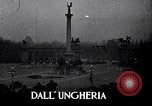
Hungarian military units parade on the streets of Budapest, Hungary during World War II
Hungarian troops in World War 2 gather for a parade in Heroes' Square (Budapest, Hősök tere, 1146 Hungary) at the end of Andrássy Avenue, in Budapest, Hungary. Millennium Memorial visible (also known as Millenary Monument). Monument pedestal visible with text AZ EZERÉVES HATÁROKÉRT, which means "For the Millennium Boundaries". Royal Hungarian Army soldiers and officers in cars, seated atop armored cars, and marching on foot. German Dornier DO-17 bombers in flight overhead. View of German military and Hungarian political dignitaries on stage, including Hungarian Prime Minister László Bárdossy. Officer fastens flag of the Kingdom of Hungary to the instrument of a trumpeter. Formations of Motorcyclists lead a parade along a main thoroughfare. Many open trucks carrying troops take part. Some tow light field artillery pieces. Military members and civilians (almost all women) stand on either side of the road to witness the event. The civilians wave and cheer. Many Hungarian 39M Csaba armored scout cars assembled in front of the Museum of Fine Arts Budapest (Budapest, Dózsa György út 41, 1146 Hungary) beginning to join the parade. A Japanese boy and girl are seen in the crowd smiling and displaying a Japanese flag. Clip ends showing vehicles towing 40mm Bofors anti-aircraft guns on wheeled mountings.
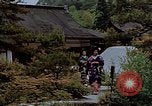
Gion Geisha and Maiko girls walk at a garden in Ginkakuji Pavilion, Kyoto, Japan.
A garden in the Ginkakuji Pavilion, also known as the Silver Pavilion (2 Ginkakujicho, Sakyo Ward, Kyoto, 606-8402, Japan) in Kyoto, Japan. Three Japanese women take a walk. They walk to edge of a pond where their image is reflected in water. Maiko girls talk and laugh. The women are Geisha and Maiko, professional performance artists trained in traditional Japanese performing art styles, from the Gion district of Kyoto.

The need of public film production and information shared by the film in Japan.
A documentary film 'New Eyes New Ears' about public film production and use in Japan. A Japanese child in a crib. A young boy plays with a pot containing hot bars. A girl pats a cat. Children walk on a boundary wall. Children wave from a train. Boys and girls study in a library. People gathered. Animation depicts people confined to their own sections in Japan. Animation depicts the way the gap between people from various sections of the world can be reduced. Pictures of information centers in Japan. Book records and old reels in an information center. Art, reference work and records from many countries in the information center. A cameraman clicks pictures of students studying in the United States. The picture is put on a bulletin board in Japan. Women look at the bulletin board. People watch a movie. The movie shows : A woman works in a laboratory. A doctor studies an X ray. People make paintings. Women sing. Workers construct a house. Japanese personnels visit the United States.
The end of WWII and U.S. President Harry Truman's role in immediate postwar actions
Opening scene shows some German infantry surrendering with hands raised. Next scene shows people thronging Times Square in Manhattan, New York City, celebrating VE Day, or Victory in Europe Day, on May 8, 1945, when Germany surrendered to end World War II, in Europe. Image of the first atomic explosion (Trinity) on July 16, 1945, in New Mexico, United States. Scene shifts to deck of the U.S. Battleship, USS Missouri, where Japanese foreign minister, Mamoru Shigemitsu, is seated and signing the instrument of surrender., on September 2, 1945. Closeup profile of General Douglas MacArthur. Another glimpse of Mamoru Shigemitsu signing. Next, MacArthur is seen signing the document. He turns and presents the pen to Lieutenant General Jonathan M. Wainwright , who is standing behind him alongside British Lieutenant-General Arthur Ernest Percival. Brief glimpse of the San Francisco War Memorial and Performing Arts Center with flag appearing to be at half staff and a long awning extending from its entrance to the sidewalk. View of representatives at the first United Nations meeting there . Views of audience in auditorium shows many notables. Closeups of Soviet Ambassador, Andrey Gromyko and Soviet Foreign Minister, Vyacheslav Molotov.. Next, President Harry S. Truman is seen broadcasting a greeting to the delegates, from the Capitol, Washington, DC, on April 25, 1945. The delegates are seen listening to the broadcast and then applauding.
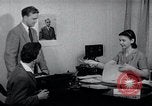
Activities of United States Information Service in various foreign countries
Opening scene shows a U.S. Information Agency (USIA) secretary provides a couple in Germany with information about American schools. Views of students in Saigon, South Vietnam, attending USIA English language classes. View of London, England, showing the Art Deco BBC Broadcasting House at Portland Place (Portland Pl, London W1A 1AA, UK) and All Souls Church, Langham Place (All Souls C of E Church, 2 All Souls' Pl, London W1B 3DA, UK). A man is seen delivering a can, containing the USIA monthly film documentary, to the BBC. View of Broadcasting House of BBC in Marylebone, England. In Iran, a Douglas DC-4 passenger plane takes off, carrying newspaper reporters and Iranian officials to look over an American technical assistance project which is seen from the air. In Tokyo, Japan, a man working in a private publishing company begins translating an American book. The book is open on his desk and contains an illustration of President Dwight D. Eisenhower. A page of the book, written in Japanese, is shown being reproduced on a type of mimeograph machine.

Brooklyn Dodgers, New York Yankees, and Chicago White Sox baseball teams practice during spring training camps in Florida.
Spring training camps for the 1957 baseball season, held in Florida. Brooklyn Dodgers practice and train at Vero Beach. Several Dodgers players seen, including Don Newcombe, Sal Maglie, Fred Kipp, Don Zimmer, and Pee Wee Reese. Visiting Japanese players from the Tokyo Giants stand and watch along side Walter O'Malley. New York Yankees practice at Saint Petersburg, including players Al Cicotte, Art Ditmar, Bobby Shantz and Mickey Mantle (brief closeup of Mantle). In Tampa, Chicago White Sox players like little Nellie Fox, Jim Wilson, Dick Donovan, Jack Harshman, Larry Doby and Walt Dropo practice.
CRITICALPAST.COM: About Us | Contact Us | FAQs - How to Order | License Agreement | My Account | My Lightboxes | Shopping Cart | Advanced Search | Featured Collections | Website Terms & Conditions | Privacy Policy ©2026 CriticalPast LLC.
License Agreement |
Terms & Conditions |
Privacy Policy
©2026 CriticalPast LLC.