


 Francais
 Deutsch
 Italiano
Refine Your Search
+"Africa" +1943 stock footage and images
- Showing 139 to 144 of 175 results more
more Hide
Hide
The U.S. 2nd Army and the British 8th Army capture the city of Bizerte and the German troops surrender during the World War II.
The Axis troops are crushed by the Allied Forces in North Africa during World War II. The U.S. 2nd Army moves towards Bizerte. U.S. tanks and infantry on the roads. Wrecked German Pz.4 from the battle of Hunt's Gap. U.S. General Eisenhower, Allied Commander in Chief, inspects the abandoned German weapons and the booby traps. The British 8th Army moves towards Tunis. The Allied troops move into a town. The locals cheer and destroy all the signs of Axis occupation. British General Bernard Montgomery standing in an open car. Citizens welcome the Allied troops. German plane drops a bomb. Another is shot down. Allied artillery destroys German naval base, across Lake Bizerte. The Allied soldiers move to the outskirts of Bizerte. The Allied tanks move in the streets. Allied troops search the streets. German troops come in trucks and surrender. An Allied soldier writes down the names of the surrendering German generals. Large numbers of German prisoners led away. The Allied Forces move into city of Bizerte. The citizens welcome the Allied troops. US, British and French flags fly.
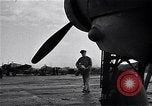
U.S. Lt Col Elliott Roosevelt, placing camera in British Bristol Beaufighter Photo Reconnaissance aircraft during World War II
La Marsa airfield, Tunis, Tunisia, North Africa during World War 2. U.S. Lieutenant Colonel Elliott, Roosevelt, Commander, Northwest African Photographic Reconnaissance Wing (a multi-national Allied Command) walks across ramp and places an aerial reconnaissance camera inside a British Bristol Beaufighter Photo Reconnaissance aircraft, of No. 540 Squadron RAF Detachment. He speaks with photo reconnaissance technicians carrying cameras to and from the airplane. He converses with two U.S. Army Air Forces field grade officers, as they look at a map spread out on the airplane wing.
General Eisenhower, Allied commander in Sicily and General Patton of U.S. 7th Army, talking in Sicily, Italy.
General Eisenhower, Allied commander in Sicily and General Patton of U.S. 7th Army, talking in Sicily, Italy, during World War 2. British General Montgomery, steps down a plane. He shakes hand with U.S. Lieutenant General George S. Patton. Two hundred thousand Axis prisoners of war, mostly Italian, are assembled and board ships for POW camps in Africa, Britain, and the United States.

The Allied invasion of Sicily during Operation Husky in World War II
British Air Chief Marshal Sir Arthur Tedder, Admiral Sir Andrew Cunningham, General Dwight D. Eisenhower, and British Field Marshal Bernard Montgomery are seen looking skyward. They stand on a field in front of a large formation of troops. Scene shifts to a seaport in North Africa, with Allied troop ships preparing to depart. A barrage balloon flies over the port. (Narrator notes that the armada includes ships of Britain, The United States, the Netherlands, Poland, Greece, the Indian navies, A warship sits in the water beside a large troop ship. A tugboat tows a large troop transport ship in the harbor. Cargo ships and a three stacker transport ship are seen. Two British battleships. Sailor using signal light to send a message. Two American destroyers in trail formation. U.S. Admiral Henry Kent Hewitt, Commander of the 8th Fleet, presents Lieutenant General George S. Patton, commander of U.S. forces, with a new battle flag. Views of ships in the invasion fleet. Transport ships anchor off the coast as they shuttle troops to the beaches in their landing ships. A landing ship flying the American flag. Naval guns fire barrages at the shore. As landing craft reach the beach, troops wade ashore through the surf. An army truck drives from a landing craft through the surf. Army truck and a jeep drive ashore from a large landing craft. Brief glimpse of Wading tanks leaving a tank carrier and driving ashore through the surf. Troops landing with dry feet from a beached landing craft. View of the city of Gela. Lieutenant George S. Patton climbs over the side of a ship and descends on a rope ladder to enter a Higgins boat that takes him to assume command of the invasion operations. Closeup of Lieutenant General Patton in the boat entering the harbor at Gela. He jumps from the boat as it reaches the beach. Local civilians view activities from the beach. DUKWs (amphibious trucks) drive ashore. Artillery pieces being towed ashore. American infantry entering the town of Gela. Military vehicles enter through rubble strewn streets. An M4 Sherman tank speeds along a road. Remains of an Italian armored train destroyed by Allied gunfire. American soldiers walk through areas destroyed by German bombing. American troops search buildings. Local Italian people mingling with American troops. Surrendered Italian troops march under guard along a street. Allied forces head toward Messina. A tracked gun carrier filled with troops in the back, moves along a street. U.S. infantry marching along a roadside. Army engineers clearing mine fields in advance of troops. Closeup of a buried mine being revealed. Major General Lucian K. Truscott, Jr., Commander of the U.S 3rd Infantry Division, inspects Axis planes and hangars captured by American forces. Many undamaged aircraft are seen in revetments and simply parked on the airfield. Fuel arrives for Allied aircraft. British Fairey Firefly aircraft taking off. Dead Axis soldiers lying on the ground. Destroyed Axis military vehicles. A knocked out German Tiger tank. A DUKW drives past a damaged Axis armored vehicle. UN forces firing mortars from a field. A knocked out Axis armored vehicle. UN motorized gun carrier fires its gun. Allied infantry advancing.
United States troops enter Port of Oran, Algeria and patrol in the city.
United States troops enter French African Port of Oran, Algeria, North Africa, during World War 2. U.S. soldiers seated inside an armored assault boat, advance towards Port Oran. Supplies and equipment brought to the beach area. United States medics treat an injured Vichy French prisoner. Civilians welcome U.S. troops as they move on streets of Oran. Troops honor a French soldier from a different war at a memorial. Vichy French soldiers (prisoners) seated on ground in groups. U.S. Army soldier sends telegraphic message to his regiment. Sign board read Saint Cloud. Troops move on road in jeeps and trucks. Two U.S. Army soldiers standing on top of a moving railroad car. U.S. Army truck driving by with large American flag on its front.
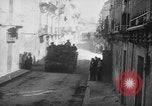
Allies, including U.S. Fifth Army, encounter heavy enemy resistance in amphibious assault at Salerno, Italy, in World War 2
Allied invasion at Salerno, Italy, during 2nd World War. Scenes of U.S. Sherman tanks, military vehicles and troops, moving easily through Sicily. Animated map depicts allied invasion routes from Bizerte, North Africa, to two points on opposite sides of Italy mainland. Convoys emerge from smoke screens in bay of Salerno, Italy. Allied warship creating heavy black smoke screen. Decks of LSTs crammed with trooops and vehicles. Allied warships bombard Salerno coastline. Commandos, Rangers and Seabees, in first assault wave are targets of German guns and dive bombers. Pontoon boat dropped from LST, with 35 Seabees aboard, strikes a mine, and is destroyed, setting off conflagration on the LST. Other LSTs (Landing Ship Tank) discharging vehicles to the beach over floating causeways, under enemy fire. Destroyed U.S. Sherman tanks, vehicles and a U.S. P-40 aircraft , litter the beach. A Seabee uses semaphore flags to direct an LST to beach area. Seabees build shelters for war materiel and dressing stations where allied wounded are treated. Seabees continue to unload supplies to beachhead. Brief view of Lieutenant General Mark Clark, 5th Army commander, on the beachhead. Allied casualties being tended. Stretcher bearers carry wounded. Allied troops advancing on roads in Italy. Admiral Moreell, chief of the U.S. Navy's Bureau of Yards and Docks, concludes narration of the Seabee documentary, from his office in Washington, DC