


 Francais
 Deutsch
 Italiano
Refine Your Search
+"Germany" +1937 stock footage and images
- Showing 13 to 18 of 90 results more
more Hide
Hide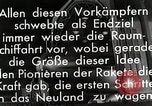
Scene of a spaceship from an animated fantasy motion picture in Germany.
Scene of a space ship from a 1937 German animated fantasy motion picture about space travel (Weltraum Schiff I, Eine Technische Fantasie). A space ship moves from its hangar, on tracks. It reaches an inclined launching ramp and ignites rockets at its tail end. It accelerates over the launching ramp and takes off. The space ship flies with fire at its tail end. A clock showing elapsed flight time. Head-on Views of the rocket ship with the earth falling away beneath it. Eventually the space ship disappears into the starry skies beyond.

German Chancellor Adolf Hitler reviews a military parade in Germany.
German Armed Forces receive new flags in April 1937. German Chancellor Adolf Hitler in a car. He steps from the car. He stands at a podium. People gather and cheer. Military soldiers parade and Hitler reviews the parade. Civilians watch the parade.

Some rocket motor designs of 1930s and speculation about future of rocketry
Liquid Rocket motor design drawings of various pioneers in the field, from the American Rocket Society, including: Constantin Paul van Lent (aka Constantin Tselentis,aka Constantin Lent, aka Dr. Constantin Paul van Lent) 1936; Alfred Africano, 1937; Reed,1937; Wild,1938; H.F. Pierce and Nathan Carver, 1938. Slates refer to the post World War I period through about 1938, as the beginnings of rocket flight, and the immediate subsequent period as the second phase of achievement that could lead to high altitude and long range rocket missiles and even manned spaceships. Slate suggests that future of rocketry is limited only by our imagination. Next are imaginary, science fiction scenes like a science fiction movie, showing a major city, in Germany, as a rocket ship travels away from it, and eventually showing Europe, and the earth from outer space, as the rocket travels into the blackness, beyond. Slate comments about eternal longings related to human flight.
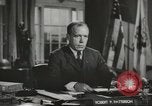
American Undersecretary of War speaks to difficulties facing Allies in confronting Germany and Japan in World War II
Undersecretary of War, Robert Porter Patterson, Sr. speaks about a report from the General staff outlining the needs for combating Germany and Japan in World War 2. He cites Operation Husky, the invasion of Sicily, as an example of what will be needed. He continues to narrate in the background as an animated map appears showing the buildup of supplies and Allied forces in North Africa; Allied air forces flying 60 thousand sorties over Sicily and, the direct amphibious assault using 3,200 vessels. Map also depicts opposing forces of 12 (“unwilling”) Italian Divisions and 3-1/2 German Divisions. View of Allied troops carrying some of their 31 thousand casualties on stretchers from field ambulances. Allied medics attending to the wounded. Some are seen lying on stretchers in a row on the ground near a wall. Interior of a field hospital where surgeons and other medical personnel treat the wounded. Animated map shifts to Europe with Germany at its center, showing , in contrast to Sicily that was only an “outpost,”, the heavily fortified perimeter of Axis controlled areas; the axis industrial might; and the disposition of 300 German Divisions (mostly on the Eastern front) defending the region. Next, the map illustrates Japan’s defended regions in the Pacific Image returns to Undersecretary Patterson i n his office, speaking of the Allied offensives planned for next year (1944), and emphasizing their challenge and difficulty. Scene shifts to General Jonathan Wainwright and his garrison at Corregidor, in the Philippines, surrendering to Japanese forces in 1941. Japanese military camera pans over the Americans being taken prisoner. Other Americans and Filipinos are seen being marched together under guard. Scene shifts to classic views of the Japanese attack on Pearl Harbor, Hawaii, on December 7, 1941. View of Japanese soldiers executing two Chinese civilians in 1937. Dangling bodies of persons hung by Nazis during Operation Barbarossa in Russia, in 1941 A Russian soldier comforts a little girl as he escorts her across a snowy landscape. Time bomb left by German forces retreating from Naples, Italy, in 1943, blows up a Post office building . Views of damage to building and bodies of victims. American Military Police assisting a victim. American soldiers carrying an injured civilian on a litter. Scene shifts to British Foreign Minister, Anthony Eden, Soviet Foreign Minister, Vyacheslav Molotov, and U.S. Secretary of State, Cordell Hull, entering a hall in the Spiridonovka Palace, during the 1943 Moscow Conference in Russia. Close-up of the American, Soviet, and British flags on a table. View of many delegates seated around the table. Close-up of Molotov, Eden, and Hull signing conference document.
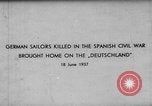
Hitler lays a wreath on the caskets of German sailors killed in the Spanish Civil War.
Date: 18th June, 1937. German sailors killed in the Spanish Civil War are brought home to Germany on the Battleship, Deutschland. The warship glides slowly to a pier, where a band and military honor guard stand at attention. Crew of the Deutschland stands on deck in formation. Flower-covered caskets of the fallen sailors, are seen on the deck of the Deutschland. A flag of Nazi Party, at half mast, on a building. Views of the funeral on land, for the fallen sailors. A German Admiral speaks at a podium, surrounded by the caskets of the fallen. Honor Guards surround the lawn. Civilian mourners stand holding umbrellas, against a rain shower. Adolf Hitler ceremoniously lays a wreath on the caskets and walks slowly and quietly past the mourners.

Ninth Nazi Party Congress Rally in Zeppelin Field, focused on the RAD (Reichsarbeitdienst) National Labor Service
A major rally in Zeppelin Field, part of the Ninth Nazi Party Congress activities in Nuremberg, Germany between 6th -13th September, 1937. German Chancellor Adolf Hitler watches Sturmabteilung (Storm Troopers) parade. He stands on a car and reviews the parade. Civilians watch the parade. The soldiers hold flags of the Nazi Party. Members of the RAD (Reichsarbeitdienst or National Labor Service) are assembled in center of the field. They are stripped to the waist and carry shovels. They perform a drill with the shovels. The crowd cheers. Leader of the RAD, Konstantin Hierl, presents the 38,000 members assembled, to Adolf Hitler, who then greets them from the podium. The RAD members sing an anthem.