


 Francais
 Deutsch
 Italiano
Refine Your Search
+"Germany" +1945 stock footage and images
- Showing 37 to 42 of 2006 results more
more Hide
Hide
Allied commander in chiefs sign the papers of partition of Germany in Berlin after world War II.
' Allied control council for Germany ' shows the taking over of the control by the Allied powers in Germany. British Field Marshal Bernard Montgomery gets off a plane as he arrives in Germany. Montgomery being greeted by officers and he inspects an honor guard of Soviet troops. Commander in Chiefs of various Allied armies arrive at a building on June 5th, 1945. U.S. General Dwight D. Eisenhower, French Major General Jean de Lattre de Tassigny and the Soviet representative Georgy Zhukov arrive and enter the building. General Eisenhower, Field Marshal Montgomery, Zhukov and Major General Tassigny sign the documents of the partition of Germany. The Commander in Chiefs pose outside the building.
Field Marshal Keitel signs the unconditional surrender act as Allies take over a ruined Germany during World War II.
The Germans sign unconditional surrender in Berlin, Germany on May 8, 1945 during World War II, signing a document similar to the one signed at Reims the day before. People gathered outside a German Army Engineering School. Soviet General Georgi Zhukov and British Air Chief Marshal Arthur Tedder at a desk as they represent the Allies. Field Marshal Wilhelm Keitel and other officers representing Germany arrive. Keitel puts his signature on the document of unconditional surrender. Zhukov and Tedder also put their signatures as they take over Germany. The two officers shake hands. Allied officers tour the city of Berlin. Damaged buildings in the city due to Allied bombings. The Brandenburg Gate in Berlin. The heavilly damaged Hotel Adlon. Aerial views of the damage caused due to Allied bombings in Hamburg. Damaged buildings and shipyards in Hamburg.
Eminent prisoners including Baroness Schuschnigg, Lord Lascelles being released from a Nazi prison in the Alps in Germany.
Eminent prisoners held in Nazi German prison camps in Germany are seen being released after the Allied victory during World War II. Snow covered Alps in Germany. A villa in the mountains. Eminent prisoners released from German camps include wife of Austrian Chancellor Kurt Schuschnigg, the Baroness Schuschnigg, industrialist Fritz Thyssen, Prince Leopold of Prussia, German General Franz Halder, Anti-Nazi Pastor Martin Niemöller, Allied pilots, Lieutenant John Winant (son of American Ambassador to England), Lord George Lascelles, the nephew of King George VI, John Alexander Elphinstone, Michael Alexander, and Max de Hamel, cousin of Winston Churchill. Scene changes to Magdeburg, Germany where German General Kurt Dittmar,a Nazi radio broadcaster (Official Military Commentator of the German Armed Forces), together with his son, young soldier Berend Dittmar, surrenders to American soldiers of the U.S. Army 117th Regiment, 30th Infantry Division, on April 25, 1945.
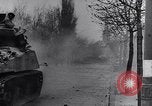
End of World War 2 in Germany, the Four-power occupation of Germany after World War II, and the Berlin Airlift
Allied tank and tank destroyer firing and Allied infantry in Germany during World War 2. British, American, and Soviet troops escorting German Prisoners of war at the end of the War. Animated map shows line where U.S. and Russian troops met and zones of occupation in Germany and Berlin. It depicts routs of access into the Soviet zone of Berlin View from a vehicle driving through utterly destroyed part of Germany in 1945 with rubble and ruin of many buildings seen. Desperate German citizens facing shortages of food and necessities after the war, cooking on outdoor fire in a city street, and trying to clear some debris of destroyed buildings by hand and using buckets in a "bucket brigade." Bus service being restored and German citizens boarding. Vehicle traffic moving with a German police officer directing. Doctors perform physical examination of a German boy as a group of German boys wait in queue for examination. Soviet Leader, Joseph Stalin, with U.S. President, Harry Truman, British Prime Minister, Winston Churchill, at the Potsdam Conference. Children receiving soup at a school in Berlin. Animated map shows routes through the Soviet occupation zone, used by Western Allies, to supply essential food and supplies through the Soviet zone of occupation to sustain West Berlin residents. It then depicts Soviet action blockading the road and rail routes to isolate West Berlin. Views of empty roads, rails, and canals. A DC-3 (US Air Force C-47) transport aircraft taking off. Men loading supplies on aircraft for delivery to West Berlin. A C-54 transport airplane taking off. A British Short S.25 Sunderland flying boat carrying cargo in the Berlin Airlift. Troops carrying supplies for airlift. A British Avro York transport aircraft taking off. A warehouse filled with barrels for Berlin. View from overflying airplane. Trucks resuming travel to Berlin after the Soviets finally lift the 9-month blockade. Normal supplies of food seen again, in West Berlin shops. Vehicle stopped at a checkpoint. Sign warning that: "You are leaving the American Sector." and similar ones at the French and British sector borders. Old road sign pointing to Potsdam, beside another sign warning of entering the Russian zone. Traffic moving between East and West Berlin.
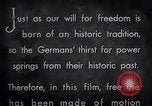
U.S. Army orientation film "Here is Germany" showing the contrast in life in Germany pre-war and during World War 2
U.S. Army training film titled 'Here is Germany'. Circa 1930 - 1938 views of pre-war German countryside, and German cities including Berlin and others before destruction in World War 2. Shots include famous German landmarks and buildings in major cities including Brandenburg Gate and Victory Column sculpture close-ups and other monuments all before bombing of World War II. Lifestyle of German people with families and children in their routine lives in the decade of 1930 before the war. Farmers working fields, mined coal transported by rail, potatoes poured from a full sack, a boy shepherd with geese; a farmer counting pigs descending a ramp at a farm. City port or harbor scene with ships and a modern looking railroad train arriving at a station, sign on side reads Deutsche Reichsbahn (German Reich Railway). High speed highway roads like the Autobahn. German cruise ship at sea. Aerial view of airport with "Berlin" sign on ground. German schools, offices, factories and markets. German woman braiding a girl's hair. German woman taking in washed clothing from a clothesline. German men, women, and children cleaning and polishing work areas and possessions. A German library with people studying and others at book shelves. German classroom with a teacher instructing children and writing on a blackboard. Scenes of German musicians and symphony orchestra and musical instruments, artisans, masons, cooks. Busy roads with cars. Narrator then presents a darker other side, showing an arms factory during rearmament of Germany, German soldiers escorting away a religious priest. German military officials. Scenes circa 1945 of victims of German armies and of the concentration camps. Lumps of dead bodies from massive public shootings, a man being tortured, burning chambers, prisoners of war, concentration camps, human ovens, gas chambers. Survivors of the German custody in relief camps of Red Cross. Evidence of atrocities committed by Nazi Germany. Articles made of human skin and bones. Daily utility items like toys and brushes made from human body parts. Scenes of survivors of concentration camps. Polish people dead from Nazi atrocities at Lublin Castle. Italians and Belgians murdered by Germans, American POWs murdered by Germans. Scenes return again to 1930s views of peaceful German citizens and German lifestyle juxtaposed with views of German soldiers and military actions in World War 2. Some famous Americans of German roots: Wendell Willkie, Admiral Chester Nimitz, Henry J. Kaiser. Narrator talking about American customs and values. View of two teenage American boy students viewing a housing area and taking notes. One of the teenage boys is African American. Some men gathered at a bar in an American town. A man holding a long fly fishing pole preparing to depart on a fishing trip. Woman neighbors in discussion. Young American women walking down a sidewalk in an American town as a group of American boys watch and admire them.
German surrender scenes and views from wrecked German cities at end of World War 2
Documentary titled 'Deutschland Erwache' recounts Germany's wartime experiences. Explosion seen as the Nazi Swastika emblem is blown up on top of the Zeppelintribüne (at Zeppelinfeld) at the Nazi party rally grounds in Nuremberg in 1945 by the U.S. Army. Following explosion, the pieces from the destroyed emblem fall from the sky. Montage shows: German Prisoners Of War (POWs) marching; Ratification of the German surrender documents (from surrender two days earlier at Reims) held at Soviet headquarters in Karlshorst, Berlin, Germany on May 9, 1945. German officers present include Colonel-General Hans-Jürgen Stumpff from the Luftwaffe, Field Marshal Wilhelm Keitel as Chief of Staff of OKW, and Admiral Hans-Georg von Friedeburg as Commander-in-Chief of the Kriegsmarine. They are seen entering room and signing documents. View of Keitel signing the surrender document. Soviet Russian General looking at surrender documents. General Eisenhower, General Montgomery and others shown in brief glimpses. Stalin, Roosevelt and Churchill at Yalta. Aerial views of heavily bomb-damaged cities in Germany, including wrecked German cities of Cologne, Nuremberg, Hamburg, and Berlin. View of Brandenburg gate in background and rubble of bombing in foreground as two people carry a stretcher down the street. A wrecked street sign for the Unter Den Linden lies on the ground partially covered in mud. Ground level views of smoking ruined buildings in Berlin and a few German citizens walking on the streets following Battle of Berlin. Views of dead German soldiers on a battlefield. German soldiers helping to carry and tend to wounded and bandaged German soldiers. Large group of German citizens gathered in a public square.